ESG team building is a corporate team building programme designed so the activity itself produces a measurable environmental, social or governance outcome. Team building with social impact works the same way: instead of ending with a photograph, the day ends with solar lights assembled, bicycles built or wheelchairs donated, and a beneficiary organisation that receives them. The team development happens through the work, not alongside it.
For Indian companies, social impact team building has shifted from a nice-to-have to a reporting requirement. This guide covers what ESG team building is, which formats produce real outputs, how each maps to the E, S or G pillar, and how to measure the result well enough to report it.
What ESG Team Building Actually Means
The term gets used loosely. ESG team building is not an outdoor day with a sustainability theme layered on top, nor a donation made while the team plays games elsewhere. The test: at the end of the session, does a physical asset exist that did not that morning, and can you name who received it?
The three pillars in practice
Environmental (E): outputs that reduce resource consumption or restore an ecosystem. Solar lighting units, trees planted, waste diverted from landfill, water filtration units assembled.
Social (S): outputs that go directly to a community. Bicycles for students with long commutes, wheelchairs for local NGOs, nutrition boxes for underserved families, book racks for schools.
Governance (G): this pillar rarely produces a physical object, and providers claiming otherwise are overselling. It shows up in how the programme is run: how beneficiaries are selected and verified, whether spend is traceable, and whether outputs are handed over with documentation.
That last point matters. Most vendors can deliver an activity. Far fewer can hand you a beneficiary confirmation, a unit count and a handover record your sustainability team can file. Governance is a procurement question, and the one most often neglected.
Why ESG Team Building Matters for Indian Companies in 2026
Reporting obligations have tightened
SEBI's BRSR framework applies to the top 1,000 listed companies by market capitalisation across the BSE and NSE, covering every sector. Reporting runs to roughly 140 indicators structured around nine principles from the National Guidelines on Responsible Business Conduct, with BRSR Core assurance phasing in progressively. The practical effect is that vague activity descriptions no longer clear internal review. Numbers do.
CSR and engagement budgets are converging
Companies covered by the Companies Act CSR provisions have a defined obligation and a committee that must account for it. Separately, HR runs an engagement calendar. These were historically two budgets; increasingly they are planned together, because one programme satisfying both is easier to defend than two that satisfy one each. Some organisations now carry it as a team building ESG line item and others as CSR spend, but the buyer is usually a CSR lead and an HR head reviewing the same proposal.
If you are building the governing structure rather than a single event, our guide to the corporate social responsibility framework covers how the policy, committee and spend obligations fit together.
Team Building With Social Impact: 8 Programmes That Deliver Measurable Outcomes
Every programme below ends with a countable output and a named recipient. The pillar mapping is what makes it reportable.
1. Solar Fusion Challenge (E and S)
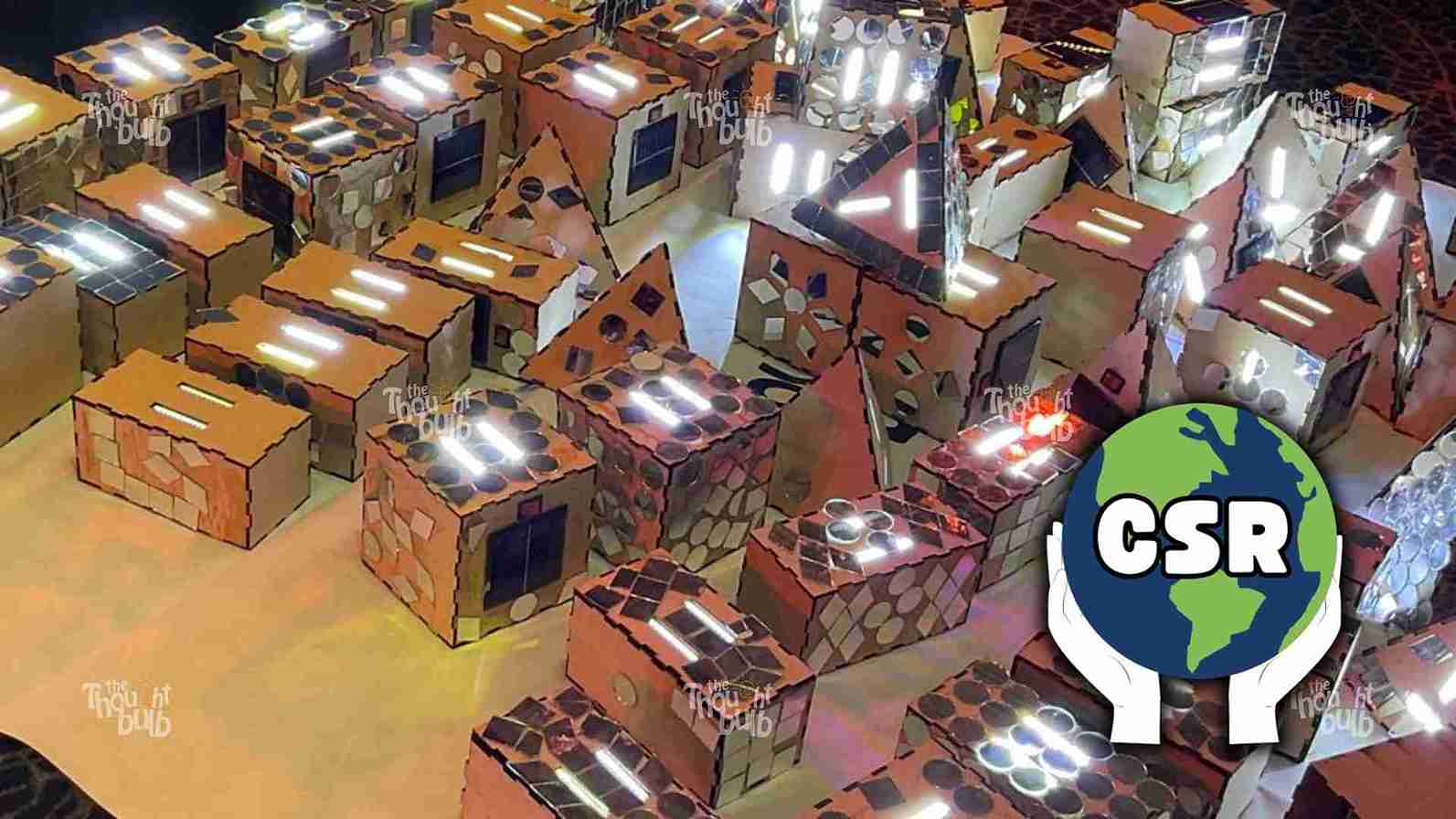
Teams assemble and test working solar lighting units, which go to households without reliable grid electricity. Output: solar lights assembled and handed over. Scales well for large groups.
2. Build A Bicycle (S)
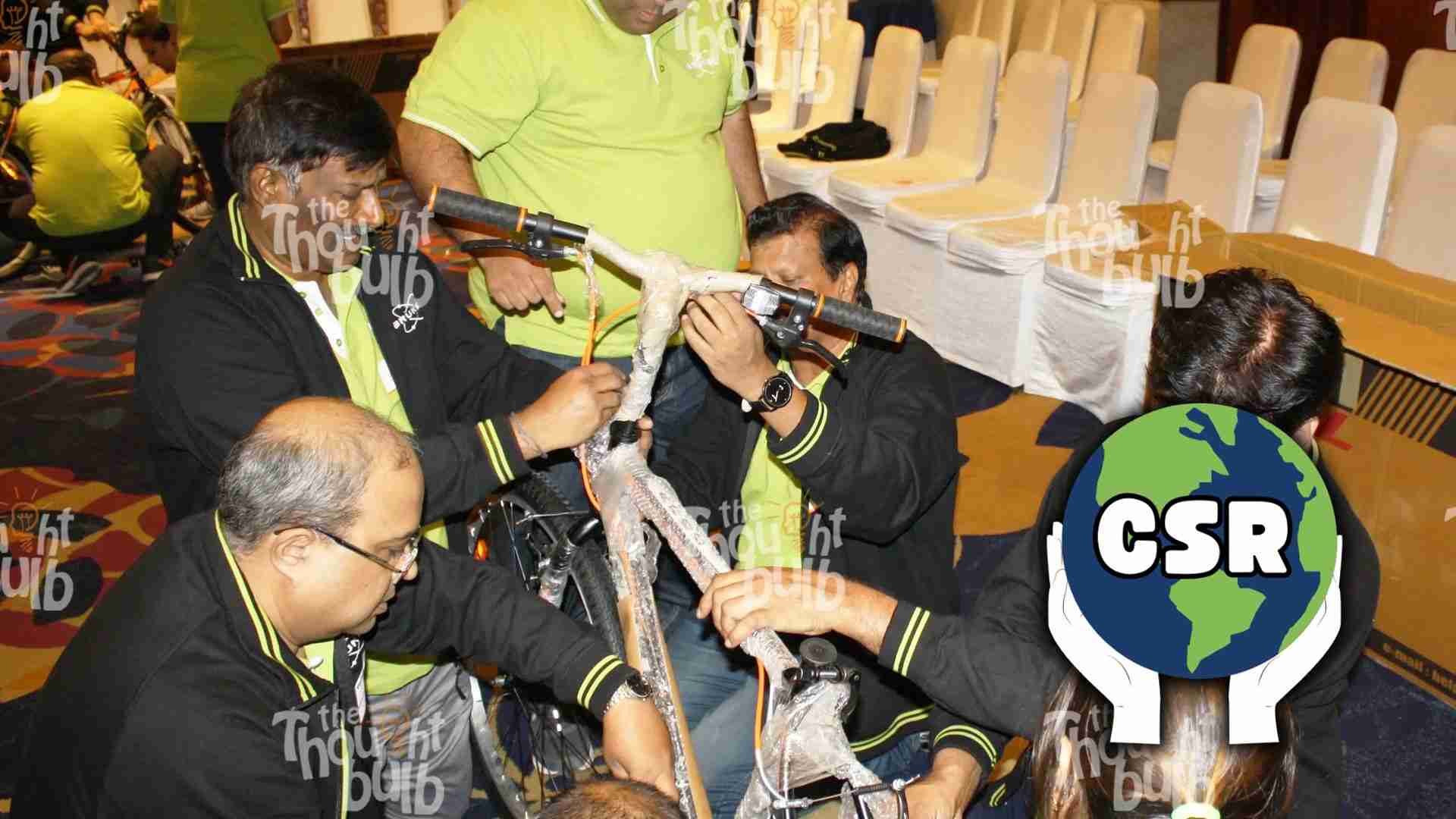
Teams build road-ready bicycles from parts and present them to recipients, usually students for whom the commute is the barrier to attendance. Output: bicycles built and donated.
3. Victory Wheels (S)
Teams assemble and personalise wheelchairs donated to local NGOs, typically in a surprise-reveal format where recipients arrive at the close. Output: wheelchairs assembled and donated.
4. Nutri Box Challenge (S)
Teams assemble nutrition boxes to a defined specification for distribution to underserved families. Output: boxes packed and delivered. Short and easy to run inside an office.
5. Trash to Treasure (E)
Teams convert discarded material into usable objects. Output: waste diverted from landfill and functional items produced. The cleanest circular-economy fit.
6. Water Drop Challenge (E and S)
Teams work through the mechanics of clean water access, ending in a contribution toward water availability for a target community. Useful where operations sit in water-stressed districts.
7. Reader's Rack Challenge (S)
Teams build and stock reading racks for schools and community centres. Output: racks built, books stocked, institutions served. Education-linked outputs align most easily with an existing CSR policy.
8. Terrarium Challenge and Wall of Colours (E and S)
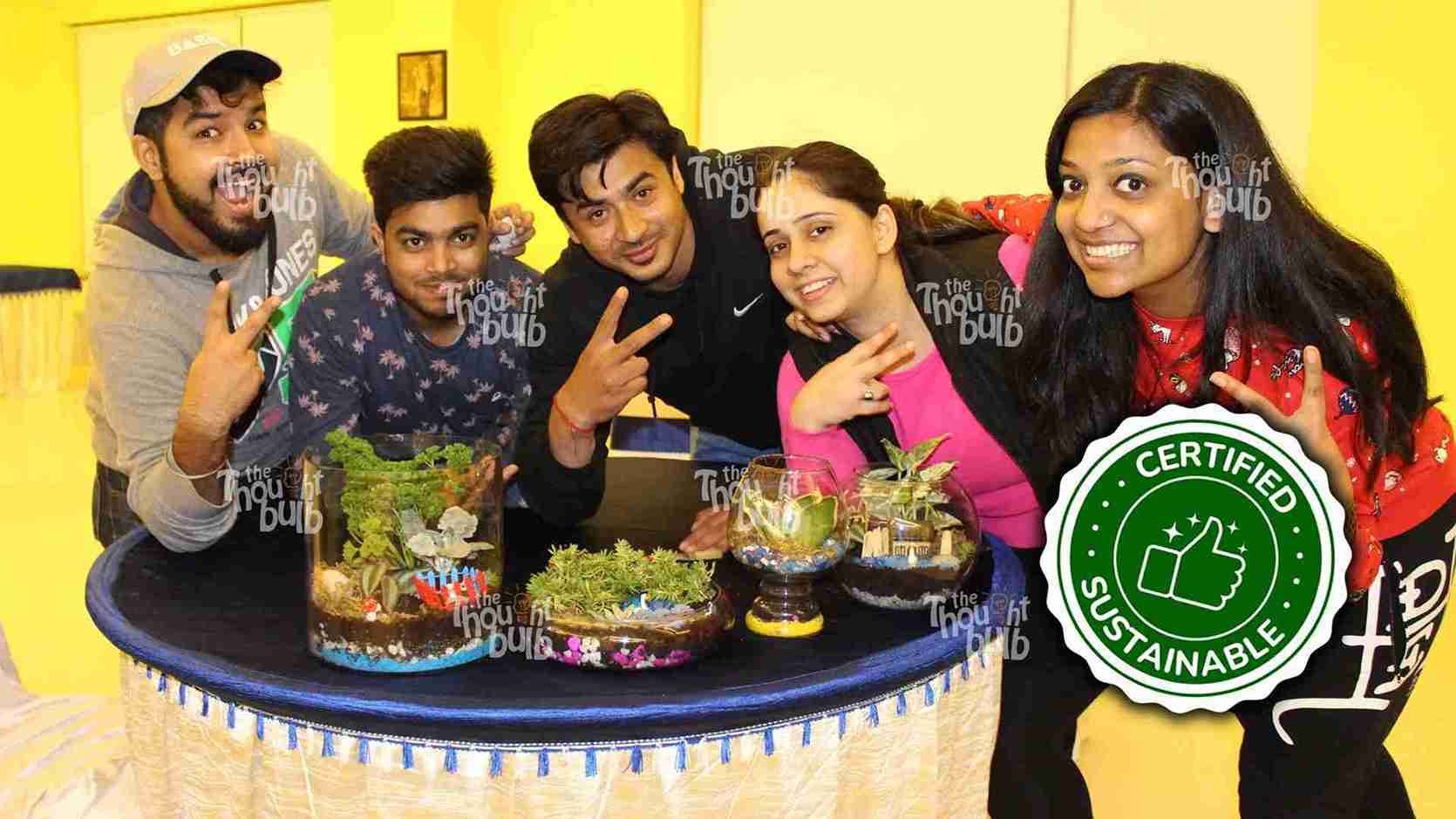
Two lighter formats. The Terrarium Challenge produces planted terrariums indoors with minimal setup. Wall of Colours turns a school wall into a finished mural. Both suit smaller groups.
Formats, group sizes and durations are listed on our sustainability activities page.
Programmes that sit under a formal CSR policy are grouped separately on our CSR activities page.
For a broader idea list before narrowing down, our roundup of 35 sustainable team activities covers lighter-weight options alongside the full programmes above.
Sustainability Team Building Activities for Corporate Teams
Once the team building sustainability brief is agreed, choosing between sustainability team building activities is mostly a question of group size, venue and available time. A few rules from running these at scale.
Under 50: Terrarium Challenge, Trash to Treasure or Nutri Box Challenge. Minimal setup, works in an office, 90 minutes to two hours.
50 to 200: Build A Bicycle, Reader's Rack Challenge or Water Drop Challenge. Needs a hall and a parts logistics plan.
200 to 500: Victory Wheels or Solar Fusion Challenge, run as one session with parallel team stations.
500 and above: run a multi-session series across days. Output quality drops sharply past designed capacity.
Two hours is the realistic floor for any programme with a physical output.
Sustainable team building that survives internal review
One failure mode is worth naming. Programmes producing a symbolic output, such as a pledge wall, feel meaningful in the room and then cannot be reported. Choose a format with a unit count.
Environmental Team Building Activities That Produce a Real Output
Environmental team building activities are where the credibility gap is widest, because environmental claims are easiest to inflate and hardest to verify. A tree planted is only an outcome if someone maintains it. Ask for the second-order detail:
Tree planting: who owns the land, who waters the saplings, and what is the expected survival rate at twelve months?
Solar lighting: what is the unit specification, and who confirms installation at the receiving end?
Upcycling: what weight of material was diverted, and where would it otherwise have gone?
A provider who answers these without hesitation is running a real programme. One who deflects to experience quality is selling an activity with environmental decoration.
Two examples from our own programmes
EY ran the Solar Fusion Challenge in Kolkata as a four-session series across four days, bringing together more than 2,200 participants who assembled 660 solar lights for communities without reliable access to electricity. A single session could not have absorbed that group without output quality collapsing.
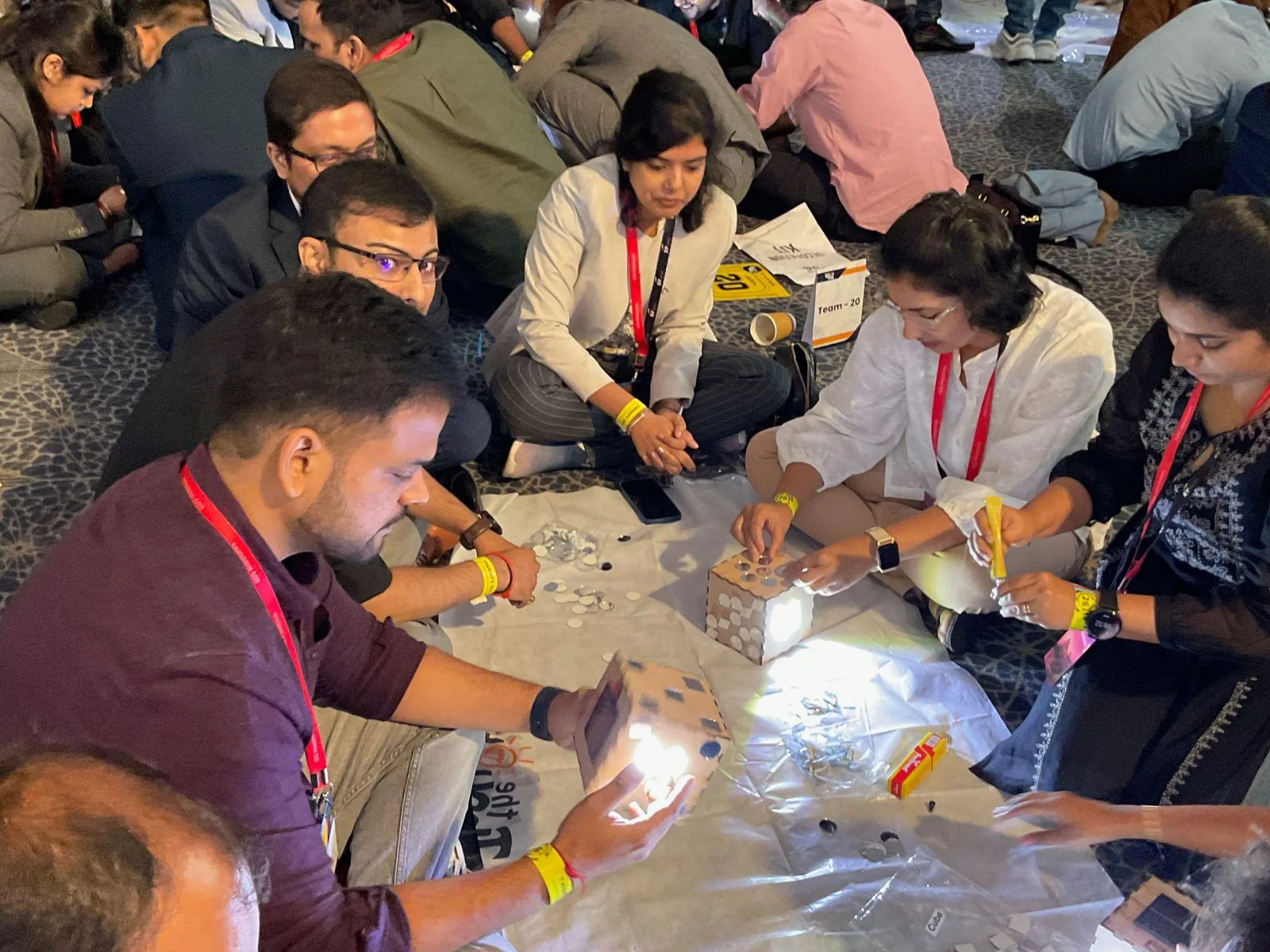
The full programme is documented in our Solar Fusion Challenge with EY in Kolkata case study.
Siemens Healthineers ran Victory Wheels in Udaipur as a two-hour programme for 400 participants in 40 teams. Each team assembled, decorated and donated a wheelchair, producing 40 wheelchairs handed to local NGOs in a surprise-reveal format. A useful benchmark for a large group in a short window.
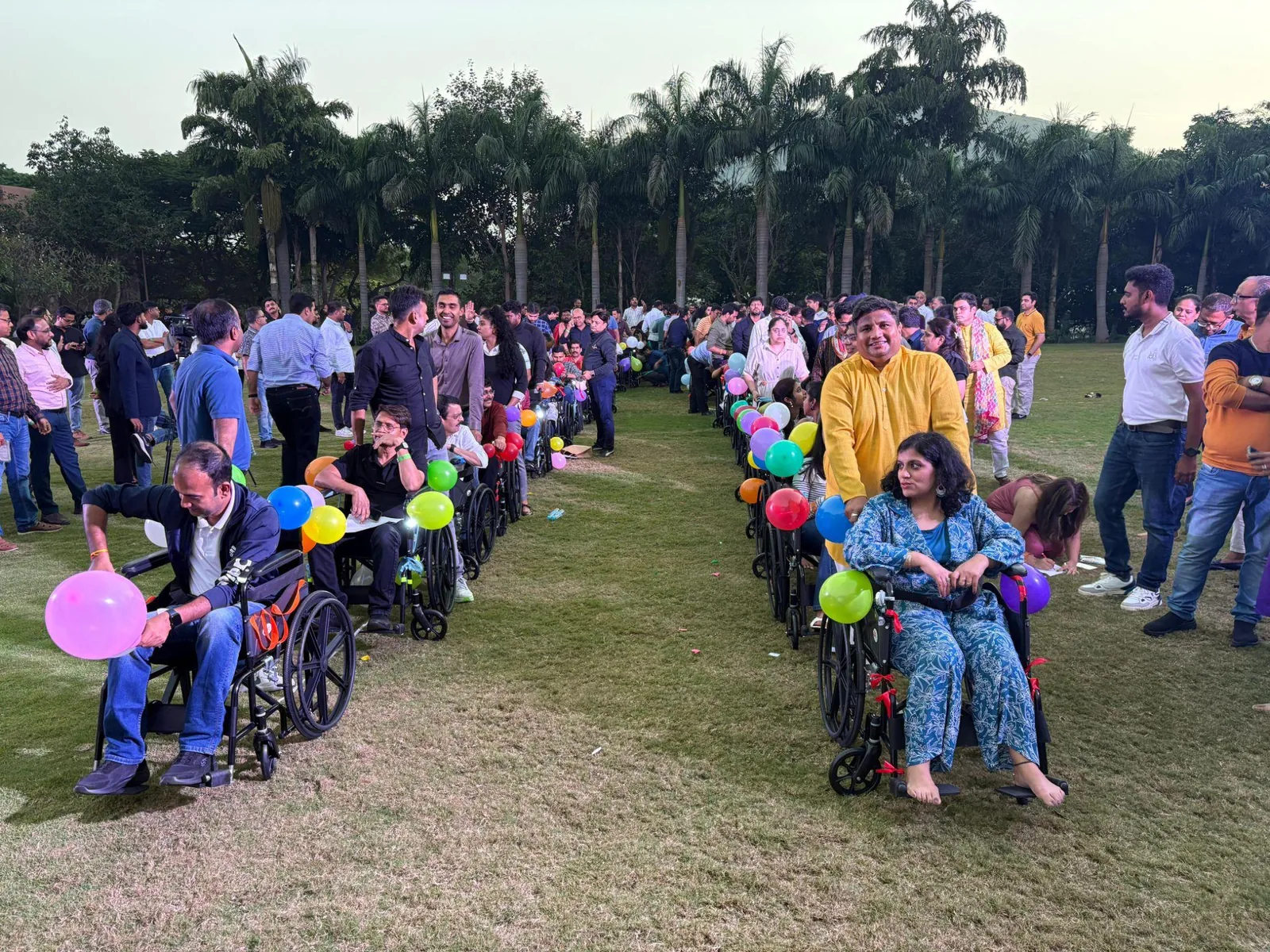
The breakdown is in our Victory Wheels for Siemens Healthineers in Udaipur case study. KPMG ran a comparable programme, bringing 400 participants through a Build a Bicycle CSR Challenge across India.
How to Measure the Impact of an ESG Team Building Programme
This is the section most providers skip and the one CSR leads need, because the outcome travels upward into a report someone else reviews. Capture all three layers rather than reconstructing them later.
Layer 1: output metrics, captured on the day
Units produced, counted and quality-checked before handover, not estimated.
Participants, and participant hours contributed.
Beneficiary organisation name, registration details, and individuals served.
A signed acknowledgement from the receiving organisation, the single most useful artefact you can walk away with.
Layer 2: outcome metrics, captured later
Output is what you made; outcome is what changed. This needs a follow-up at 60 to 90 days, which most organisations never do, which is why doing it differentiates your report. Ask whether the units are in use and what changed. For solar lighting that might be usable hours of light per household; for bicycles, school attendance.
Layer 3: engagement metrics
The programme must work as team building or the budget will not survive next year. Run a three-question post-session pulse: was the work meaningful, did people collaborate outside their usual group, would they recommend the format. Track it against your normal activity baseline.
Mapping the result to your ESG report
Environmental outputs map to environmental disclosures with unit counts. Social outputs map to community development disclosures with beneficiary numbers and spend. Governance is evidenced by process: documented beneficiary selection, traceable spend, and a signed handover record. That third element turns an activity into a disclosure rather than an anecdote.
If you are running this in-office rather than as an offsite, our guide to planning a CSR day at the office covers the logistics and approvals sequence.
How to Choose an ESG Team Building Partner
The market has expanded quickly and quality varies widely. A short diligence list separates real programmes from relabelled activities.
Ask for unit counts from three past programmes at your group size. Vague answers predict vague reporting later.
Ask who the beneficiary organisations were and whether they can be contacted.
Ask what documentation you receive afterwards, and to see a sample.
Check the materials are genuinely usable. Units that do not function are worse than no programme.
Ask how they would handle double your group size. The answer reveals whether they run a series or simply compress the session.
On cost: ESG team building runs higher per head because you are paying for materials that leave with someone else. Compare it against a team building day plus a separate CSR contribution, not against a regular team building day.
Where to Start
Pick one programme, one group and one beneficiary organisation, and run it properly rather than three superficially. Capture the unit count and handover record on the day, then do the 90-day follow-up. One well-documented programme gives your sustainability team something to file and you a template for every session after.
If you are planning ESG team building for 2026 and want help matching a format to your group size, venue and reporting requirements, we are happy to talk.