Something quiet has changed in Indian offices over the last eighteen months. The junior analyst who used to walk over and ask a senior how to frame a client deck now asks a chatbot. The manager who once pulled two people into a room to argue out a positioning line now generates six versions before lunch. Nobody scheduled this shift, nobody announced it, and almost nobody has measured what it is doing to the way teams actually hold together. India is now one of the fastest AI-adopting workforces on the planet. That is a genuine competitive advantage. But adoption speed and team health are two different metrics, and right now most Indian organisations are tracking only the first one.
This is not an argument against AI at work. The evidence, as you will see below, is more interesting and more useful than the usual panic. It suggests that AI does not damage cohesion by itself. What damages cohesion is adopting AI without ever redesigning the human rituals it quietly displaces. That is a solvable problem, and it is squarely an HR problem.
Why This Matters In India Right Now
India has a structural exposure that most markets do not. A very large share of our white-collar workforce sits in services, GCCs, IT, consulting, and BPM, precisely the roles where generative AI eats the first draft, the research summary, the status update, and the routine analysis. These are also the tasks that historically created contact between junior and senior people. The first draft was never just a draft. It was the pretext for a conversation.
Layer on top of that a workforce that is young, largely hybrid, and spread across cities. Many of our teams were already running on thin relational fuel after the hybrid transition. AI has arrived into that gap, not into a healthy baseline.
The three things AI actually removes from a team
The apprenticeship moment. Juniors used to learn judgement by getting a draft returned with red ink. AI now returns a competent draft instantly, so the correction conversation never happens.
The productive friction. Two people disagreeing about an approach used to generate the best answer. A single person prompting alone generates a fast answer, which is not the same thing.
The shared struggle. Teams bond over difficulty they got through together. Remove the difficulty and you also remove the bonding mechanism, unless you deliberately replace it.
What The 2026 Data Actually Says
The numbers point in two directions at once, which is exactly why this topic gets argued badly. Taken together, they tell a coherent story.
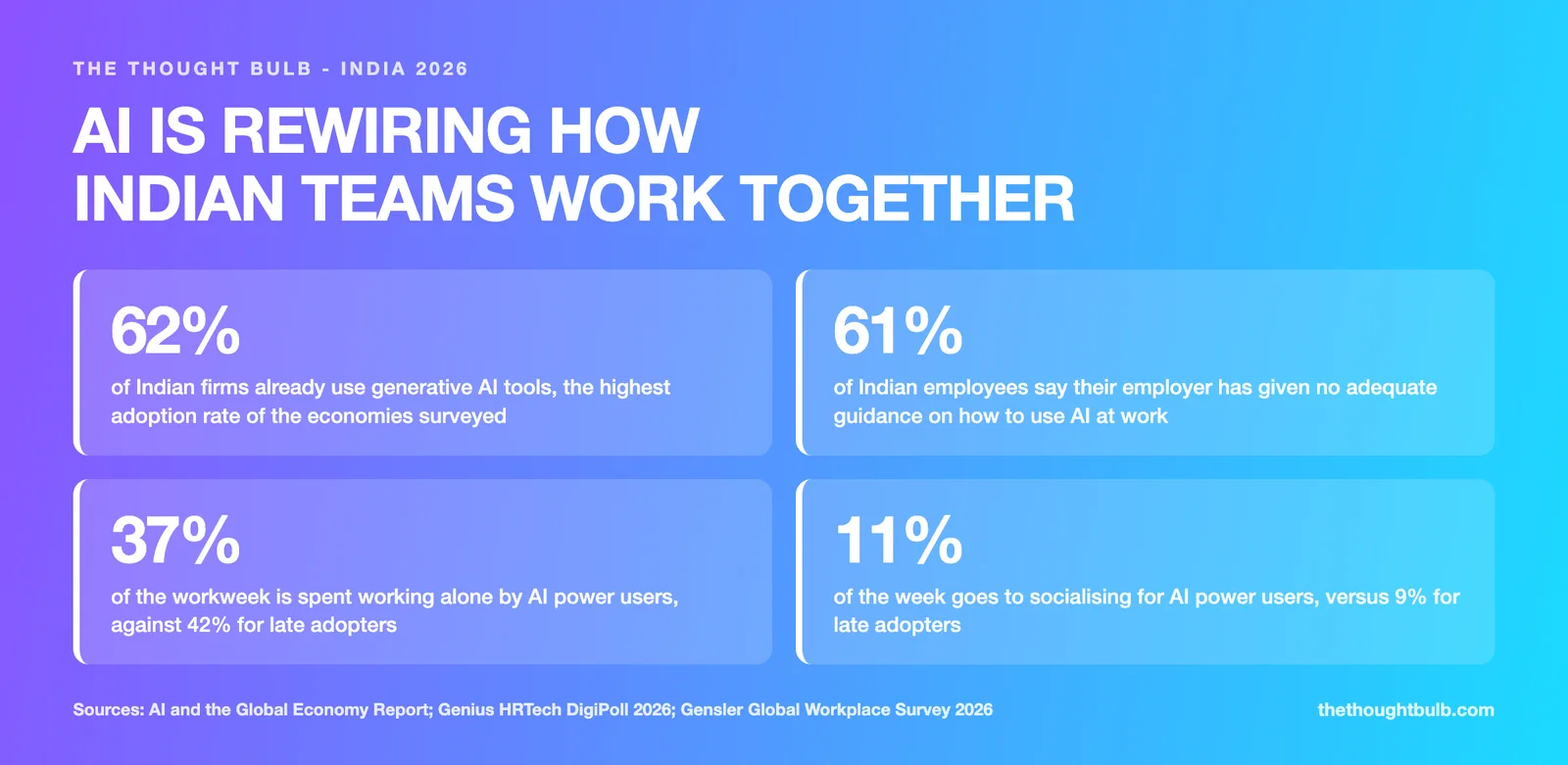
Adoption in India is ahead of the world. 62 percent of Indian firms report already using generative AI tools, the highest rate among the economies surveyed in the AI and the Global Economy Report.
Guidance has not kept pace. 61 percent of Indian employees say their organisation has not provided adequate guidance on how to use AI effectively, according to the Genius HRTech DigiPoll 2026, and only 37 percent report receiving proper training.
Heavy AI users are not the lonely ones. Gensler's 2026 Global Workplace Survey of more than 16,400 office workers across 16 countries found that AI power users spend 37 percent of their workweek working alone, compared with 42 percent for late adopters.
And they socialise more, not less. The same survey found AI power users spend 11 percent of the week socialising versus 9 percent for late adopters, and 12 percent learning versus 8 percent.
Read that carefully, because the conclusion is counter-intuitive and it is the single most important thing in this article. The people using AI most heavily are the ones spending the least time working alone. AI is not, on the available evidence, an isolation machine. What it does is free up hours, and those hours go somewhere. In organisations with strong rituals, they flow into mentoring, learning, and collaboration. In organisations without them, they flow into more solo output and a slow thinning of the relationships that hold a team together. The differentiator is not the technology. It is whether the organisation has designed anything for the space AI opens up.
The Cohesion Risks Nobody Is Tracking
1. Invisible skill decay in the middle layer
When juniors stop producing rough work, seniors stop coaching. Two years of that and you have a mid-level cohort that can operate tools brilliantly but has never been taught how to make a judgement call under ambiguity. This shows up in your attrition data long before it shows up in your engagement survey, because the people who leave are the ones who noticed they were not growing.
2. Credit confusion
When output is partly machine-generated, teams get quietly awkward about attribution. Who gets recognised for the deck? Recognition systems built for human effort start misfiring, and misfiring recognition is corrosive to trust. Most Indian companies have not updated a single line of their recognition criteria since AI entered the workflow.
3. The confidence gap between adopters and holdouts
In almost every team we work with, AI use is wildly uneven. Some people are three months ahead; others are quietly avoiding it and hoping nobody notices. That gap becomes a status hierarchy nobody voted for, and it fractures teams along lines that have nothing to do with capability or contribution.
4. Meetings that lost their purpose
If AI has already summarised, drafted, and circulated everything, the status meeting has no reason to exist. But it is still in the calendar. Teams end up spending their scarce shared time on the least valuable possible activity while the genuinely human work of debating, deciding, and connecting gets no slot at all.
Designing For The Space AI Opens Up
The practical response is not to slow AI adoption. It is to be as deliberate about redesigning human contact as you are about rolling out the tools. Three principles hold up well in Indian contexts.
Name what stays human
Write it down. Feedback conversations, credit and recognition, difficult calls, career conversations, and conflict resolution stay human. A one-page charter that says this explicitly removes a huge amount of ambient anxiety, and it costs nothing.
Convert saved hours into shared experience, not more output
If AI saves your team six hours a week and you fill all six with more deliverables, you have optimised for throughput and paid for it in cohesion. Ring-fence some of that time. This is where structured experiences earn their keep, because they create the shared difficulty that day-to-day work no longer supplies.
Teams that have gone AI-heavy tend to need experiences that are creative and collaborative rather than purely physical, because the thing they have lost is joint thinking. You can browse the full range of formats across our team building activities library and filter by what your team actually needs.
Make AI itself the shared object
The most effective single intervention we see is getting a team to build something with AI together, in a room, with a deadline. It equalises the confidence gap in an afternoon, it surfaces the good prompts and the bad ones, and it turns a private tool into a team practice.
Two Experiences That Work For AI-Heavy Teams
We run these regularly for Indian and global teams that have moved fast on AI and are now trying to rebuild the human layer around it.
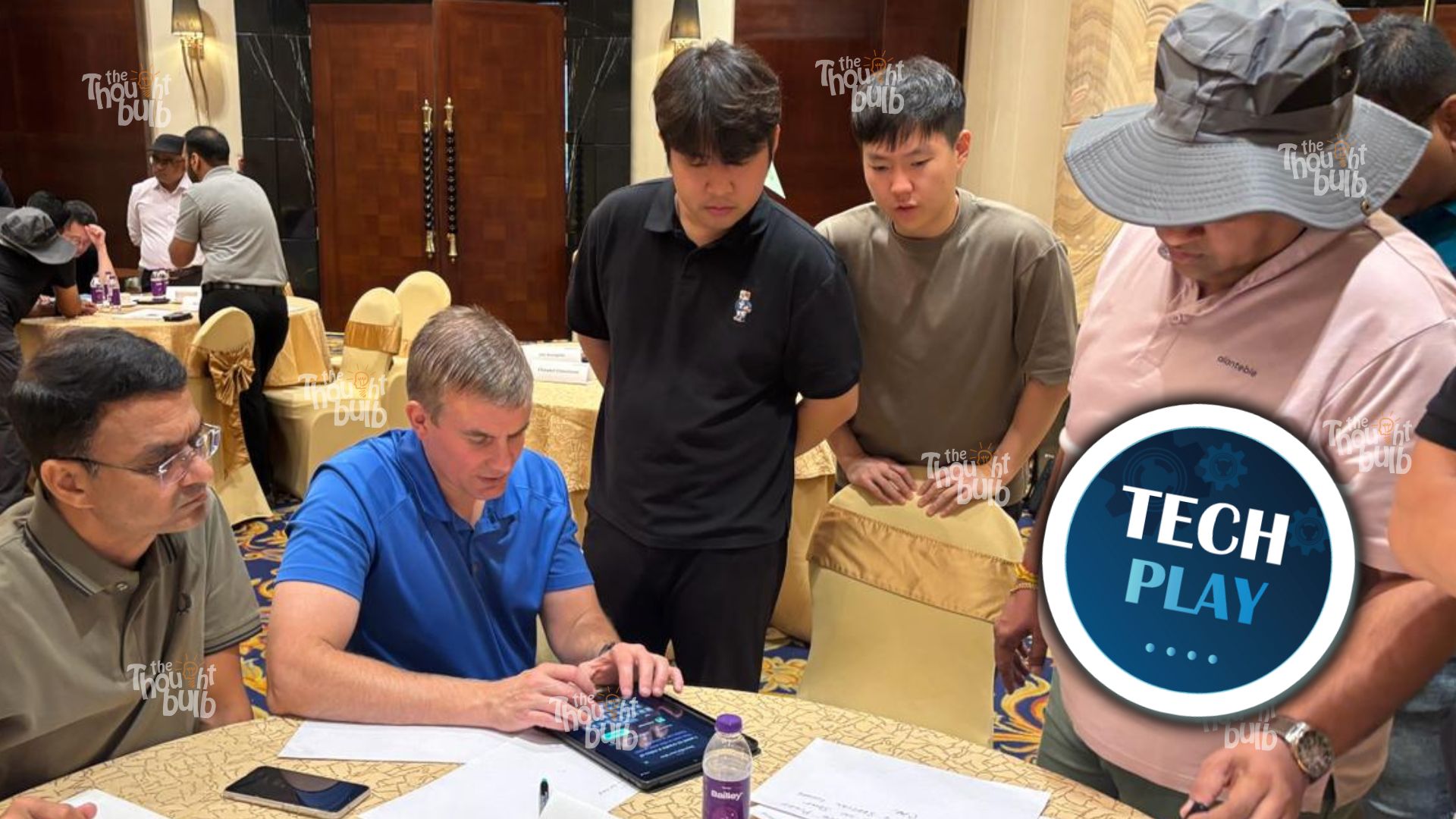
AI Movie Making Challenge
Teams are given a brief and a few hours to write, generate, and edit a short film using AI tools. It works because it is genuinely difficult, genuinely funny, and completely dependent on collaboration. The quiet people who have been experimenting with AI at home suddenly become the most valuable person in the group, which resets the internal hierarchy in a way no workshop can. It also gives everyone a shared vocabulary for what these tools are good and bad at, which pays off in real work the following week.
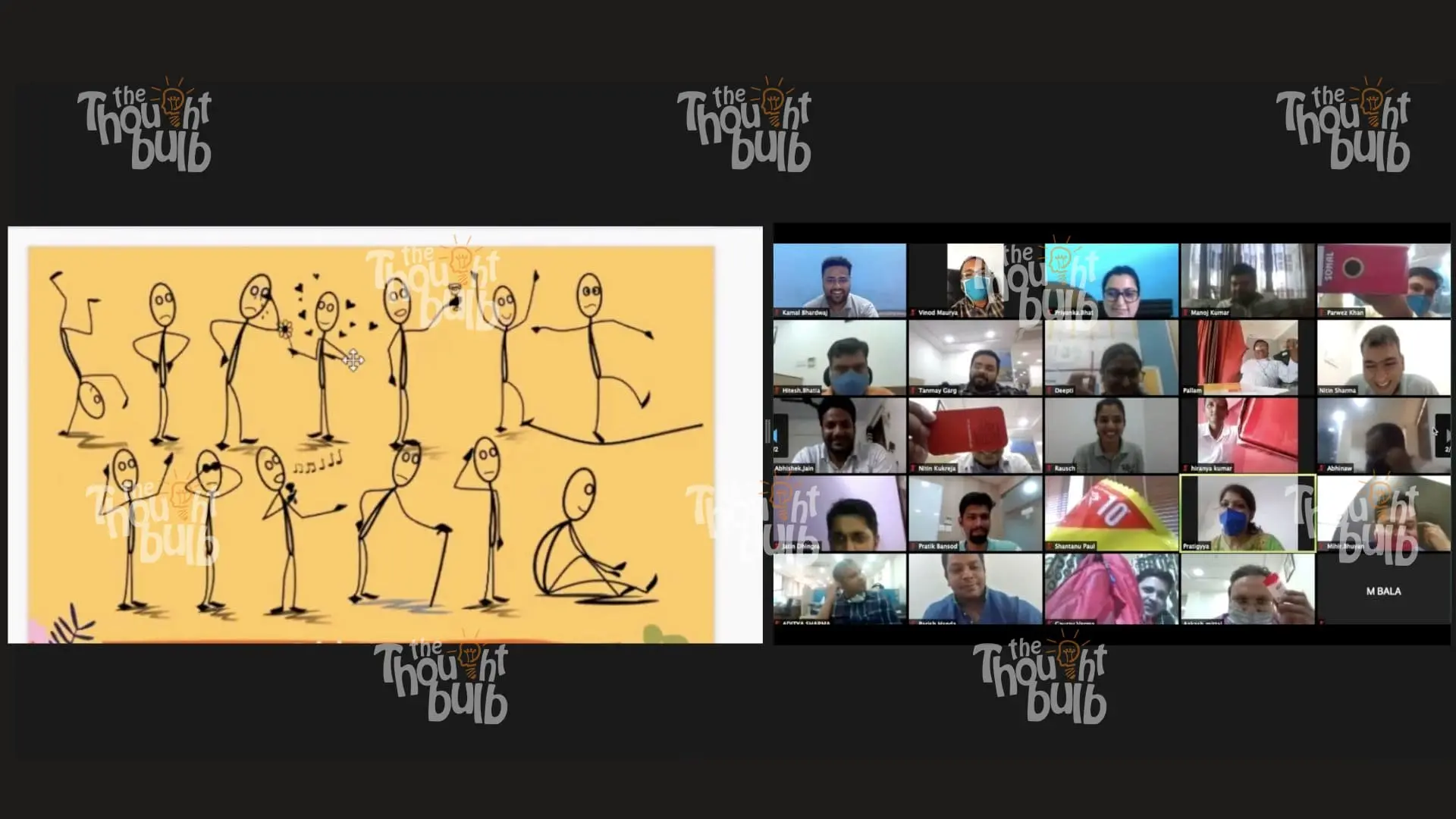
Comic Strip Virtual Challenge
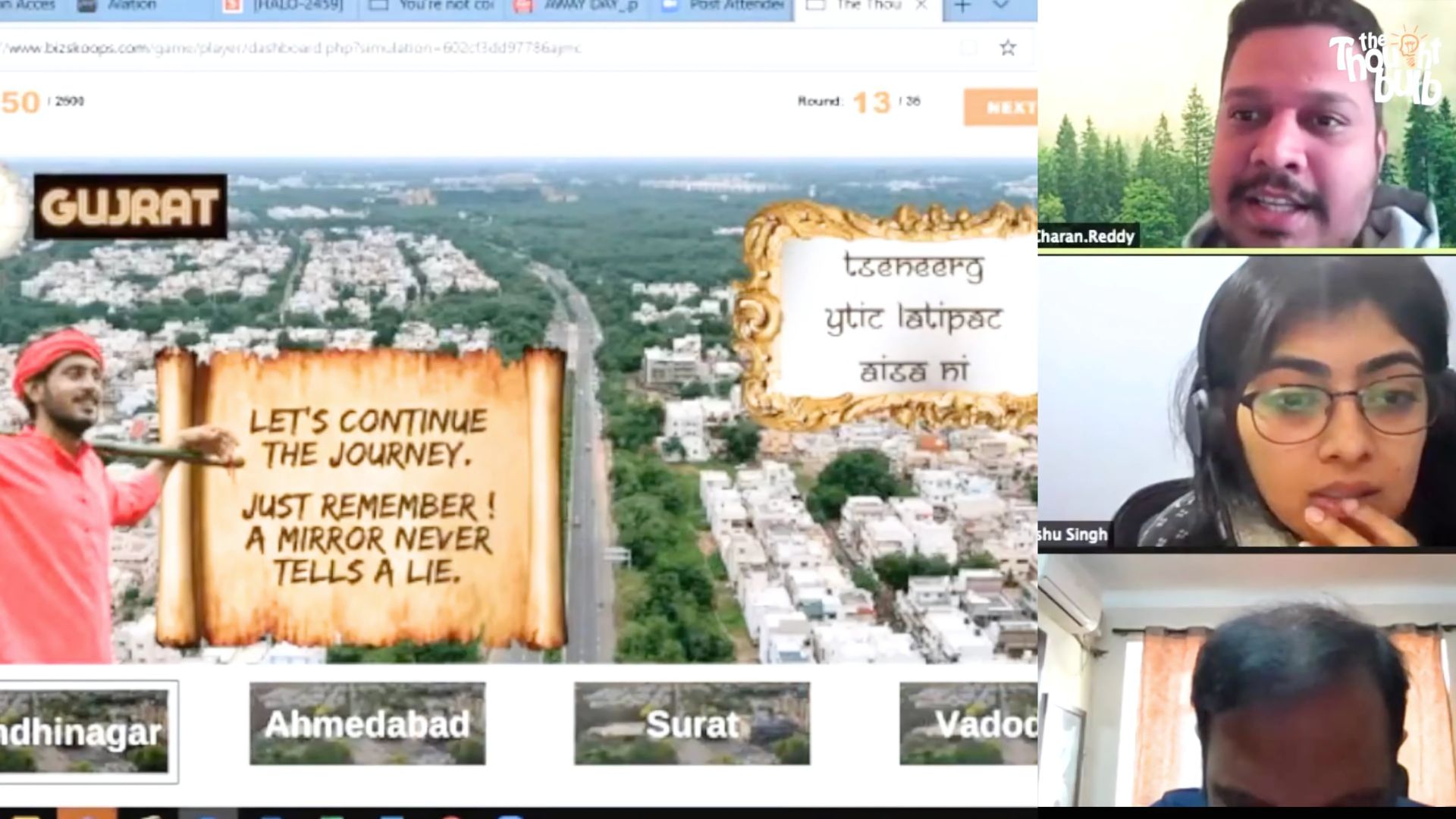
For distributed teams, the virtual comic strip format does something similar in a shorter window. Teams build a narrative panel by panel, which forces the kind of sequencing and hand-off conversation that AI-assisted work tends to skip. It is a low-friction way to get remote colleagues creating together rather than simply reporting to each other, and it runs comfortably for groups spread across time zones.
If most of your team is remote or split across offices, the wider set of virtual team building formats is worth looking at before you default to another all-hands call.
What This Looked Like With Prodapt
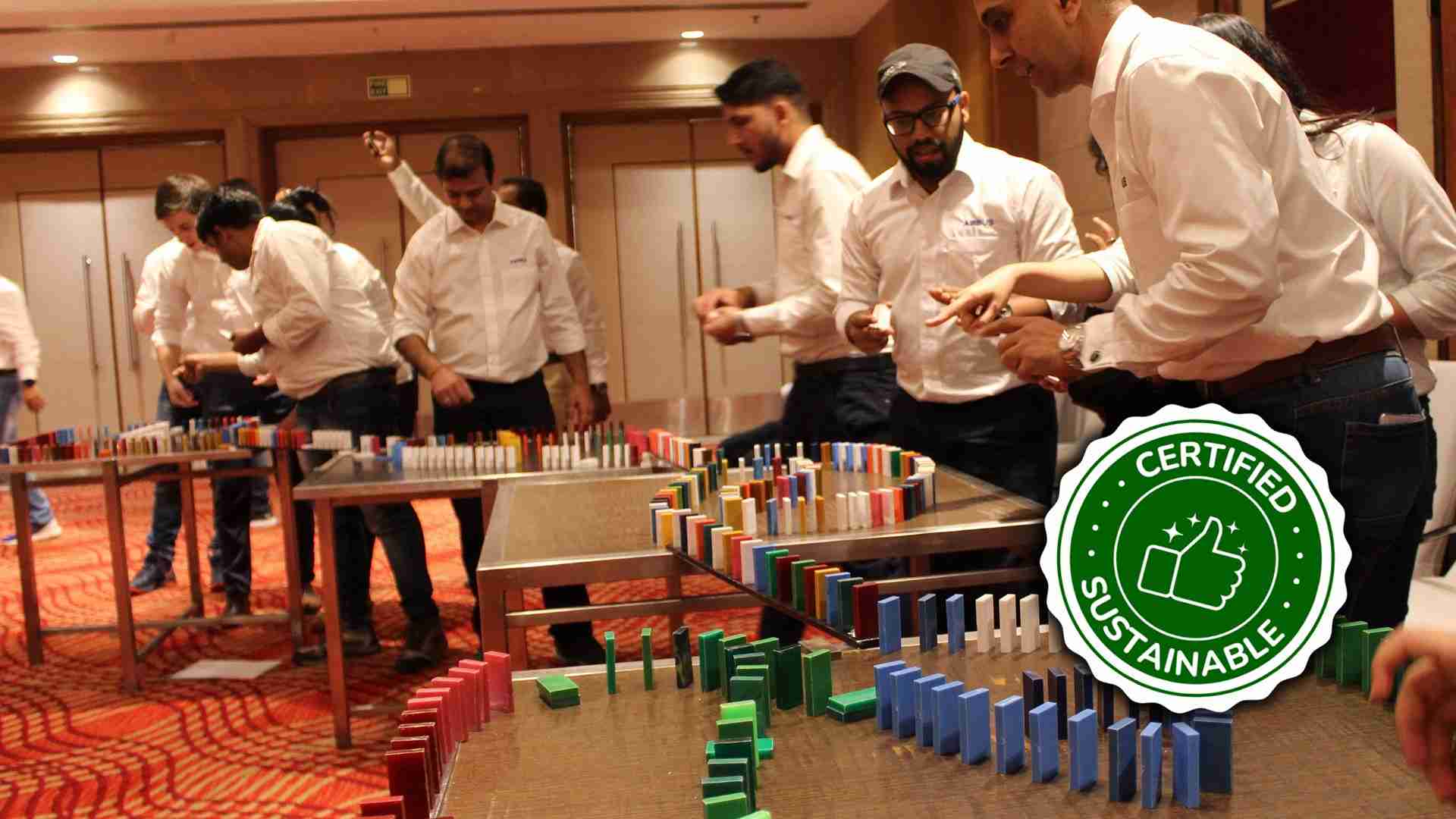
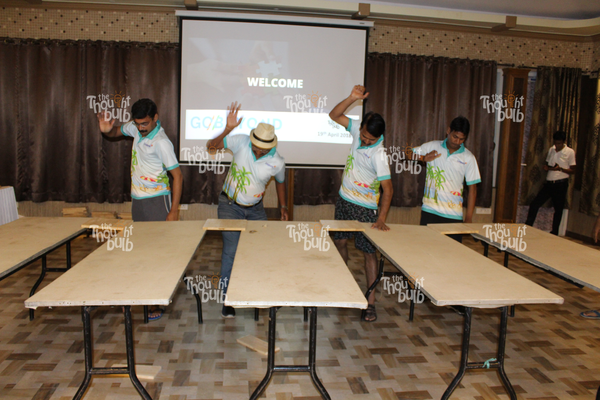
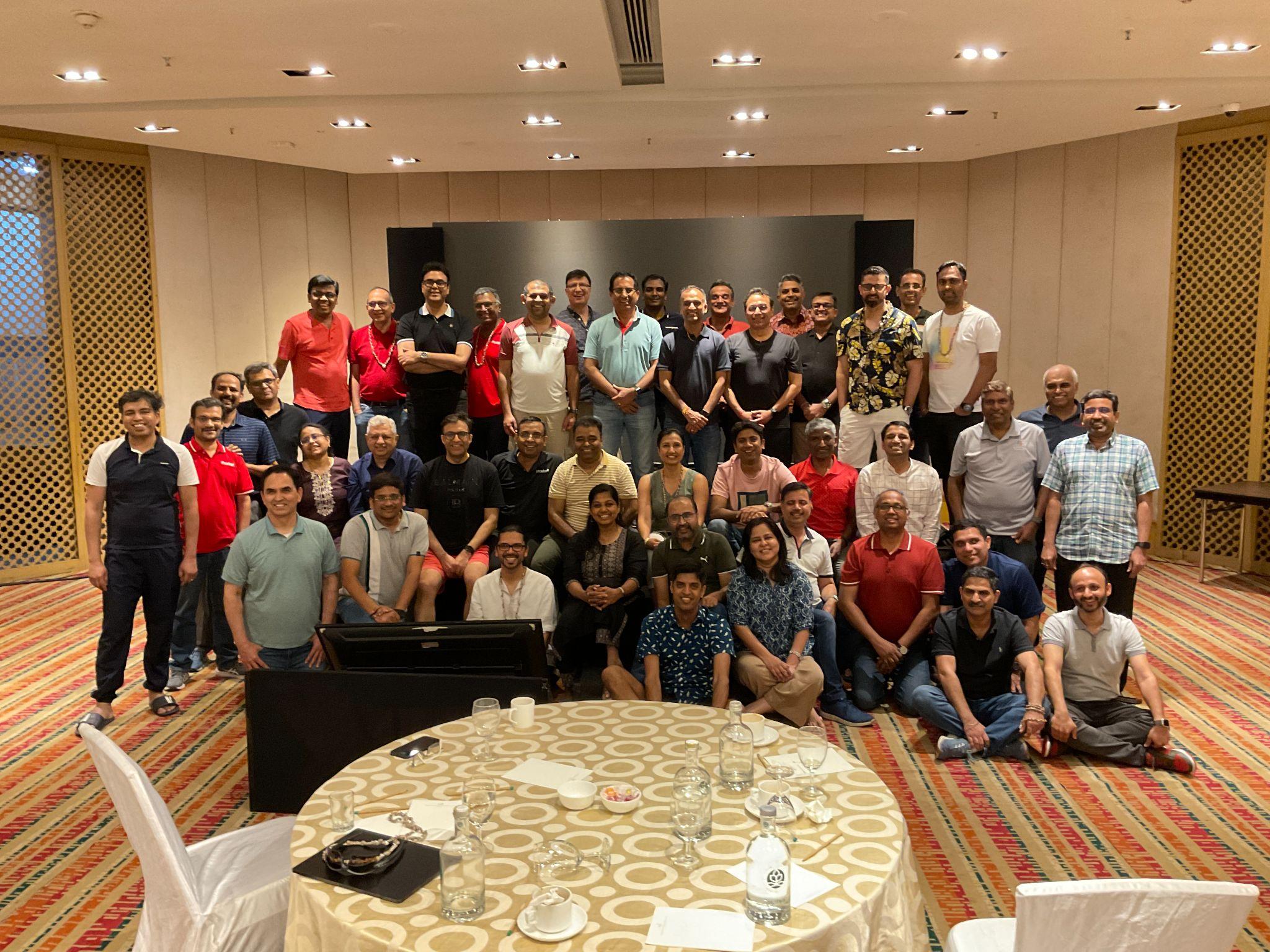
Prodapt, a technology and consulting firm serving the connectedness industry, brought their team to Mahabalipuram for an offsite. We ran the AI Movie Making Challenge as the centrepiece. The teams were given a creative brief and had to take it from concept to finished short film using AI generation tools, with all the scripting, casting decisions, and editing calls made collectively under time pressure.
Two things came out of it that are worth reporting plainly. First, the confidence gap closed fast. People who had been hesitant about AI tools were producing usable output within the first hour because they had a peer next to them rather than a help doc. Second, the films themselves became internal artefacts that the teams kept referencing long after the offsite, which is the clearest signal you get that a shared experience actually landed.
More examples of how organisations have structured these programmes are collected in our client case studies.
A 90-Day Plan For HR Leaders
If you want to move on this without launching a transformation programme, this sequence works and fits inside a normal quarter.
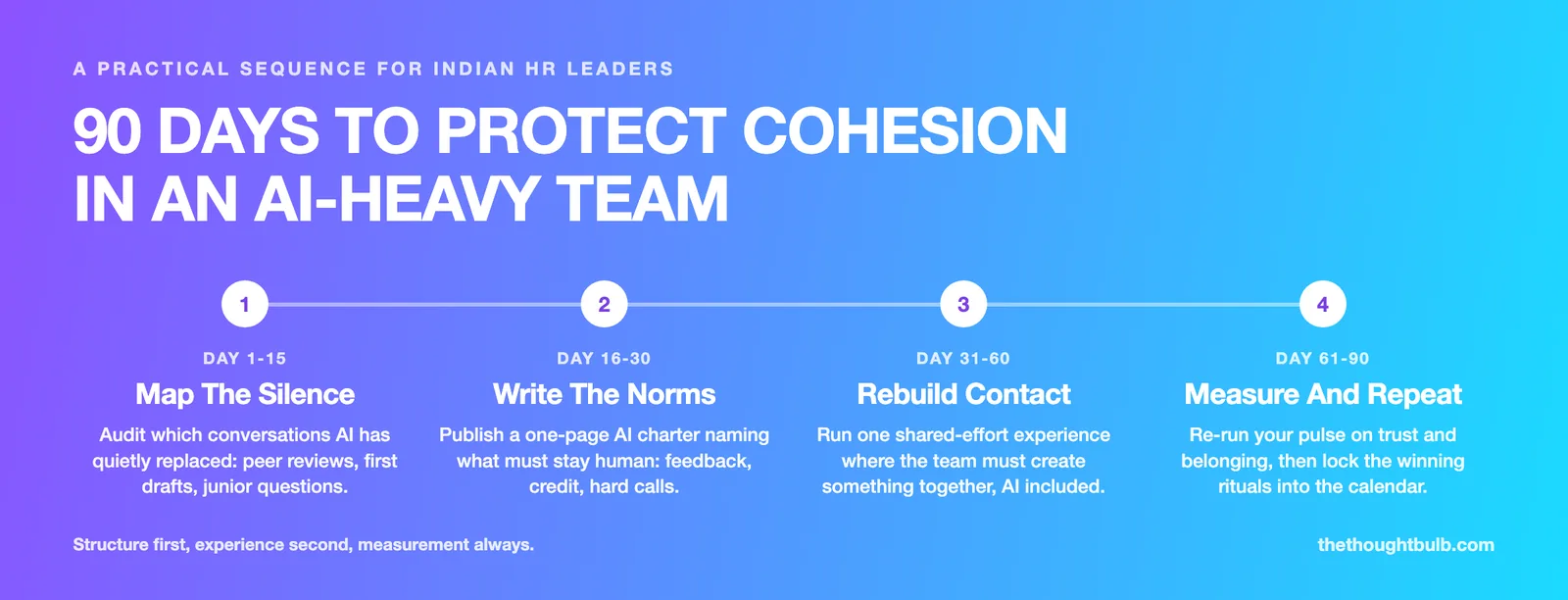
Day 1 to 15 - Map the silence. Audit which conversations AI has quietly replaced. Ask managers directly: what discussions used to happen that no longer do? Peer review, first-draft feedback, and junior questions are the usual casualties.
Day 16 to 30 - Write the norms. Publish a one-page AI charter naming what must stay human: feedback, credit, and hard calls. Circulate it, do not just file it. This also closes the 61 percent guidance gap in your own organisation.
Day 31 to 60 - Rebuild contact. Run one shared-effort experience where the team has to create something together, with AI in the room rather than banned from it. Aim for genuine difficulty and a real deadline.
Day 61 to 90 - Measure and repeat. Re-run your pulse survey on trust and belonging, compare against your baseline, and lock the rituals that worked into the calendar so they survive the next quarter.
What to measure
Cross-team contact: how many people outside their immediate pod did each person work with this month?
Coaching frequency: are managers still giving developmental feedback, or only approving AI-assisted output?
Confidence spread: the gap between your most and least confident AI users is a cohesion risk indicator.
Belonging pulse: a single well-worded quarterly question beats an annual 40-item survey nobody reads.
The Leadership Piece
Senior leaders set the norm here more than any policy does. If a leader visibly uses AI to draft and then still holds the human conversation, the team learns that the tool changes the input and not the relationship. If a leader disappears behind polished AI-generated communication, the team learns the opposite very quickly.
This is a specific and trainable leadership behaviour, and it belongs in your development plans for 2026. Our leadership team building programmes work on exactly this: how leaders hold connection when the mechanics of work change underneath them.
Conclusion
The most useful finding in the 2026 data is also the most hopeful one. Heavy AI users are spending less time alone and more time learning and socialising. AI is not pulling teams apart on its own. It is creating space, and space is neutral until somebody decides what goes into it. Indian organisations have adopted the technology faster than almost anyone. The organisations that will actually compound that advantage are the ones that put the same deliberate effort into designing what happens with the hours it gives back.
If your team has gone AI-heavy over the last year and you have a sense that something has thinned out, that instinct is worth acting on before it shows up in your attrition numbers. We are always happy to talk through what a first intervention could look like for your specific team, whether that is a half-day experience or a full offsite.