How Great Teams Talk: 5 Rules That Change Everything

High-performing Indian corporate teams share 5 communication rules: they listen to understand (not respond), speak with candor and care, disagree directly, communicate context not just information, and close every conversation with clarity on next steps. The Thought Bulb teaches these rules in team communication workshops.

How Great Teams Talk: 5 Rules That Change Everything

Communication is one of those things that everyone agrees is important and almost nobody actively practices. We've watched teams with exceptional individual talent underperform because they never figured out how to talk to each other. The five rules in this piece aren't theories — they're patterns we've observed in teams that genuinely communicate well.

Nishit Lal, Leadership Facilitator · The Thought Bulb

Effective team communication is the secret sauce behind every high-performing team. Whether you're leading a project, launching a new initiative, or navigating change, the way your team talks makes all the difference. It’s not just about words—it's about trust, rhythm, intention, and structure.

In this blog, we explore five communication rules that transform average teams into aligned, resilient, and result-driven ones. These aren't just theoretical tips—they're the day-to-day behaviors that reshape how great teams communicate at work.

1. Everyone Speaks, Everyone Listens

In great teams, communication isn’t dominated by one or two voices. There’s a healthy rhythm where everyone gets to contribute, and everyone is heard. It’s called balanced participation, and it builds engagement, clarity, and ownership.

If your team has a few silent members during meetings or brainstorming sessions, you’re likely missing out on ideas, concerns, and opportunities. Great leaders create space for quieter voices, invite opinions directly, and normalize sharing early, rough ideas without judgment.

Tip: Start meetings by going around the room with a short check-in. Rotate facilitation roles to ensure varied voices lead the flow.

2. They Build Psychological Safety

One of the most defining traits of successful teams is psychological safety—the belief that you won’t be punished or humiliated for speaking up with a question, idea, or mistake.

When teams feel safe, they talk openly. They challenge respectfully. They bring up concerns before they snowball. Most importantly, they don’t fear being wrong—they see it as part of learning.

Leaders play a vital role in this. When a manager says, “That’s a great question,” or “Thanks for pointing that out,” they’re reinforcing a culture of safety.

Tip: When someone speaks up with a concern, thank them first. Then explore the issue together. Don’t rush into solving—start with listening.

3. They Talk Frequently, Not Just Formally

Poor teams wait for the next formal check-in. Great teams don’t. They use frequent, short, informal communication to stay aligned.

A five-minute sync-up can prevent a week’s worth of confusion. A one-line update on chat can remove blockers. Waiting for a weekly meeting to raise critical updates is a recipe for misalignment.

High-functioning teams don’t just communicate more—they do it faster, with more transparency, and with fewer filters.

Tip: Encourage lightweight, regular updates. A daily standup, an end-of-day wrap-up, or a simple “here’s where I’m stuck” channel can go a long way.

4. They Clarify Before They Assume

Most team friction comes not from disagreement, but from misinterpretation. Great teams have learned to pause and ask: “What did you mean when you said that?”

They clarify timelines. They double-check expectations. They paraphrase to confirm. Why? Because they know that every assumption costs time, trust, or both.

These teams replace passive-aggressive silence with curiosity. They don’t shy away from tough conversations—they lean in, gently.

Tip: Use phrases like “Can I clarify what you meant?” or “Here’s how I understood it—did I get that right?” to keep everyone on the same page.

5. They Reflect and Reset Often

Great communication is not a one-time achievement—it’s a continuous, evolving skill. High-performing teams take time to reflect on how they talk.

They debrief after projects. They discuss what helped and what hindered communication. They call out patterns like “We rushed decisions” or “We didn’t loop in the right people.” Then, they reset norms and move forward with sharper awareness.

Tip: After every major project or sprint, dedicate 15 minutes to reflect as a team: What worked? What didn’t? What do we want to do differently next time?

Quick Recap: The 5 Rules Great Teams Follow
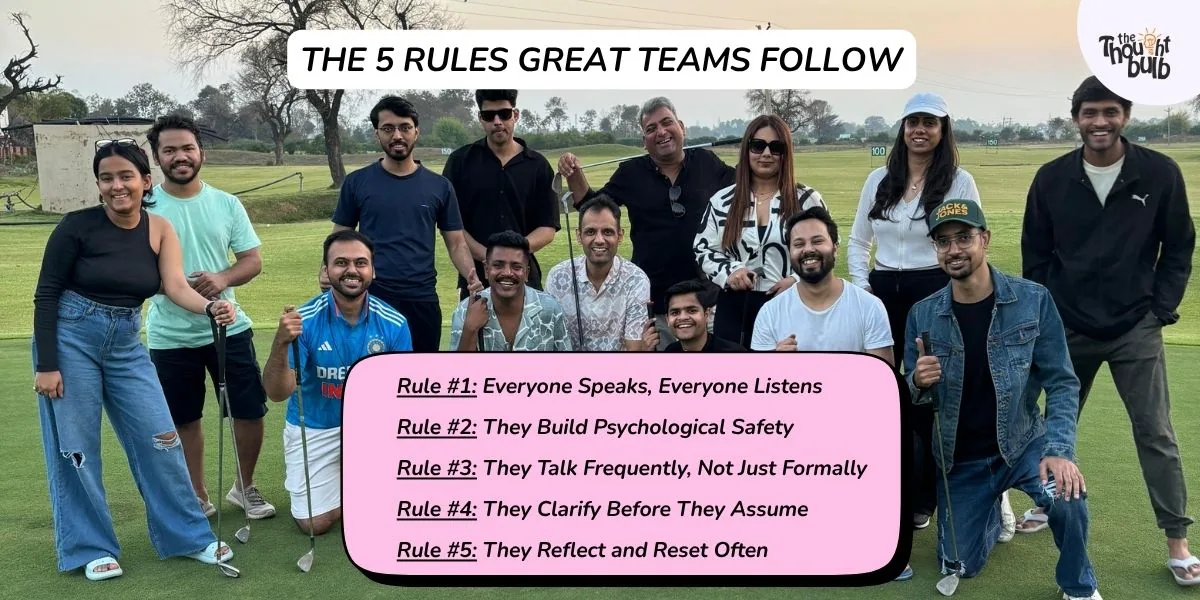
The 5 Rules Great Teams Follow

Start small—introduce one rule per week and observe the shift.

Final Word: The Way You Talk Defines the Way You Work

Team communication is more than sharing information—it's about how people think, feel, and connect while doing work together.

If you want a team that delivers under pressure, innovates consistently, and sticks together through challenges, start by improving how you talk.

Make space for all voices. Build trust. Communicate early and often. Clarify constantly. Reflect regularly.

Great teams talk differently. And that changes everything.
Topics

#Communication#Leadership#Team Building

Share this article

Frequently Asked Questions

What communication rules do the best corporate teams in India consistently follow?+

India's best corporate teams follow 5 communication rules: (1) Listen to understand before responding, (2) Give feedback with care and specificity, (3) Disagree directly and respectfully, (4) Share context not just instructions, (5) End every discussion with explicit next steps. The Thought Bulb teaches these rules in team communication workshops across 12 Indian cities.

How does poor team communication affect performance in Indian corporate organizations?+

Poor communication costs Indian companies an estimated Rs. 2-5 lakh per employee per year in lost productivity, rework, and conflict resolution. The Thought Bulb's communication workshops help Indian corporate teams identify their specific communication gaps and build new habits through structured experiential practice.

Which communication workshop activities work best for Indian corporate teams?+

Highest-impact communication activities for Indian teams: Active Listening Triads (practice listening without interrupting), Feedback Role-Play (giving candid, caring feedback), Perspective-Taking Debates (argue the opposite position), and Communication Style Mapping (DISC or similar). The Thought Bulb facilitates all these for Indian corporate teams.

How can Indian managers improve communication within their teams immediately?+

Immediate communication improvements for Indian managers: start every meeting with a check-in, end with action items read back aloud, create a team communication charter, establish feedback norms, and model the communication behaviors you want to see. The Thought Bulb's manager communication coaching reinforces these practices across India.

When should Indian companies run dedicated communication team building workshops?+

Run communication workshops when: new teams form, cross-functional projects launch, post-conflict situations arise, managers are promoted, or engagement surveys show communication gaps. The Thought Bulb recommends annual communication audits for all Indian corporate teams and targeted workshops when specific gaps are identified.

You might also like

Building Psychological Safety in Indian Teams: A 2026 Playbook
Employee Engagement

Building Psychological Safety in Indian Teams: A 2026 Playbook

9 Jun 2026 · 8 min
How to Measure the ROI of Team Building in India (2026 Guide)
Team Building

How to Measure the ROI of Team Building in India (2026 Guide)

4 Jun 2026 · 8 min
India Employee Engagement & Attrition in 2026: What HR Leaders Need to Know
Employee Engagement

India Employee Engagement & Attrition in 2026: What HR Leaders Need to Know

27 May 2026 · 9 min

Activities to try with your team

View all 150+ activities →
Ripple Effect
indoor

Ripple Effect

Ripple Effect is an immersive business simulation where teams navigate 10 quarters of real-world business challenges — making strategic decisions under pressure, managing cross-functional departments, and seeing exactly how every choice ripples across the organisation.

Explore activity →
Cricket Auction Simulation
indoor

Cricket Auction Simulation

Cricket Auction Simulation puts your team in the role of IPL-style franchise owners competing in a live player auction. Teams strategise, bid, and build their dream squad under budget pressure — blending the excitement of cricket with real-world collaboration, negotiation, and smart decision-making.

Explore activity →
Storytelling Workshop - Once Upon A Time
virtual

Storytelling Workshop - Once Upon A Time

Engage in a riveting storytelling session to learn and have fun while inculcating leadership and life skills messages in adults and children alike.

Explore activity →

Looking for team building activities?

Browse our full catalogue of in-person, virtual and CSR experiences across India.

Explore Activities →