December is the hardest month to be a banker in India. Year-end targets are due, audit queries are piling up, the March close is already being planned, and the relationship manager who quietly hit every number for three years has just accepted an offer from a competitor. Across banks, NBFCs, insurers and fintechs, the people problem has become a business risk. Even the Reserve Bank of India now treats employee attrition as an operational concern rather than an HR footnote. This guide explains why team building for BFSI and banking teams has to look different from a generic office outing, what the data says, and how HR leaders can run a practical 90-day plan that actually holds people together.
Why BFSI Teams Need A Different Kind Of Team Building
Financial services teams are not built like most corporate teams. They are spread across branches, regional offices, operations hubs and technology centres. They work inside tight regulation, and their days are measured in targets, turnaround times and compliance checklists. A one-size-fits-all outing rarely moves the needle for them.
Siloed functions that rarely meet
Sales, credit, operations, risk, compliance and technology all touch the same customer, yet most employees never spend unstructured time with colleagues outside their own vertical. Friction between front office and back office is one of the most common complaints we hear from BFSI leaders.
Pressure that is constant, not seasonal
Monthly targets, quarterly closes and annual audits mean there is no real off-season. Engagement work has to fit around that rhythm, not compete with it.
Distributed workforces
Branch teams in tier-2 and tier-3 cities who rarely see head office colleagues.
Operations and shared-services centres running in shifts.
Technology and analytics teams that are often hybrid or fully remote.
Senior leadership groups that meet mostly in review meetings.
Any engagement plan for a bank has to connect all of these groups, which is why a mix of in-person and virtual experiences works better than a single annual offsite.
What The Data Says About BFSI Engagement In India
The numbers explain why BFSI leaders are paying attention. Attrition, exit intent and low engagement are showing up across every major study of the Indian workforce.
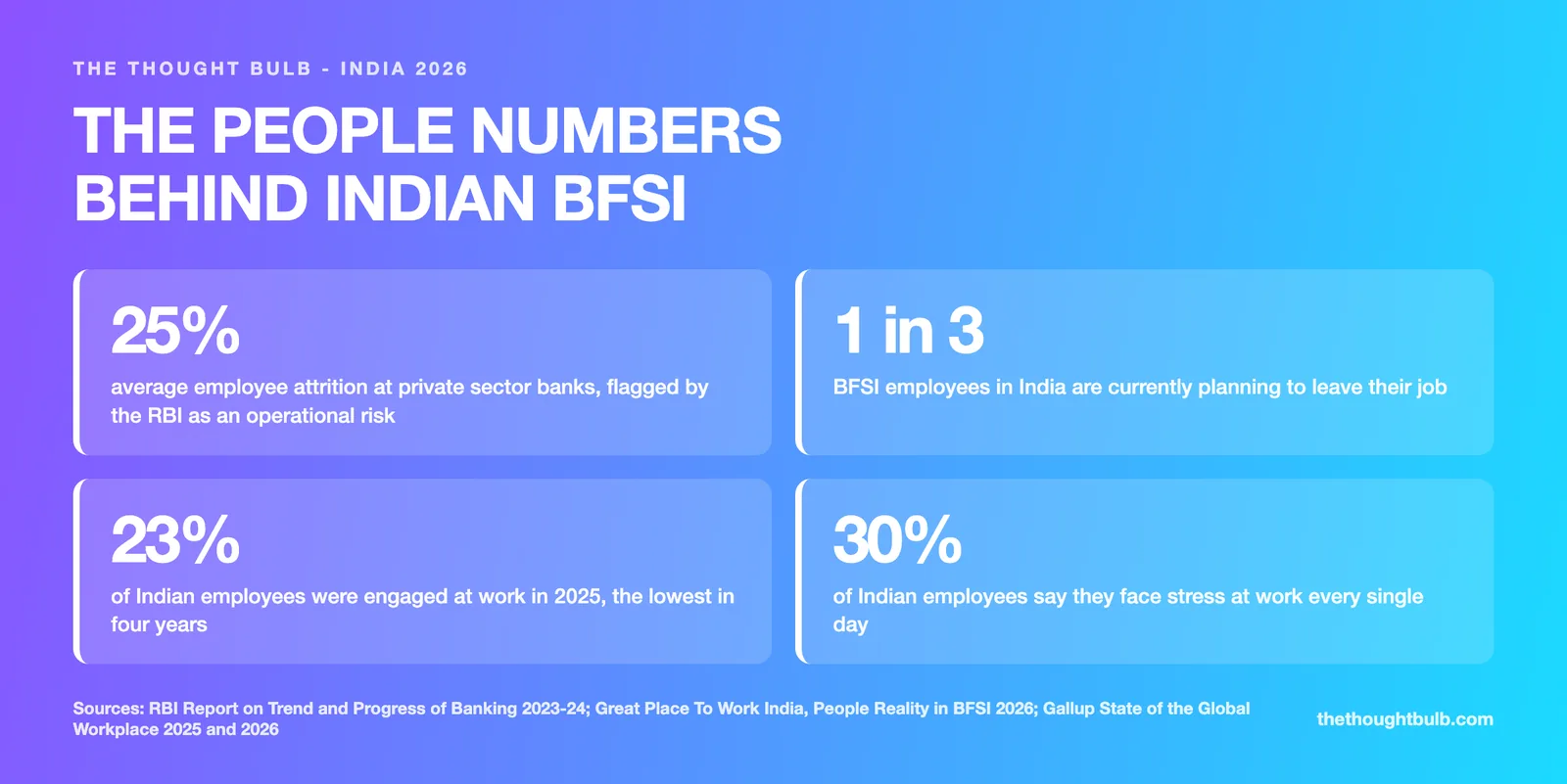
Private sector banks have seen employee attrition rise to an average of around 25 percent, according to the RBI Report on Trend and Progress of Banking in India 2023-24, which flagged it as an operational risk.
Nearly one in three BFSI employees in India is currently planning to leave their job, according to the Great Place To Work India report People Reality in BFSI (2026).
Only 23 percent of Indian employees were engaged at work in 2025, the lowest figure in four years, down from 30 percent in 2024, according to Gallup's State of the Global Workplace 2026 report.
Manager engagement in India fell from 39 percent to 30 percent over the same period, and Gallup's 2025 report found that 30 percent of Indian employees face stress at work every day.
Read together, these figures tell a clear story. BFSI employees are not disengaged because they dislike finance. They are stretched, under-connected and often led by managers who are themselves running on empty. When one in four people in a private bank leaves every year, the cost shows up in onboarding time, lost customer relationships and compliance gaps created by inexperienced replacements. Team building that strengthens relationships between colleagues and their managers is one of the few levers that addresses all three at once.
Five Principles For Team Building In Banks And Financial Services
1. Respect the calendar
Avoid month-end, quarter-end and audit weeks. Two to three hour formats in the first or second week of a month land far better than a full day squeezed in before a close.
2. Mirror the work, do not lecture about it
Finance professionals respond to simulations that echo real decisions: allocating capital, managing risk, negotiating under uncertainty. A well-designed challenge creates the same pressure safely, and the debrief connects it back to how the team works on Monday.
3. Mix functions on purpose
Build teams that deliberately combine relationship managers with credit analysts, operations with technology, and branch staff with regional leads. The real value is in the conversations that would never happen otherwise.
4. Include the people who are never in the room
Branch and remote teams should not be an afterthought. A strong virtual team building format lets a team in Indore compete alongside colleagues in Mumbai and Bengaluru in the same session.
5. Build managers first
Because manager engagement drives team engagement, start with your branch heads, cluster managers and team leads. Our leadership team building programmes are designed to give managers a shared experience before they are asked to lead one.
Experiences That Work For BFSI Teams
When we design programmes for banks, insurers and fintechs, we favour experiences that combine strategy, numbers and collaboration over pure fun-and-games formats. Two that consistently resonate:
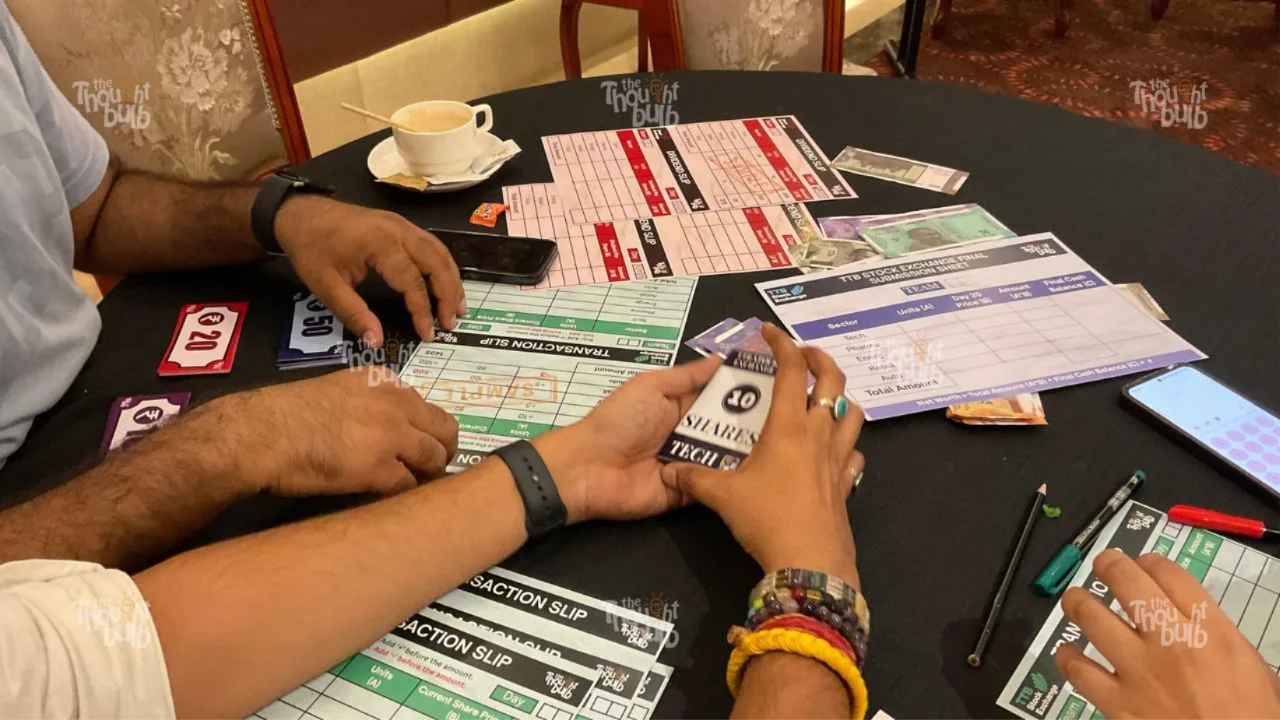
Chanakya Stock Simulation (in-person)
The Chanakya Stock Simulation is a business simulation in which teams trade, analyse market news and make investment calls under time pressure. For finance teams it feels familiar enough to be credible and competitive enough to be energising. The debrief focuses on how teams shared information, who influenced decisions, and how risk appetite differed between functions, which is exactly the conversation many banks need to have.
Mission Moon Lander (virtual)
Mission Moon Lander is a virtual challenge in which teams must make a sequence of high-stakes decisions to land safely, with a live leaderboard driving friendly rivalry. It works well for distributed branch networks and operations centres because everyone can join from their own location, and the debrief centres on trust, open conflict and accountability.
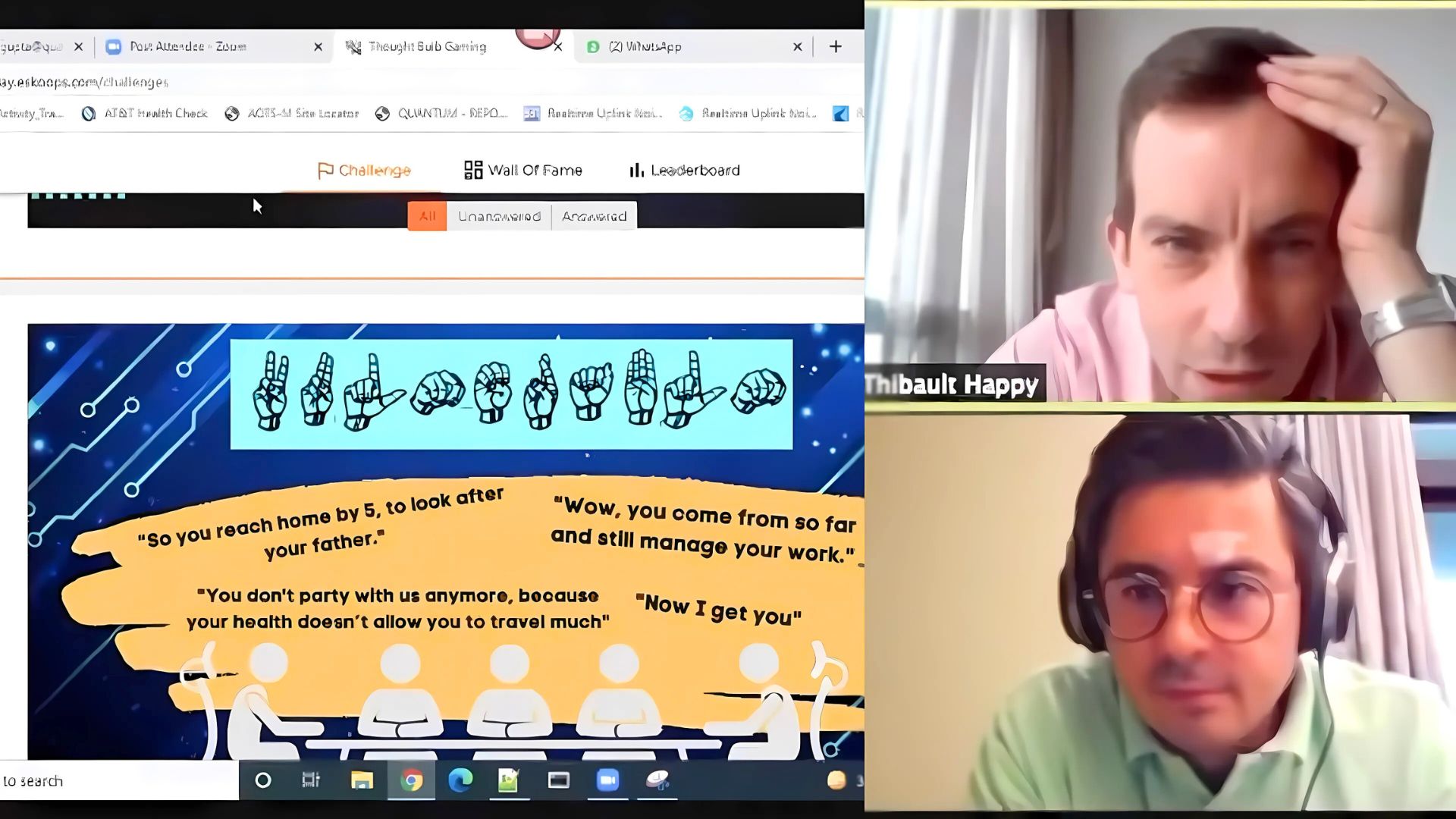
You can browse more formats suited to finance teams, from city races to CSR builds, on our activities page.
Case Study: NPCI Leadership Connect In Mumbai
NPCI, the organisation behind UPI, RuPay, IMPS and FASTag, brought its Mumbai employees together for a Leadership Connect and Collaboration Workshop. The brief was a familiar one for financial services: as teams grow more specialised, people focus on their own responsibilities and lose sight of how every role contributes to the larger mission.
The Thought Bulb designed a three-part programme. Speed Networking connected colleagues who had never had a real conversation. The Tech Terrain Challenge put teams through problem-solving tasks that depended on communication, quick decisions and adapting leadership styles. The session closed with the Radiant Pyramid Challenge, where teams built and aligned sections of a single structure.
The outcome was a shared, lived understanding that leadership is situational and can emerge from any level, and that organisational success depends on every role working toward a common purpose. For a payments organisation where operations, technology and business teams must move in lockstep, that message carried straight back to the desk.
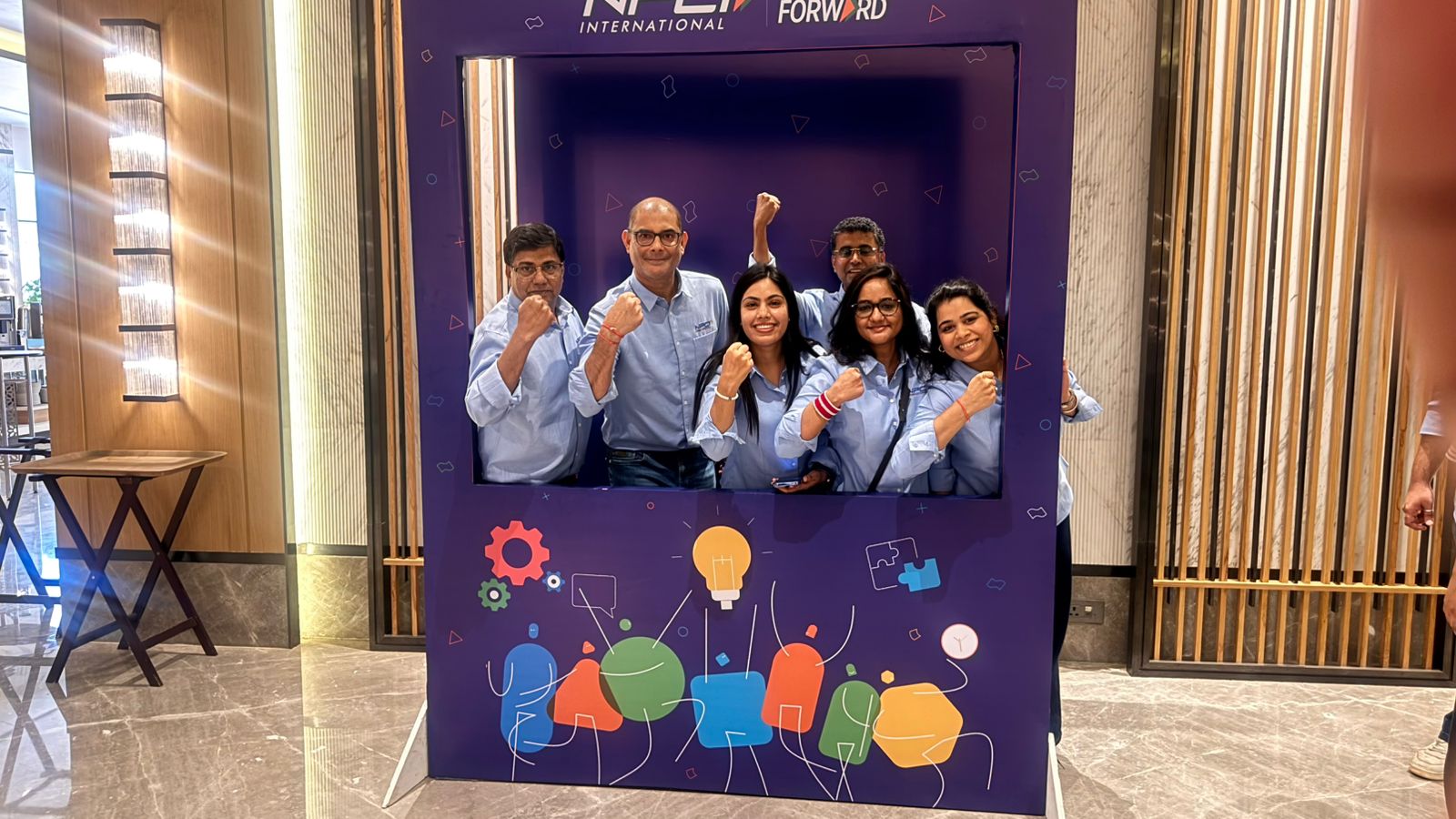
Read more stories from financial services and other sectors in our case studies.
A 90-Day Team Building Plan For BFSI HR Leaders
One event will not fix 25 percent attrition. A short, staged sequence will do far more. Here is the plan we recommend to banks and financial services firms heading into the new financial year:
Day 1-15: Diagnose
Map attrition hotspots by branch, role and manager, then run a short pulse survey of eight to ten questions on connection, workload and manager support. Look for clusters, not averages.
Day 16-45: Equip managers
Run a hands-on experience for branch heads and team leads focused on trust and decision-making. Ask each manager to commit to a simple monthly team ritual, such as a 30-minute recognition huddle.
Day 46-75: Connect functions
Bring sales, operations, risk and technology together in one shared challenge, in person where teams are co-located and virtual for branch networks. Keep mixed teams and a proper debrief.
Day 76-90: Measure and lock in
Re-run the pulse survey, compare 90-day attrition and absenteeism with the baseline, and fix the next quarter's engagement calendar before the year-end rush begins.
Day 1-15: diagnose attrition hotspots and run a pulse survey.
Day 16-45: equip managers with a shared experience and monthly rituals.
Day 46-75: connect functions through mixed-team challenges.
Day 76-90: measure results and lock in next quarter's calendar.
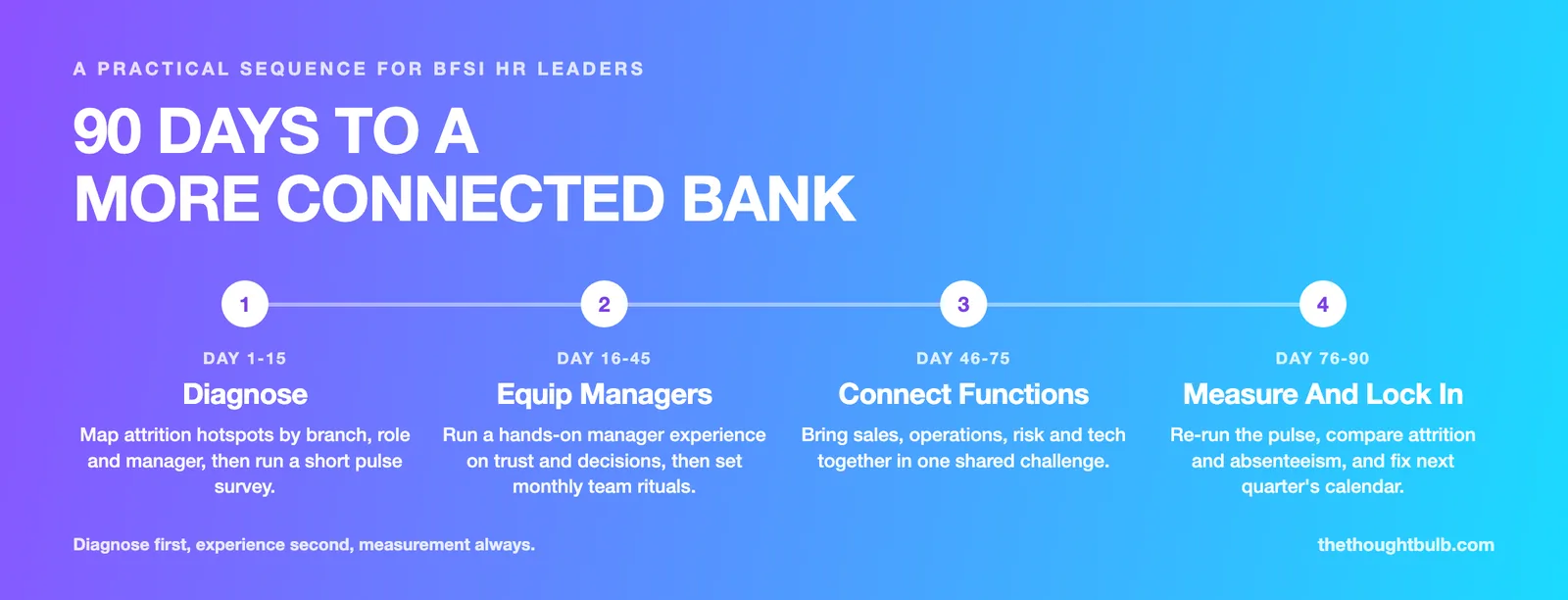
To space these moments sensibly across the year, use our employee engagement calendar as a starting point.
Common Mistakes To Avoid
Scheduling engagement during month-end or audit weeks, which signals that it does not really matter.
Running a senior-leadership offsite and assuming the benefit trickles down to branches.
Choosing activities with no debrief, which turns a learning opportunity into a pleasant afternoon.
Measuring only attendance and feedback scores instead of attrition, absenteeism and pulse movement.
Leaving remote and branch employees out because they are harder to bring together.
Conclusion: Connection Is A Risk Control Too
In BFSI, leaders already think in terms of risk. High attrition, disengaged managers and siloed functions are risks too, and they compound quietly until a key client walks out with a departing relationship manager. Thoughtful team building, timed around the business calendar, rooted in real decisions and backed by measurement, is one of the most practical controls available. If you are planning engagement for your bank, NBFC, insurer or fintech for the coming quarter, The Thought Bulb can help you design a programme that fits your calendar, your locations and your goals.