Somewhere between the third floor lift lobby and the 47-minute crawl down the Outer Ring Road, the return-to-office conversation in India stopped being about policy and started being about worth. Most people have accepted that they will be in the office two or three days a week. What they have not accepted is turning up to a floor where they sit on video calls all day with headphones on, surrounded by colleagues they never speak to. That is a commute spent to reproduce the conditions of home, minus the home.
Attendance policies across India tightened through late 2025 and into 2026, and enforcement got sharper. But attendance is an input, not an outcome. If your people are in the building and still disengaged, you have paid for the real estate and the commute without buying the thing you actually wanted, which is connection. This piece is about closing that gap: what the data says, why mandates alone fail, and a 90-day sequence that turns office days into something people would choose.
What the 2026 numbers actually say
The engagement picture in India got worse in the same period that office attendance got stricter. That correlation is not proof of causation, but it should stop any HR leader who assumes presence solves the problem.
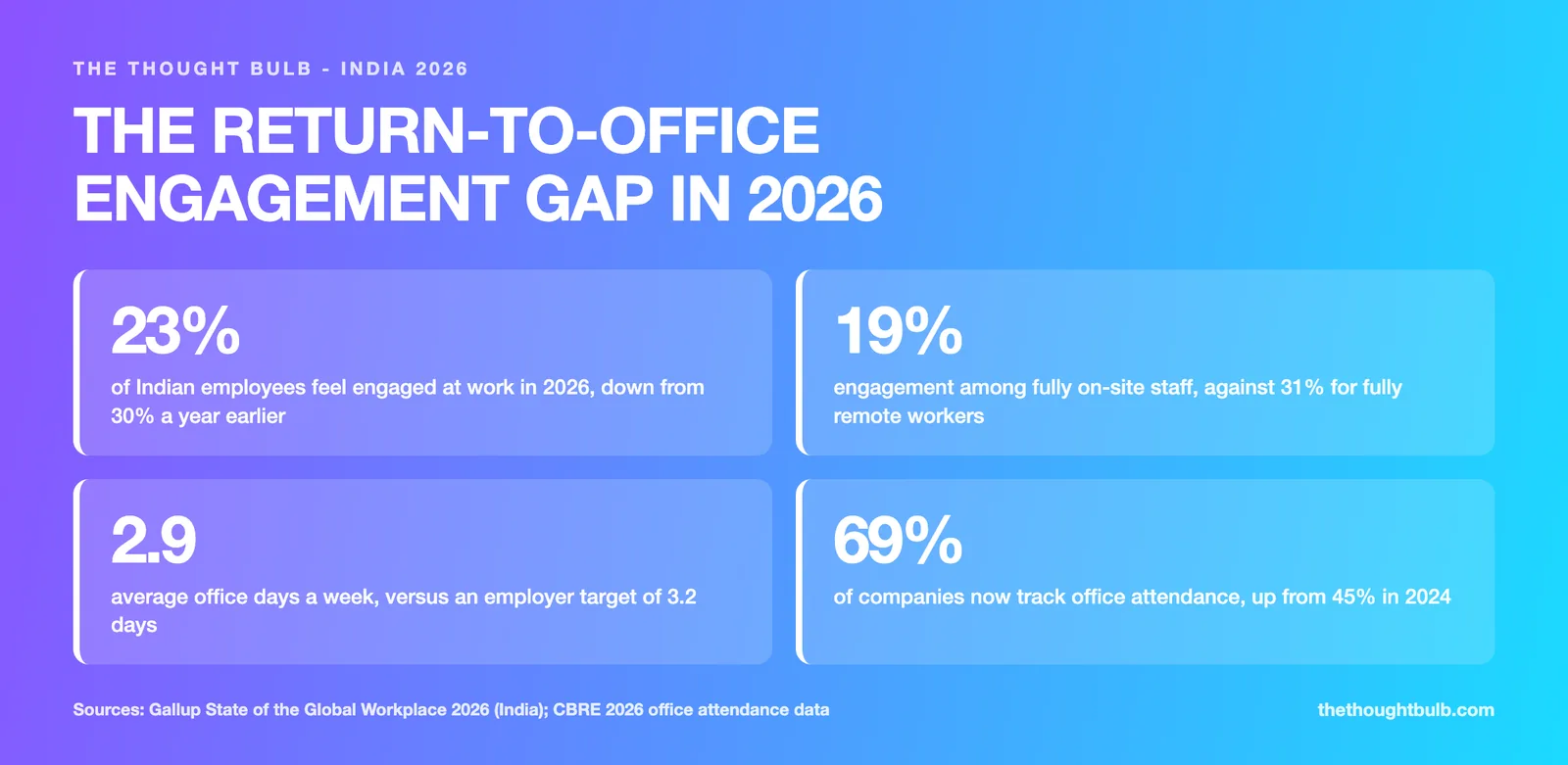
Gallup 2026 puts Indian employee engagement at 23 percent, down from 30 percent the previous year. That is the sharpest single-year drop India has recorded.
The same research finds 31 percent engagement among fully remote workers, 23 percent among hybrid workers, and 19 percent among fully on-site workers.
CBRE 2026 data shows average office attendance running at 2.9 days a week against an employer target of 3.2 days, the closest those two lines have ever been.
Sixty-nine percent of companies now actively measure attendance compliance, up from 45 percent in 2024, and 37 percent take enforcement action, up from 17 percent.
Indian attrition fell to 16.2 percent in 2025 from 17.7 percent in 2024, with roughly 75 percent of it voluntary. A tighter market means fewer people quit over policy. It does not mean they are happy.
Reading the numbers honestly
The lowest engagement scores belong to the people who are physically in the office the most. That finding gets misread constantly. It does not mean offices harm engagement. It means the roles that never had flexibility in the first place, and the organisations that mandate hardest without redesigning what happens on site, are the ones with the weakest connection. A quieter attrition number in 2026 is not a vote of confidence either. It reflects a cautious job market. Disengaged people who cannot leave are a more expensive problem than disengaged people who do, because they stay and set the temperature for everyone around them.
Why blanket mandates fail to rebuild connection
Presence is not the same as contact
A mandate specifies that a person is in a building. It says nothing about who they talk to. In practice, most people who come in sit with the two or three colleagues they already know, eat lunch with the same group, and leave. Cross-functional contact, which is the thing hybrid work genuinely eroded, does not restore itself because a badge was swiped. It has to be designed.
The commute maths is not abstract
In Bengaluru, Mumbai, Gurugram, and Pune, a three-day week can mean six to nine hours of commuting. That is a real cost paid by the employee, and people run the arithmetic whether or not their employer does. When the return on those hours is a day of solo work at a hot desk, the policy reads as a loyalty test rather than a business decision. When the return is a workshop that unblocked a project, a lunch with a team they had only ever seen on a call, or a review that closed three decisions in an hour, the maths works and the resentment disappears.
Enforcement without design invites malicious compliance
The more tightly attendance is tracked, the more creative people become about satisfying the tracker. Coffee-badging, half-day appearances, and Tuesday-Wednesday-Thursday clustering are all rational responses to a metric that measures the wrong thing. Track experience, not just entry.
Anchor days beat blanket mandates
The single highest-return change most Indian companies can make is switching from "three days a week, pick your own" to "two fixed days, the whole team together". Individual choice sounds generous and produces the worst outcome: everyone in the office on different days, so nobody meets anybody. Anchor days concentrate the same number of commutes into moments where the whole team is actually present.
Pick two days per team, not per company. Sales and engineering do not need the same rhythm.
Publish them a quarter ahead so people can plan childcare, travel, and long weekends around them.
Protect them. No all-hands, no company-wide training, no calendar creep that turns an anchor day into a webinar day.
Leave the third day genuinely optional. A choice that people actually have is worth more than a third mandated day they resent.
Give people a reason to be in the room
An anchor day with nothing on it is just a mandate with better branding. Each one needs at least one thing that could only have happened in person. Some of that is work: a design review, a customer visit, a planning session. Some of it needs to be deliberately social, because the informal contact that used to happen by accident now has to be scheduled.
The format that works best on an office floor is short, physical, and mixed across teams. Our Indoor Olympics runs inside a cafeteria or an open floor in ninety minutes, splits people into deliberately cross-functional squads, and gets the finance team competing alongside the product team. No offsite budget, no travel, and it fits into the back half of an anchor day.

Hybrid also means the remote days need their own connective tissue, and the people who are dialling in from Kochi or Indore should not become second-class colleagues. The Comic Strip Virtual Challenge works well here: small breakout groups build a shared comic strip around a real team situation, which surfaces how people actually see the last quarter. It runs in an hour on video and gives distributed teams the same shared reference point their in-office colleagues get for free.

What this looked like at Siemens in Mumbai
Siemens ran our Bridge The Gap challenge in Mumbai with a group drawn from functions that rarely worked side by side. Teams built sections of a bridge independently, working only from a shared specification, and the halves had to meet in the middle at the end. The gaps that showed up in the structure were the same gaps that show up in cross-functional projects: assumptions nobody wrote down, handover points nobody owned. The debrief did more for interdepartmental trust than a quarter of status meetings, and it is one of several examples in our case studies. The point for RTO planning is straightforward: this is the kind of session worth asking people to travel for.

A 90-day plan to make office days worth the commute
This sequence assumes you already have an attendance policy and it is not working as well as you hoped. It does not require changing the policy. It requires changing what happens inside it.
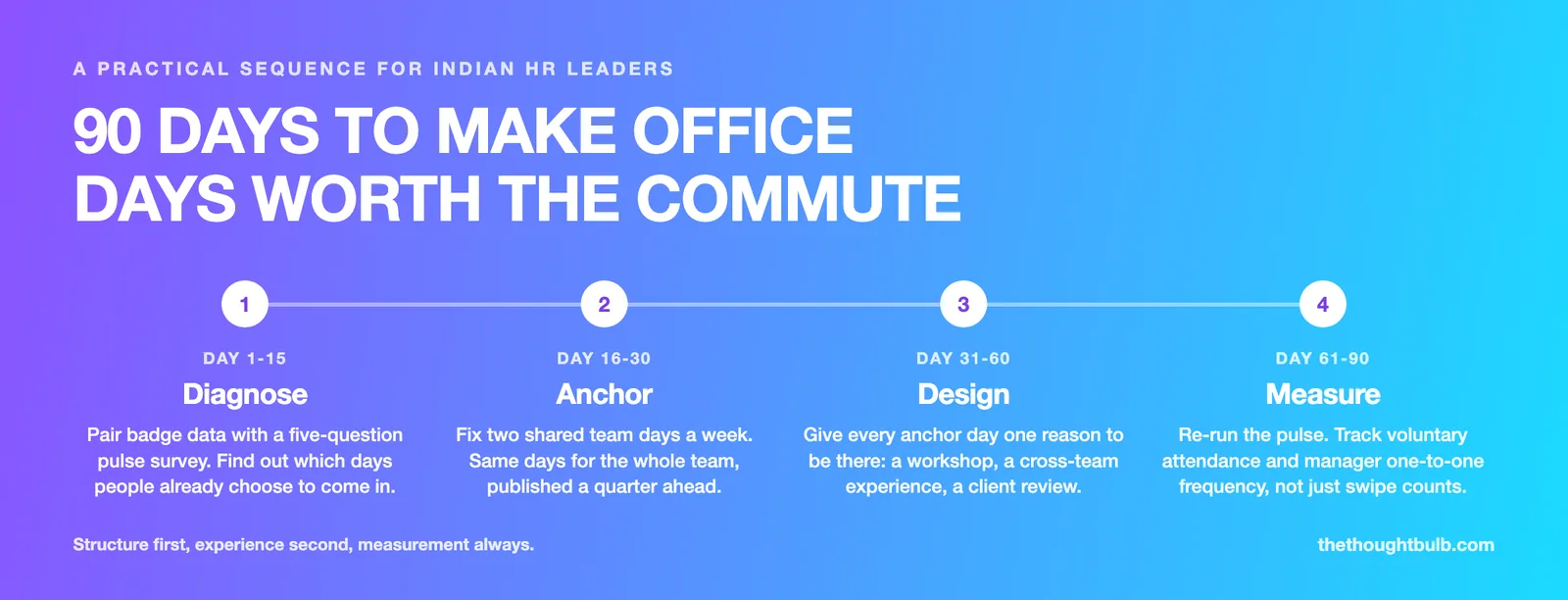
Days 1 to 15, diagnose. Pull badge or access data for the last quarter and pair it with a five-question pulse survey. You are looking for one thing: which days do people already choose to come in, and what do they say makes a day feel worth it.
Days 16 to 30, anchor. Convert to two fixed team days. Announce them a quarter ahead. Get every people manager to commit publicly to being present on both.
Days 31 to 60, design. Give every anchor day one reason to exist. Rotate between working sessions, cross-team experiences, and client or leadership exposure. Budget for one facilitated team experience per team per quarter.
Days 61 to 90, measure. Re-run the pulse. Track voluntary attendance outside anchor days, manager one-to-one frequency, and cross-team collaboration, not just swipe counts.
What to measure instead of attendance
If attendance is your only metric, you will optimise for attendance and get exactly that. Four alternatives are more useful and none of them are hard to collect.
Voluntary attendance rate. What share of office days happen outside mandated ones? This is the single cleanest signal that the office is worth something.
Cross-team contact. Ask people how many colleagues outside their immediate team they had a real conversation with last month. Track the direction of travel.
Manager one-to-one frequency. Gallup consistently finds the manager relationship explains most of the variance in engagement. It is also the first thing to break under hybrid drift.
Intent to stay at twelve months. In a market where 75 percent of attrition is voluntary, stated intent gives you a warning that exit data gives you far too late.
The uncomfortable conclusion
The office is not the problem and it is not the solution. It is a tool that works when it is used for the things distance genuinely degrades: trust between people who need to disagree productively, informal knowledge that never makes it into a document, and the sense of a shared project. Used for solo work under supervision, it is an expensive way to make people feel monitored. India is going to keep tightening attendance policy through 2026 because the market allows it. The organisations that come out ahead will be the ones who spent the same period making sure there was something on the other end of the commute.
If you are planning anchor days for the next two quarters and want them to be worth showing up for, we can help you design the in-person and virtual sessions that go on them. Tell us how your teams are split and we will suggest a rhythm that fits.