Most Indian organisations no longer live in one building. A company might have its leadership in Gurugram, engineers in Bengaluru, operations in Pune, sales in Mumbai and a delivery centre in Hyderabad or Chennai. On paper this footprint is a strength. In practice, it quietly produces the problem HR leaders keep describing to us: teams that share a payroll but not a sense of belonging. Colleagues in different cities meet on video calls, trade documents, and rarely build the trust that makes collaboration easy.
This guide explains why multi-location teams in India are struggling with engagement in 2026, what the research says, and how to build a practical plan that connects your cities without flying everyone to one place every quarter. It is written for HR heads, people partners and L&D leads who need something they can act on this month.
Why Multi-Location Teams Lose Connection Faster
Distance on its own is not the problem. The problem is that every informal mechanism that used to build relationships, such as corridor chats, shared lunches and spontaneous help, disappears when teams are split across cities. What remains is formal communication, which is efficient but thin.
Proximity bias shapes who gets heard
When some members of a team sit together and others dial in, the people in the room tend to dominate. Owl Labs research on hybrid work found that 54 percent of workers are more likely to ask for opinions from colleagues who are physically nearby. For a team spread across Delhi, Pune and Chennai, that means the largest office quietly becomes the centre of decision-making.
Local cultures become silos
Each city office develops its own rhythm, festivals, language mix and manager style. Without deliberate bridges, these local cultures harden into silos, and requests from another city start to feel like interruptions from strangers.
Managers are stretched thin
The people expected to hold these teams together are themselves under pressure. As the data below shows, manager engagement in India has fallen sharply, which makes the usual advice of simply asking managers to do more unrealistic.
What the Data Says About Engagement in India
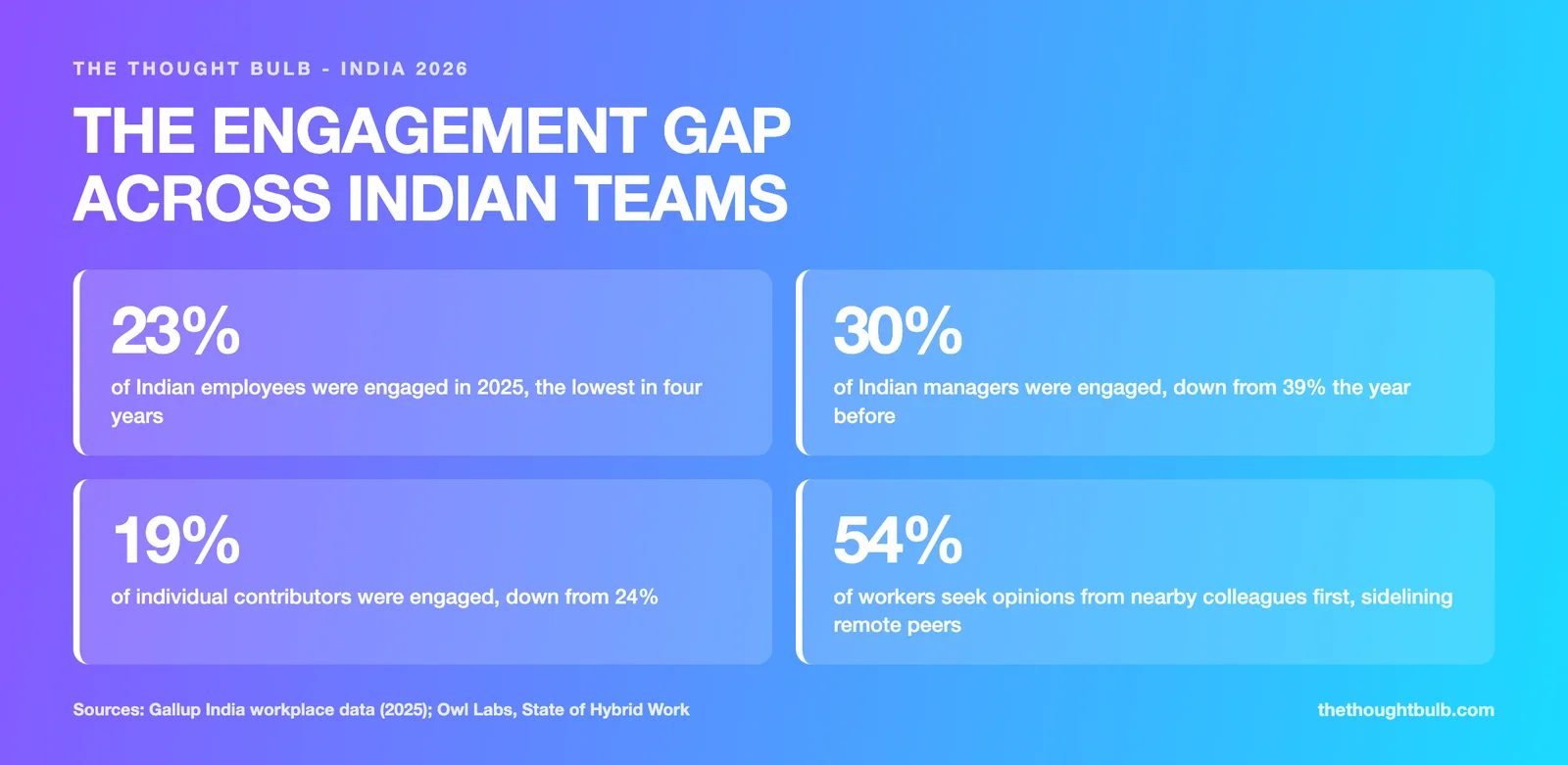
Gallup research on Indian workplaces, reported in 2026, paints a sobering picture. Only 23 percent of Indian employees were engaged in 2025, the lowest level in four years. Manager engagement fell from 39 percent in 2024 to 30 percent in 2025, and engagement among individual contributors dropped from 24 percent to 19 percent. Gallup also estimates that disengagement costs India roughly 351 billion US dollars a year, about 9 percent of GDP.
Read together with the Owl Labs finding on proximity bias, the picture for distributed teams is clear. Engagement is already fragile, and geography adds a second layer of distance on top of it.
23 percent of Indian employees were engaged in 2025, the lowest in four years (Gallup).
Manager engagement fell from 39 percent to 30 percent between 2024 and 2025 (Gallup).
Individual contributor engagement dropped from 24 percent to 19 percent (Gallup).
54 percent of workers are more likely to seek opinions from nearby colleagues, which sidelines remote peers (Owl Labs, State of Hybrid Work).
These numbers matter for planning. If your engagement baseline is already low, a once-a-year town hall will not move it. You need a repeating, structured rhythm of connection across cities.
Five Principles for Engaging Teams Across Cities
1. Design for equity, not just access
Give every city the same quality of experience. If headquarters gets the offsite and the other offices get a recorded message, you have told most of your people where they rank. Rotate hosting cities, share budgets fairly, and make sure remote participants have a clear role in every meeting.
2. Mix people across cities on purpose
Teams that only mix with their own city never build cross-city trust. Put people from different locations into the same project squads, buddy pairs and activity teams so that the first interaction is not a request or a complaint.
3. Use shared experiences, not shared slides
Presentations inform people, but experiences bond them. A challenge that requires a Hyderabad analyst and a Mumbai manager to solve something together creates a memory they will refer back to months later. That shared story is the raw material of trust.
4. Respect local context
Time zones within India are not an issue, but festival calendars, commute patterns and language mix are. Plan sessions around local realities and let each city add its own flavour to a common format.
5. Make it a rhythm, not an event
One big gathering a year cannot hold a distributed team together. A light monthly virtual touchpoint, a quarterly in-person meet for key groups and a regular pulse survey work far better than a single grand event.
If you are building your yearly plan, our employee engagement calendar is a useful starting point for slotting these touchpoints around festivals and business cycles.
Virtual and In-Person Experiences That Connect Cities
The right answer is almost always a mix. Virtual experiences keep the rhythm going cheaply and include everyone at once. In-person experiences deepen the relationships that virtual sessions begin. Here are two formats we use with distributed teams.
Mission Moon Lander: a virtual experience for cross-city decision-making
Mission Moon Lander is a virtual challenge in which mixed teams make key decisions and solve problems together under time pressure. Because participants are placed in teams that cut across cities, the exercise surfaces how people communicate, who steps up, and how trust forms between colleagues who have never met. It also gives managers a rich set of observations to bring back to their regular team conversations.
Relay Radio: an in-person experience that builds reliance between teams
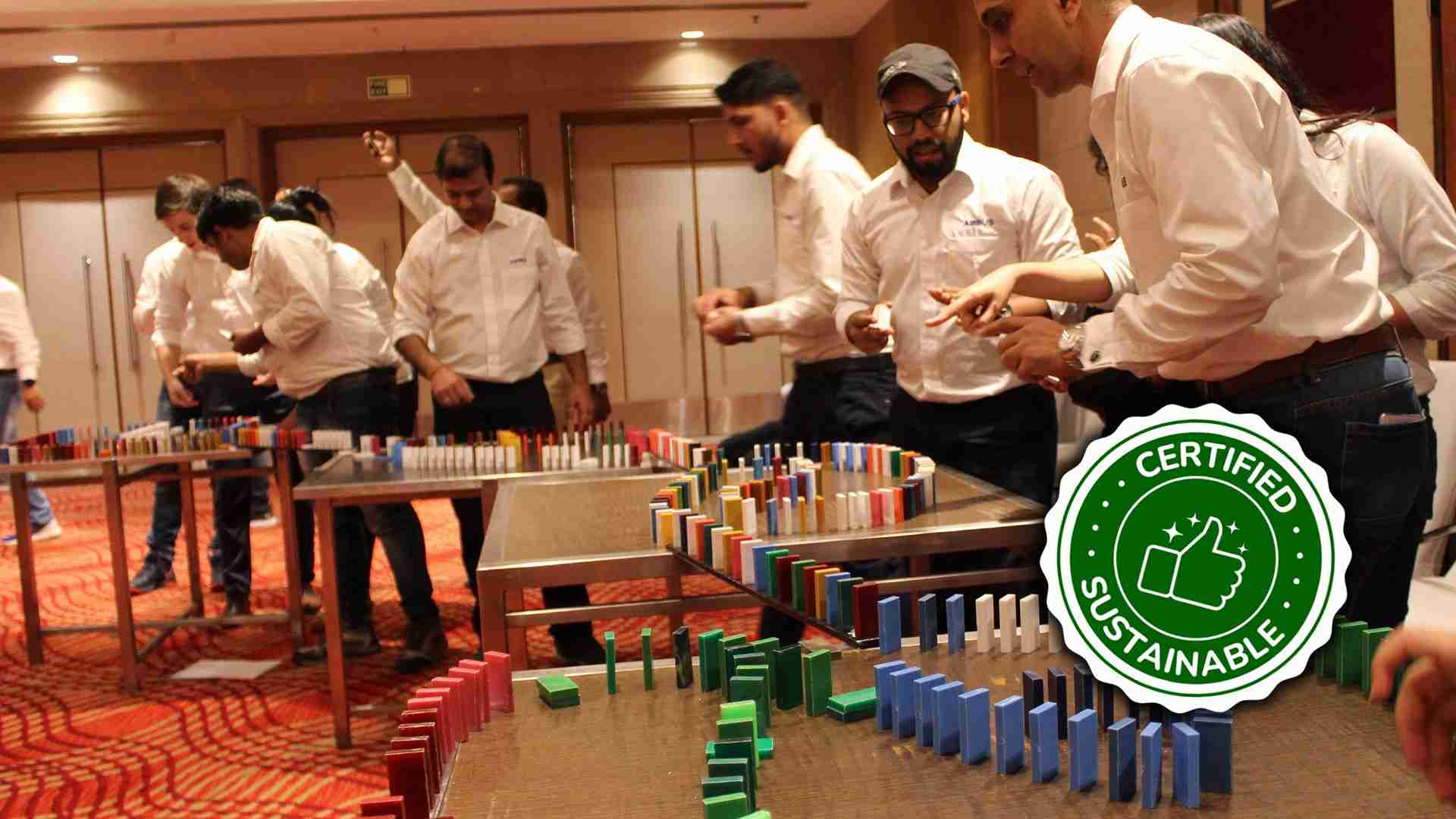
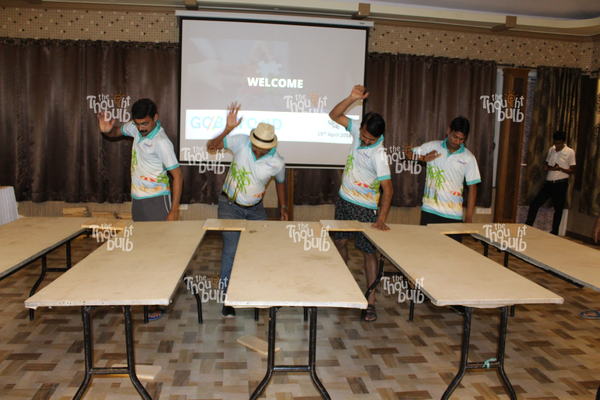
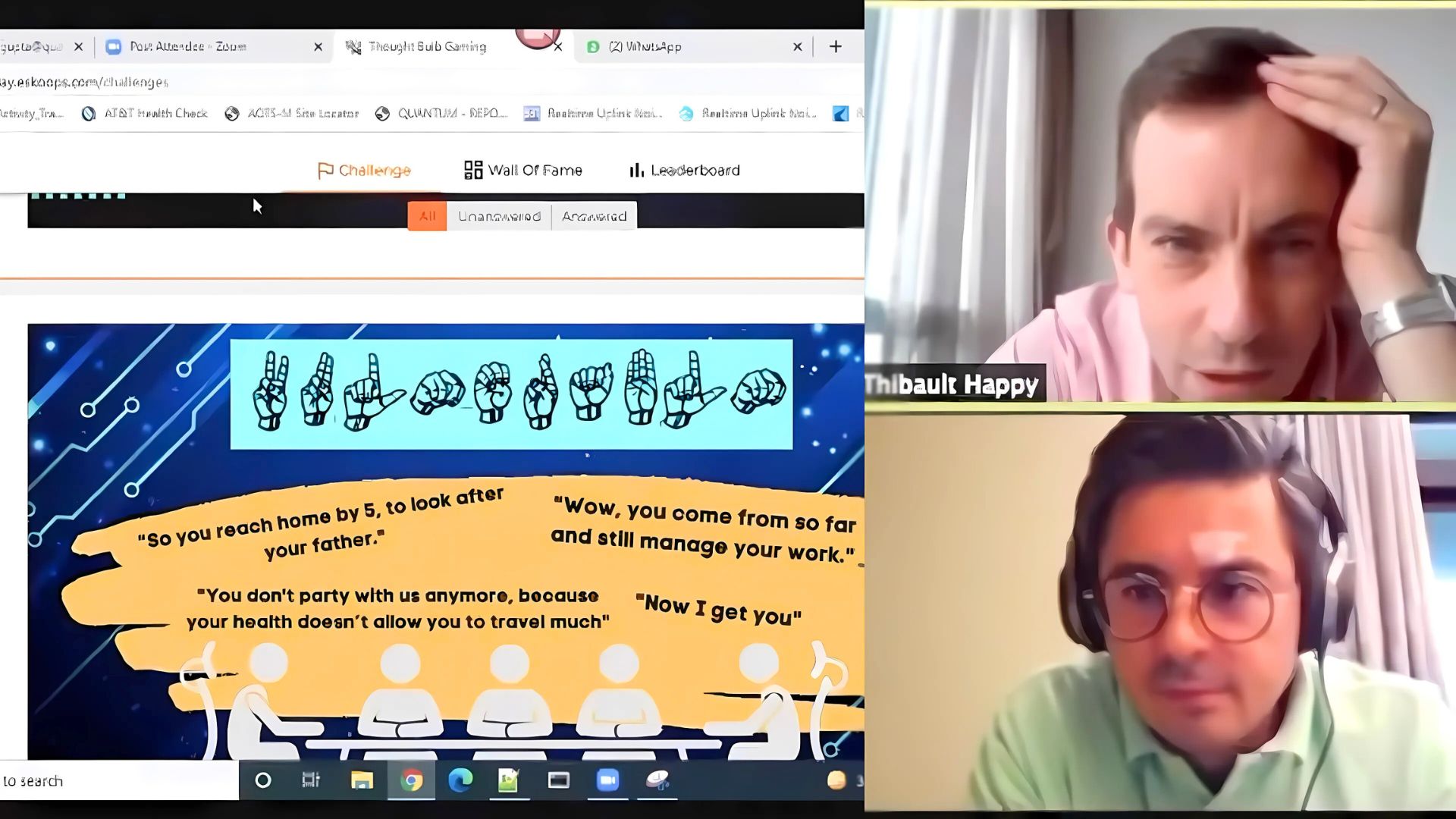
Relay Radio is an in-person experience designed around communication between teams who must rely on one another to succeed. When colleagues from different offices gather for a quarterly meet, an activity like this turns a polite introduction into real collaboration, because success depends on passing clear information and trusting the people on the other end.

You can browse many more formats, filtered by in-person and virtual, on our activities page, and read more about running remote and hybrid sessions in our guide to virtual team building.
A Real Example: Engaging Employees Across Cities at Sun Pharma
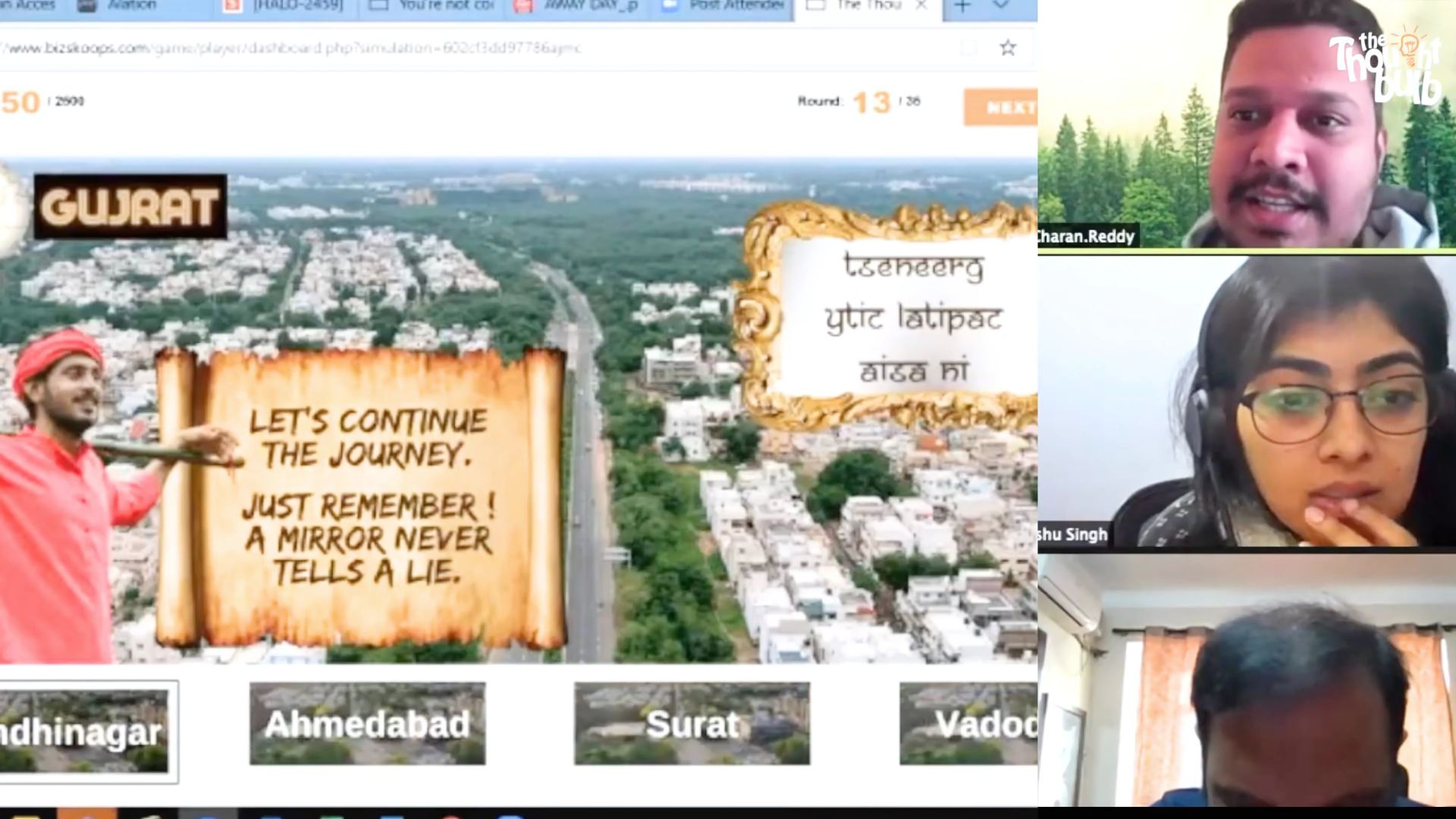
Sun Pharma, a leading pharmaceutical organisation, partnered with The Thought Bulb for a fully custom virtual engagement programme designed to bring together employees from different cities across India. The session brought together 70 participants and was built to strengthen cross-team collaboration and build trust.
The day began with internal discussions, followed by icebreakers to help participants relax and connect. Teams were then mixed across cities and moved through three activities one by one, including Fun Trivia, a Treasure Hunt and Mission Moon Lander. Well-planned breaks and energisers, including a blooper video, kept the atmosphere lively, and the session closed with a winners announcement. Participants rated the programme 9.3 out of 10.
The lesson for HR teams is that the format mattered as much as the content. Mixing teams across cities, pacing the day with breaks, and keeping the tone light gave colleagues who rarely meet a genuine shared experience.

See more examples of how organisations have approached this in our case studies.
A 90-Day Plan to Connect Your Cities
You do not need a large budget to start. You need a sequence. The plan below is designed to be run by a small HR team and adjusted to your size.
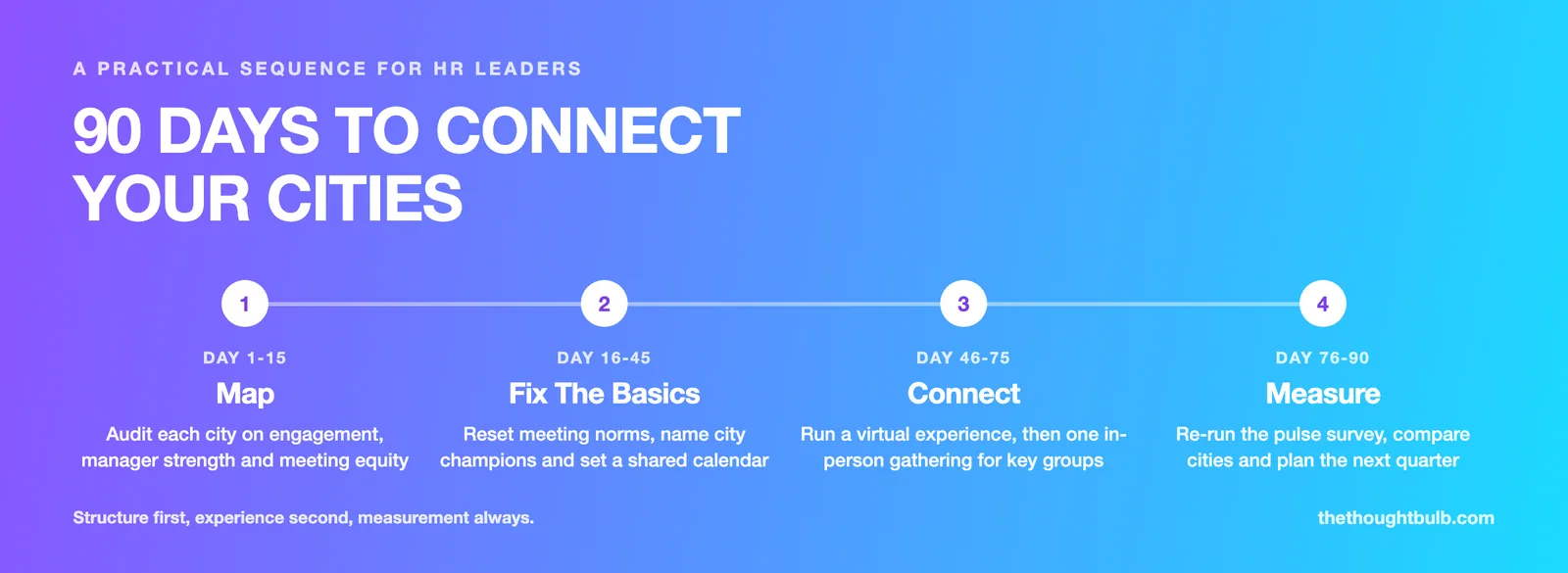
Days 1 to 15: Map
Audit each city on engagement, manager strength and meeting equity. Run a short pulse survey, listen to team leads, and note which locations feel closest to decisions and which feel furthest.
Days 16 to 45: Fix the basics
Reset meeting norms so remote participants speak first, name a city champion in each location, and set up a shared calendar of rituals, festivals and touchpoints.
Days 46 to 75: Connect
Run a virtual experience that mixes people across cities, then plan one in-person gathering for the groups that depend on each other most.
Days 76 to 90: Measure
Re-run the pulse survey, compare results city by city, and decide what to repeat next quarter.
Days 1 to 15, Map: audit each city on engagement, manager strength and meeting equity.
Days 16 to 45, Fix the basics: reset meeting norms, name city champions and set a shared calendar.
Days 46 to 75, Connect: run a virtual experience, then one in-person gathering for key groups.
Days 76 to 90, Measure: re-run the pulse survey, compare cities and plan the next quarter.
Leaders who sit at the centre of these teams carry much of the load, so it also helps to invest in them directly through leadership team building.
Common Mistakes to Avoid
Treating the headquarters city as the default. Rotate locations and hosting responsibilities.
Running one big annual event and calling it a strategy. Build a monthly and quarterly rhythm instead.
Measuring only company-wide averages. Break results down by city so gaps become visible.
Leaving managers to do it alone. Give them a ready format, a budget and a facilitator.
Conclusion
Engaging teams across Indian cities is less about technology and more about intent. With engagement at a four-year low and manager engagement falling, distributed organisations cannot rely on goodwill to hold teams together. A clear rhythm of mixed-team experiences, fair treatment of every location and honest measurement will do more than any single event.
If you would like help designing a programme that fits your cities, headcount and budget, our team is happy to talk it through with no obligation.