Kolb’s Experiential Learning Cycle: A Guide for Leaders

Kolb's Experiential Learning Cycle — Concrete Experience, Reflective Observation, Abstract Conceptualization, Active Experimentation — is the foundation behind every effective team building activity. The Thought Bulb's 150+ programs are all structured around this proven 4-stage model.

Kolb’s Experiential Learning Cycle: A Guide for Leaders

I went back to Kolb's learning cycle recently after running a session that didn't land the way I expected. The debrief helped me see exactly where the cycle had broken down — and why. That's the thing about this model: it's not just a design tool, it's a diagnostic one. Here's how to use it as both.

Nitin Sharma, Leadership Facilitator · The Thought Bulb

Struggling to lead your team effectively despite years of experience? You're not alone.

Thousands of managers face this every day — juggling team dynamics, tight deadlines, and shifting expectations, all while trying to grow into better leaders. That’s where the Kolb’s Experiential Learning Cycle comes in — a powerful, real-world framework for managers who want to improve leadership skills and create high-performing teams. Let’s break down how Kolb’s model works and how you, as a manager, can use it to build habits that drive growth, reflection, and results — starting today.


What Is Kolb’s Experiential Learning Cycle?
Kolb’s Experiential Learning Cycle

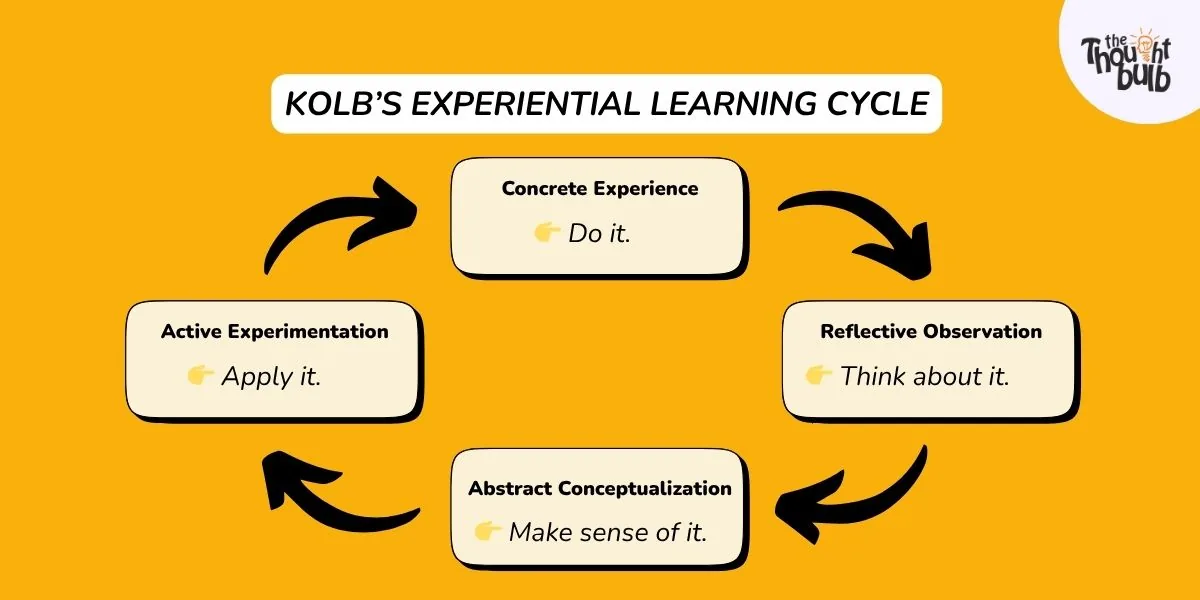
Kolb’s model explains how adults learn best — not by theory, but through doing, reflecting, understanding, and reapplying.

The 4 stages of Kolb’s Learning Cycle:

  • Concrete Experience – You face a situation.

  • Reflective Observation – You step back and ask, “What happened?”

  • Abstract Conceptualization – You draw insights and lessons.

  • Active Experimentation – You try something different based on what you learned.

Now, let’s apply it to a real-life manager situation — something you’ll likely relate to.


Real-Life Manager Example: The Missed Deadline

Situation: Priya is a team lead in operations. She assigned a high-priority client deliverable to her team. Instructions were vague, meetings were skipped due to her packed schedule, and when the deadline arrived — the output was off-mark.

Her first reaction? “Why didn’t anyone clarify?”

But what if she used Kolb’s learning model to grow through the moment?

1. Concrete Experience: It Happened

The team missed the mark. The client was disappointed. Tension followed. Instead of jumping into blame or rework, Priya decides to pause.

2. Reflective Observation: Think It Through

She reflects:

  • Did I set expectations clearly?

  • Was my brief confusing?

  • Did I create space for questions?

She realises: she was available but not accessible. She created a gap — unintentionally.

3. Abstract Conceptualization: Connect the Dots

Priya makes a new connection: “When I’m busy, I reduce communication. But that’s when my team needs more clarity, not less.” She’s not just reacting. She’s learning.

4. Active Experimentation: Try It Differently

Next assignment, she:

  • Schedules a kickoff meeting to clarify roles.

  • Sets up a midway check-in.

  • Asks, “What’s unclear?” instead of “All good?”

The difference? The work is aligned. The team is more confident. The delivery? On time and on point.


Why Managers Should Use Kolb’s Cycle to Improve Leadership Skills?

Every week, you experience:

  • Tough conversations

  • Missed goals

  • Breakthroughs

  • Silent disengagement

These aren’t just work moments. They’re learning moments — if you slow down long enough to reflect.

Managers who learn from their actions lead better. Kolb’s cycle gives you the system to make that happen.


Kolb’s Learning Cycle in Experiential Learning Workshops

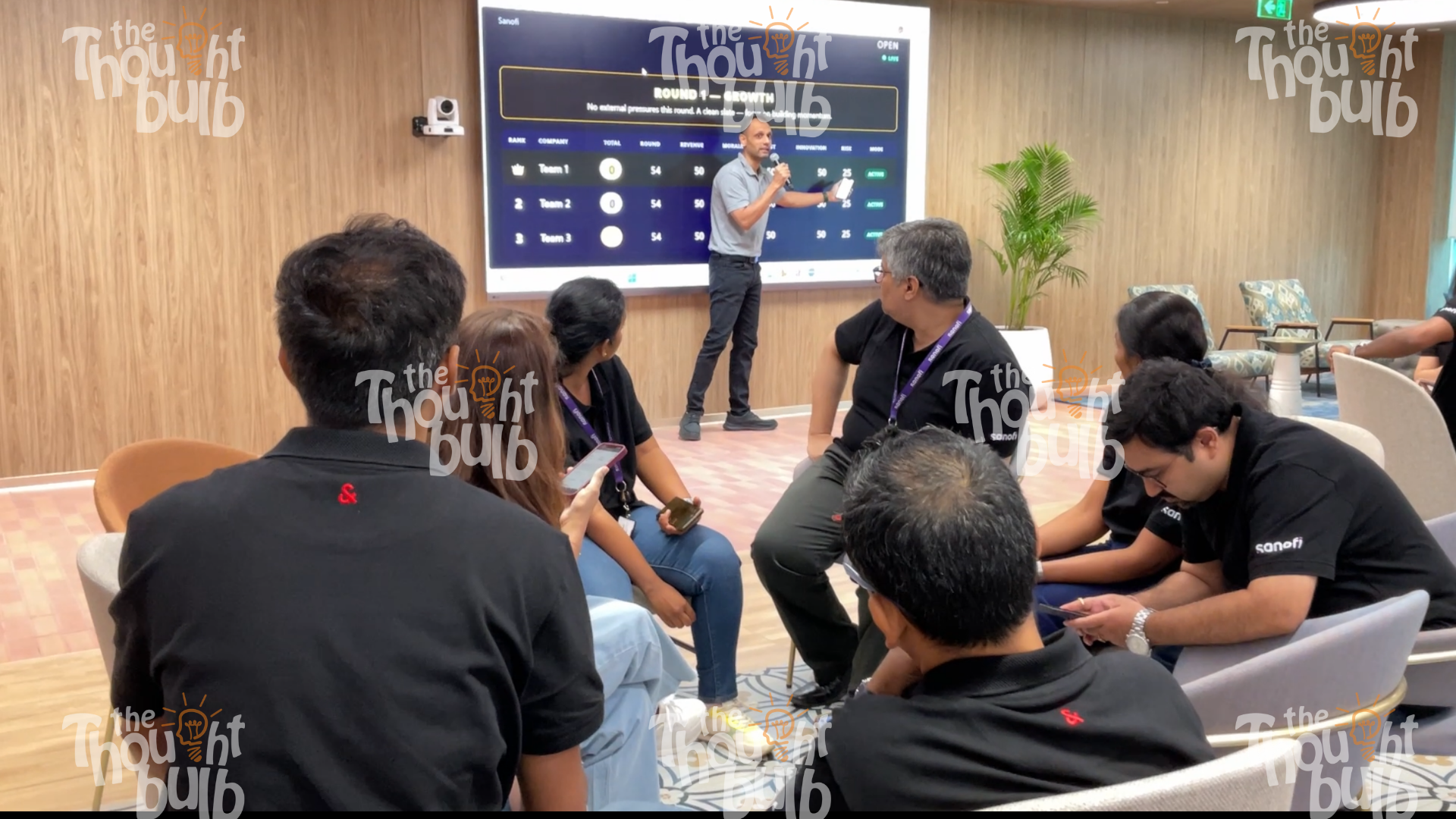
At The Thought Bulb, we design manager programs where Kolb’s model meets real-world team simulations.

Whether it’s navigating a challenge like:

Managers move through all 4 Kolb stages:

1. Experience it in action

2. Reflect with their team

3. Identify real workplace parallels

4. And plan new approaches

They leave with tools, not just takeaways.


Quick Takeaways for Managers:
Quick Takeaways for Managers
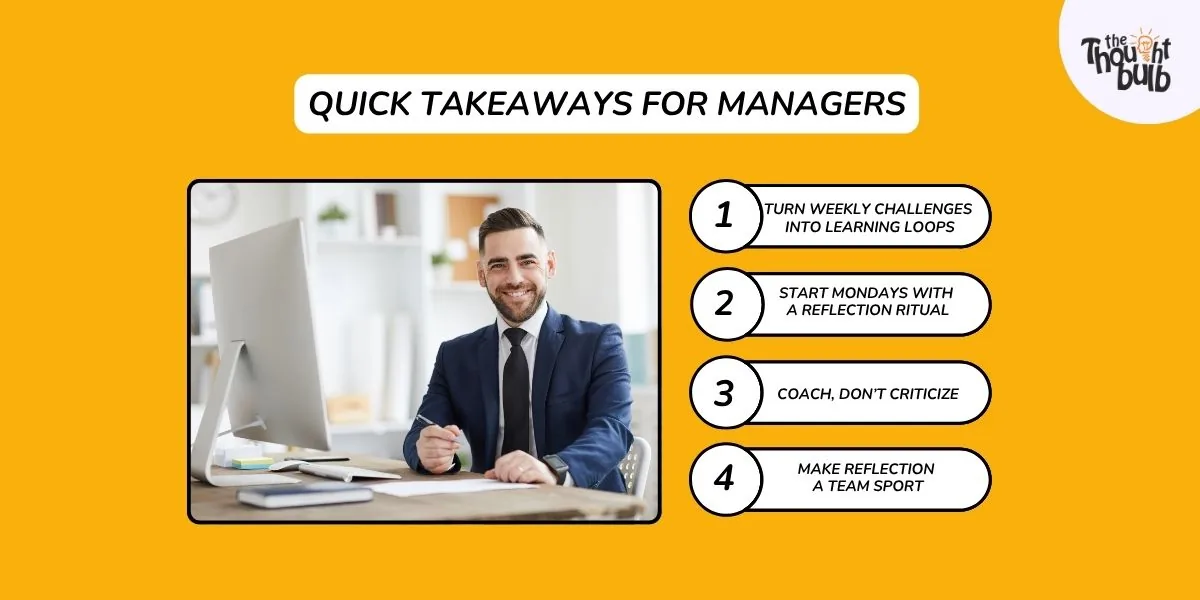
  • Turn Weekly Challenges into Learning Loops Frame tasks as opportunities to apply, reflect, and improve—just like Kolb’s cycle.

  • Start Mondays with a Reflection Ritual Ask your team (and yourself): “What did we learn last week?” Make learning a habit.

  • Coach, Don’t Criticize Address performance gaps with curiosity and feedback, not fault-finding. Support growth, not fear.

  • Make Reflection a Team Sport Encourage your team to use the same experiential cycle—experience, reflect, learn, apply.


Final Thoughts:

Leadership isn’t about getting it right the first time. It’s about learning fast, reflecting deeper, and showing up better.

If you want to stop repeating the same mistakes and start growing as a manager, Kolb’s Experiential Learning Cycle is your new best friend.


Ready to Build Better Managers in Your Company?

Let’s design a custom experiential leadership program using Kolb’s model and real-time feedback loops.

Help your leaders reflect better, lead smarter, and grow faster.

Contact The Thought Bulb today to bring experiential learning to life.
Topics

#Communication#Leadership#Productivity#Team Building

Share this article

Frequently Asked Questions

What is Kolb's Experiential Learning Cycle and why do leaders need to understand it?+

Kolb's cycle has 4 stages: Concrete Experience (doing), Reflective Observation (reviewing), Abstract Conceptualization (concluding), Active Experimentation (planning). Leaders who understand this cycle design better learning experiences and help teams extract maximum value from both successes and failures. The Thought Bulb applies this cycle in all leadership programs across India.

How does Kolb's model explain why some team building programs work and others don't?+

Programs that only provide Concrete Experience (activity) without Reflective Observation (debrief) and Abstract Conceptualization (insight) fail to create lasting change. The Thought Bulb dedicates 35-40% of program time to debrief and reflection — the stages most programs skip — ensuring Kolb's full cycle is completed for every Indian corporate team.

Which of Kolb's 4 learning stages is most neglected in Indian corporate training?+

Abstract Conceptualization is most neglected in Indian corporate training — the stage where participants extract generalizable principles from their experience. Without this stage, learning stays situational and doesn't transfer to the workplace. The Thought Bulb's facilitators are specifically trained to guide teams through this conceptualization stage.

How can Indian managers apply Kolb's learning cycle in their day-to-day leadership?+

Apply Kolb's cycle in daily leadership by: creating learning experiences (stretch assignments), building in structured reflection time (weekly team retrospectives), facilitating insight extraction (asking 'what does this tell us?'), and planning behavior experiments (30-day micro-commitments). The Thought Bulb teaches this cycle to Indian managers in leadership programs.

When should Indian companies use Kolb's Experiential Learning model to design team programs?+

Apply Kolb's model when designing: onboarding programs, leadership development workshops, team building offsites, and any learning intervention requiring behavioral change (not just knowledge transfer). The Thought Bulb uses Kolb's framework as the foundation for all 150+ team building activities designed for Indian corporate teams across 12 cities.

You might also like

Building Psychological Safety in Indian Teams: A 2026 Playbook
Employee Engagement

Building Psychological Safety in Indian Teams: A 2026 Playbook

9 Jun 2026 · 8 min
How to Measure the ROI of Team Building in India (2026 Guide)
Team Building

How to Measure the ROI of Team Building in India (2026 Guide)

4 Jun 2026 · 8 min
India Employee Engagement & Attrition in 2026: What HR Leaders Need to Know
Employee Engagement

India Employee Engagement & Attrition in 2026: What HR Leaders Need to Know

27 May 2026 · 9 min

Activities to try with your team

View all 150+ activities →
Ripple Effect
indoor

Ripple Effect

Ripple Effect is an immersive business simulation where teams navigate 10 quarters of real-world business challenges — making strategic decisions under pressure, managing cross-functional departments, and seeing exactly how every choice ripples across the organisation.

Explore activity →
Cricket Auction Simulation
indoor

Cricket Auction Simulation

Cricket Auction Simulation puts your team in the role of IPL-style franchise owners competing in a live player auction. Teams strategise, bid, and build their dream squad under budget pressure — blending the excitement of cricket with real-world collaboration, negotiation, and smart decision-making.

Explore activity →
Storytelling Workshop - Once Upon A Time
virtual

Storytelling Workshop - Once Upon A Time

Engage in a riveting storytelling session to learn and have fun while inculcating leadership and life skills messages in adults and children alike.

Explore activity →

Looking for team building activities?

Browse our full catalogue of in-person, virtual and CSR experiences across India.

Explore Activities →