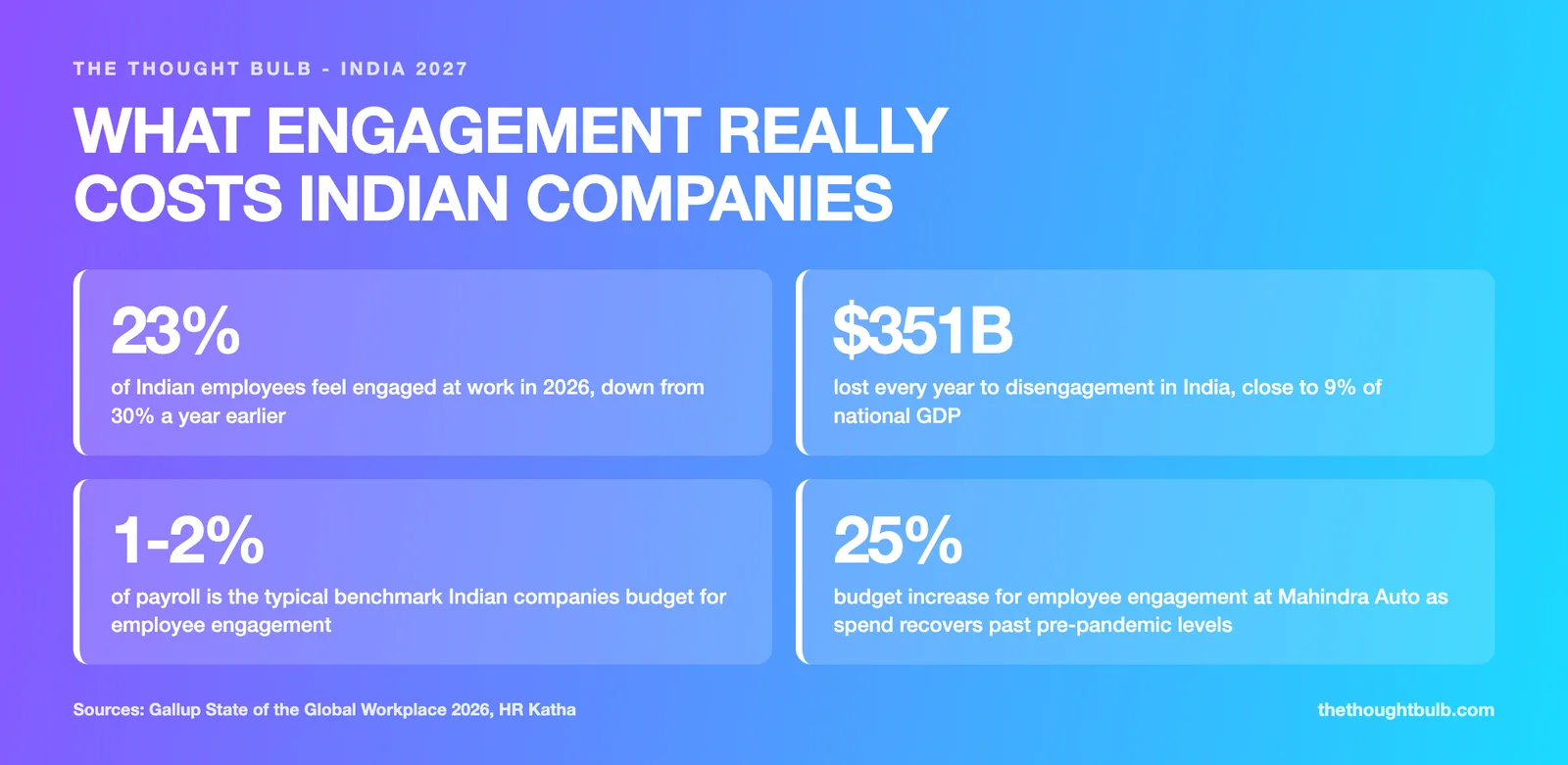
Every October, HR teams across India start defending next year's people budget, and employee engagement is usually the first line item someone tries to trim. That instinct got harder to justify after 2026. Gallup's State of the Global Workplace found that only 23% of Indian employees feel engaged at work, down from 30% a year earlier, and put the cost of that disengagement at roughly $351 billion a year, close to 9% of the country's GDP. If you are building your 2027 people plan right now, the real question isn't whether to fund engagement. It's how to build a budget precise enough that leadership signs off on it without a fight.
Why Your 2027 Engagement Budget Needs A Different Approach
HR budgets in 2027 are being squeezed from both directions. Companies need more HR technology and stronger compliance processes, but funding for those needs isn't growing at the same pace as demand for them. Every rupee spent on employee experience now competes harder against payroll systems, background verification tools, and statutory compliance software. Engagement can't be the department that asks for money once a year around Diwali and hopes nobody asks what it delivered. It needs a number, a method, and a story that survives a finance review.
The cost of getting it wrong
Skip the budgeting exercise and the fallback is reactive spending: a last-minute offsite before appraisals, a hurried festival party, a wellness webinar nobody signed up for. None of that moves engagement scores, and last-minute bookings are consistently more expensive per employee than programmes planned a quarter in advance, simply because vendors and venues charge a premium for short notice.
What Indian Companies Are Actually Spending Right Now
Salaries and wages still eat 70-80% of the average HR budget in India. What's left is split across hiring, benefits, learning and development, and engagement, roughly in that order of priority. The most commonly used benchmark, and the one most engagement leads reference when building a business case, is that a company should spend between 1% and 2% of its payroll on employee engagement. That's a wide enough range that a lot depends on company size, how spread out your offices are, and how much of the workforce is remote or hybrid.
The direction of travel matters more than the exact percentage. Engagement spend is now at or above pre-pandemic levels at most large Indian employers, reversing the cuts made during 2020-2021. At Mahindra Auto, the employee engagement budget grew by 25% as the company rebuilt its calendar of in-person and virtual programmes. That's the pattern worth building your own 2027 number around: a base allocation that survives budget cuts, plus room to grow once HR can prove the programme is working.
Always-on recognition and rewards, usually the largest single line inside the engagement budget
Festival and seasonal moments (Diwali, New Year, regional festivals), often a large share of the annual spend concentrated in Q3 and Q4
Structured team experiences and offsites, both in-person and virtual
CSR-linked team activities, increasingly budgeted alongside engagement rather than as a separate CSR-only line
Wellness and mental health programmes, one of the fastest-growing categories in recent HR budgets
A Practical Framework For Building Your 2027 Budget
Start with a per-employee baseline
Multiply your average annual payroll cost per employee by 1-1.5% as a starting baseline, then adjust upward for distributed teams (virtual programmes plus occasional in-person gatherings cost more per head than a single-office team) and downward if your organisation already spends heavily on benefits that double as engagement, like subsidised meals or transport. Present the number as a range to leadership rather than a single figure. A range signals you've thought about scenarios; a single number just invites a straight cut.
Separate always-on spend from one-off moments
Two different budgets solve two different problems. Always-on spend, such as recognition platforms, work-anniversary moments, and monthly team rituals, should be predictable and protected, since it's what keeps baseline engagement from sliding between big events. One-off spend, such as an annual offsite, a CSR day, or a festival celebration, is where you have room to experiment with new formats and measure what actually moves the needle. Budgeting them separately means a cut to one doesn't silently kill the other.
Build in a dedicated virtual allocation
If any part of your workforce is remote, hybrid, or spread across smaller offices, carve out a specific virtual engagement line rather than assuming in-person budget will stretch to cover everyone. Distributed employees who get left out of the annual offsite disengage faster than co-located ones, and a well-run virtual session costs a fraction of flying people in for a single day.
Choosing Experiences That Justify The Spend
Where the budget actually goes matters as much as how much of it there is. Classroom-style training modules are easy to approve because they look safe on a line item, but they rarely move engagement scores the way a shared experience does. For 2027, weight your calendar toward formats employees actually talk about afterward, and mix in-person with virtual so distributed teams aren't an afterthought.
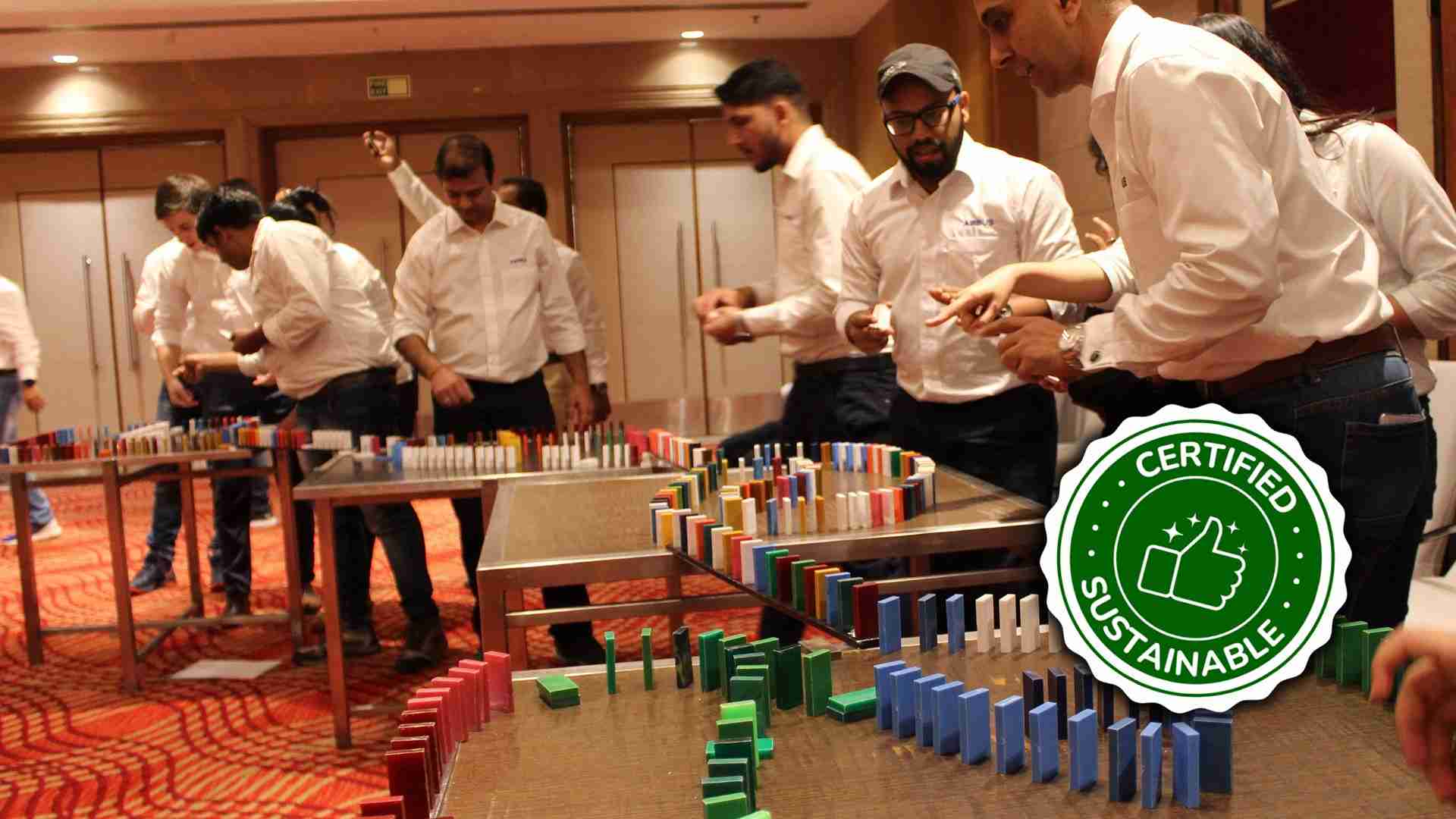
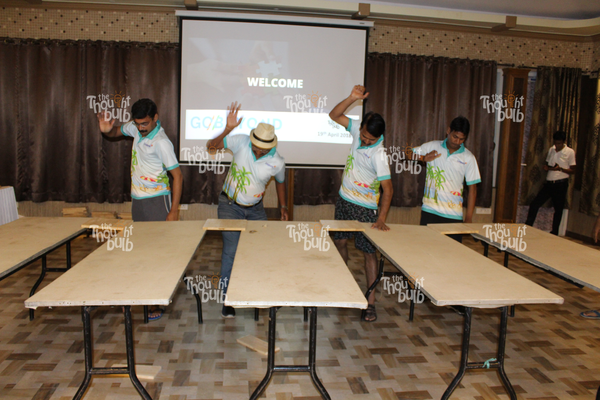
For in-office and hybrid teams, budget-friendly formats like Minute To Win It scale to large groups at a low cost per head and still produce the kind of energy that shows up in the next engagement survey. You can browse the full library of in-person and virtual activities to match formats to your headcount and city spread.

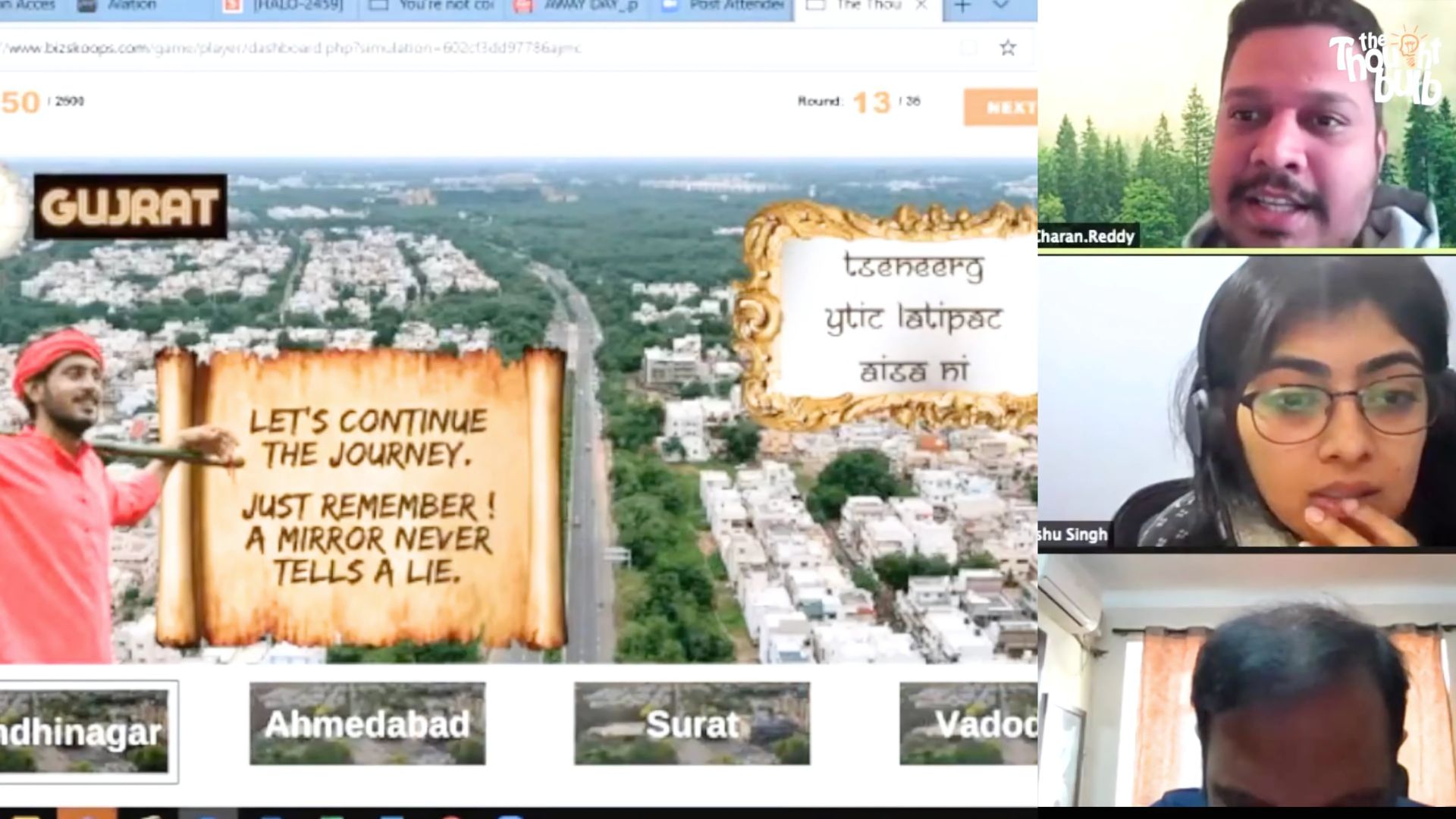
For remote and hybrid teams, virtual formats deserve their own line item rather than an afterthought. The Team Happiness Challenge is built specifically for distributed teams who need a shared moment on the calendar without flight and venue costs. It sits inside a wider set of virtual team building programmes designed to keep remote-first employees from falling out of the engagement calendar entirely.
Turning Spend Into A Story Finance Will Approve
Budget approval gets easier when you can point to a documented result instead of a promise. Infosys ran a structured team building programme aimed squarely at driving measurable business outcomes rather than a one-off morale boost, pairing the experience with clear objectives tied to how teams collaborated afterward. That kind of framing, spend mapped to a business outcome rather than a feel-good event, is what turns an engagement budget request into something finance can underwrite. You can read this and other outcomes in our case studies.
What The Data Says About 2027 Budgets
Put the numbers side by side and the case for a planned budget writes itself. Engagement in India has fallen to 23%, disengagement is costing the economy hundreds of billions of dollars a year, and the accepted spending benchmark is still only 1-2% of payroll. That gap between the scale of the problem and the size of the typical budget line is exactly why HR needs a documented framework rather than an annual guess. The figures below are worth pulling into your own budget deck.
A 90-Day Roadmap To Lock In Your 2027 Budget
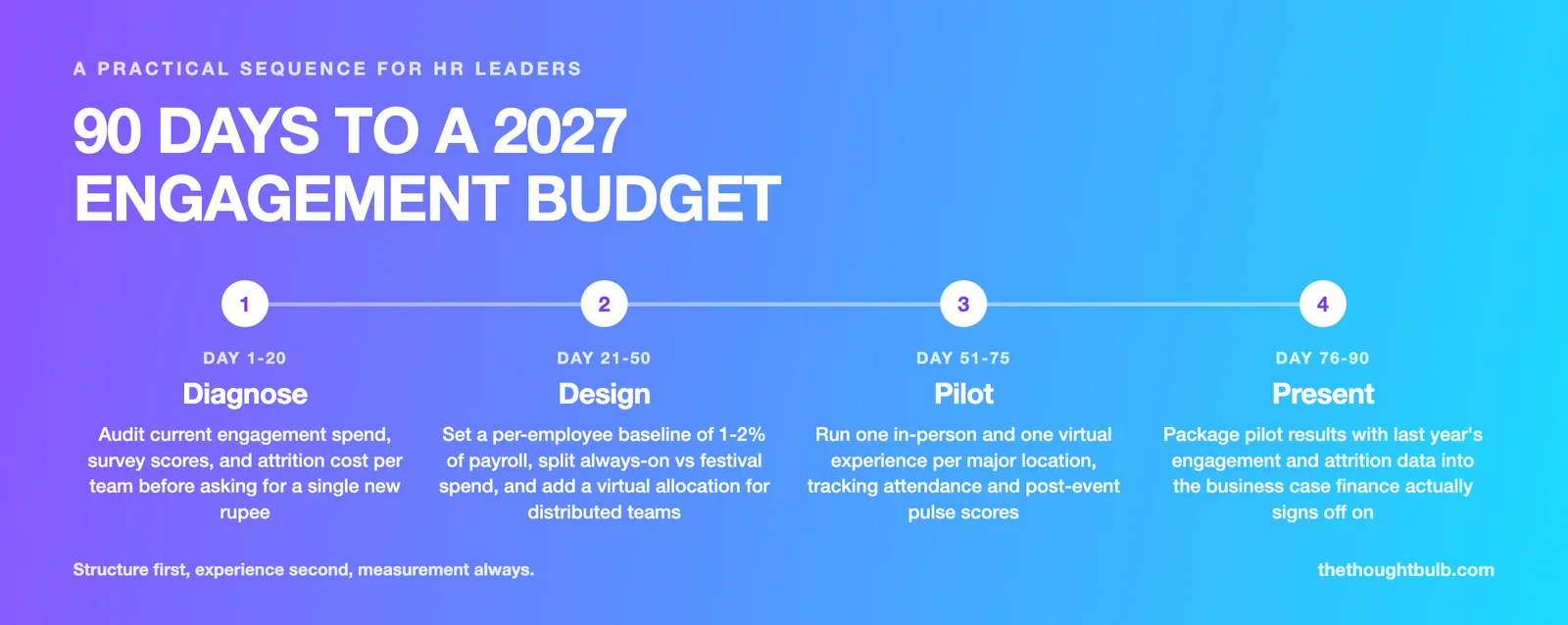
Budget conversations move faster when HR shows up with a sequence rather than a single ask. This 90-day plan is built to run alongside a typical October-to-December Indian budgeting cycle, ending with a business case rather than a guess.
Days 1-20, Diagnose: audit current engagement spend, pull last year's survey scores, and estimate attrition cost per team before asking for a single new rupee
Days 21-50, Design: set a per-employee baseline of 1-2% of payroll, split always-on spend from festival and one-off spend, and add a dedicated virtual allocation for distributed teams
Days 51-75, Pilot: run one in-person and one virtual experience per major location, tracking attendance and a short post-event pulse score
Days 76-90, Present: package the pilot results together with last year's engagement and attrition data into the business case finance actually signs off on
Budgeting Mistakes That Sink Engagement Programmes
Treating engagement as a single line item instead of splitting always-on and one-off spend, so one budget cut kills the entire programme
Letting festival spend such as Diwali and New Year eat a disproportionate share of the annual budget, leaving little for the rest of the year
Skipping a dedicated virtual allocation and assuming remote employees are covered by the same budget built for the head office
Not tracking a single before-and-after metric, so next year's budget conversation starts from zero credibility again
Ignoring CSR-linked activities that could be co-funded from a separate CSR budget, which would effectively double the available spend
Building A Budget Leadership Actually Trusts
Budgeting for employee engagement in 2027 is less about finding more money and more about being able to defend the money you already have. A range built on a per-employee baseline, split across always-on and one-off spend, with a dedicated virtual allocation and one measurable pilot, is a business case finance can actually approve. Start the 90-day sequence above this month, and you'll walk into your 2027 budget review with a number leadership trusts, instead of another round of last-minute festival spending.