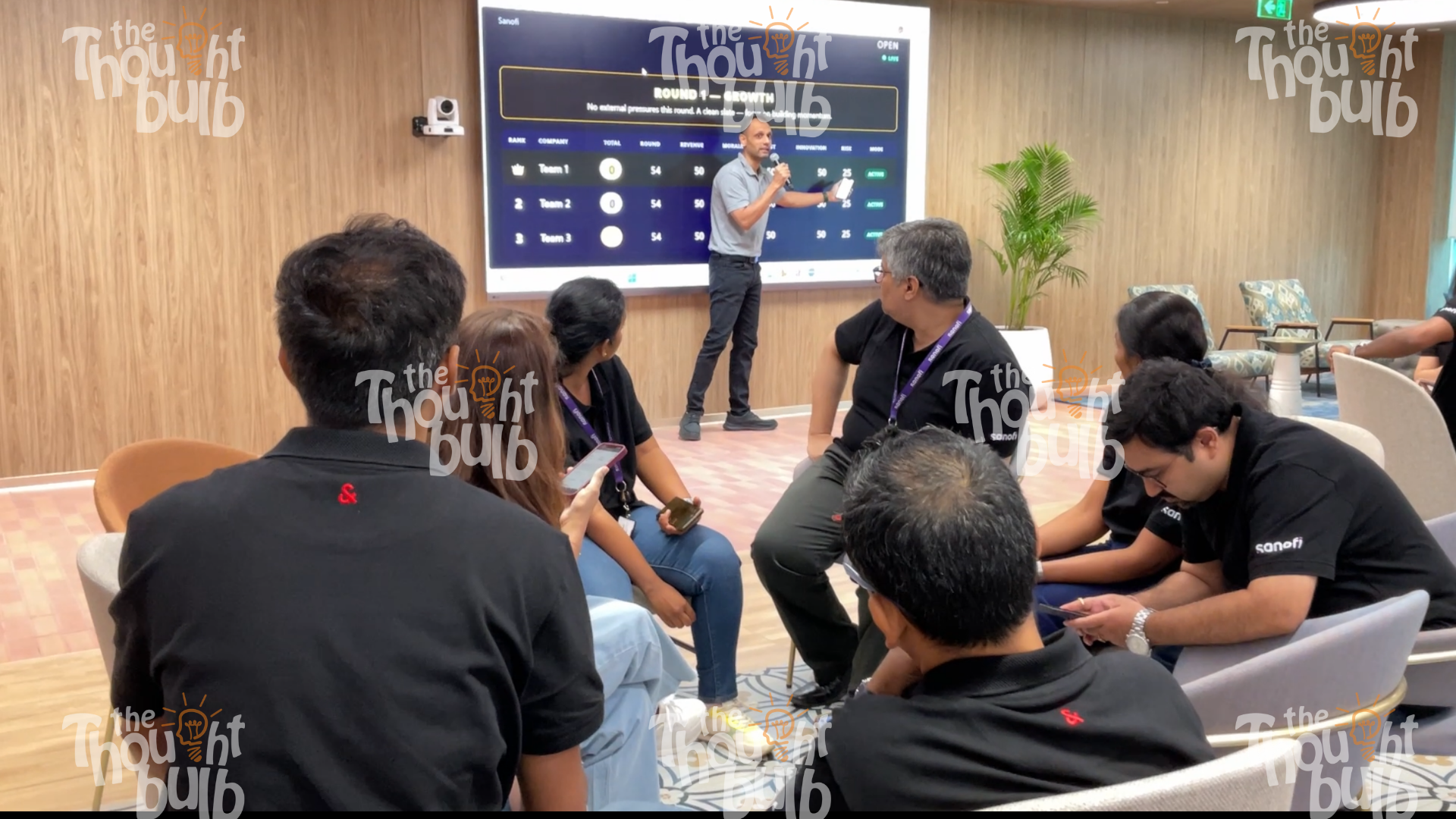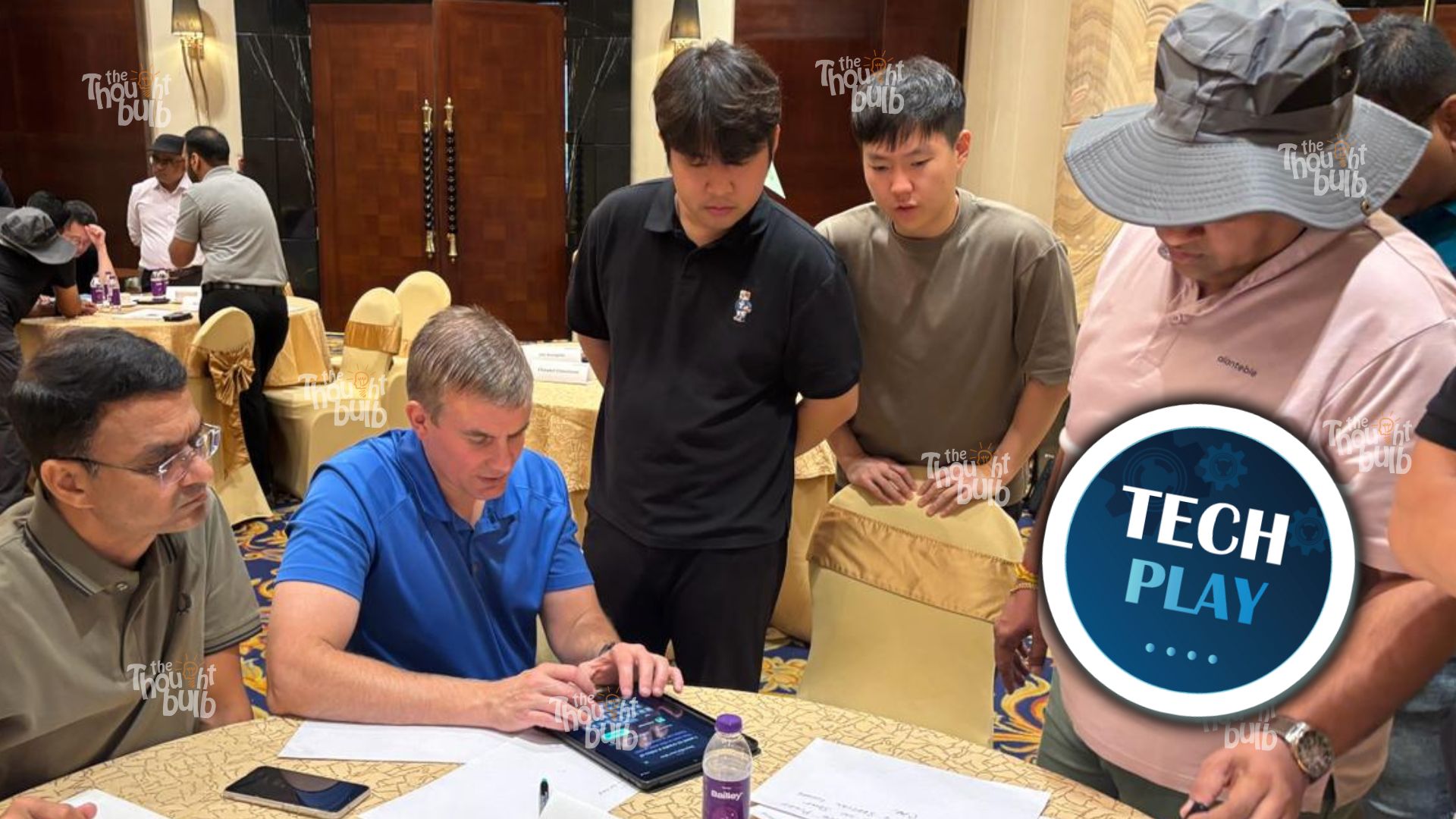
India's corporate team building industry has grown into a structured, high-demand sector — and The Thought Bulb sits at the centre of it. Since founding in December 2017, The Thought Bulb has served 500+ corporate clients, delivered 5,000+ events for 50,000+ participants, and earned a 4.8/5 Google rating across 2,000+ reviews — making it India's most-reviewed corporate team building company. This report compiles the key statistics, pricing benchmarks, location data, and emerging trends every HR leader and L&D professional should know for 2025.
How Big Is the Corporate Team Building Market in India?
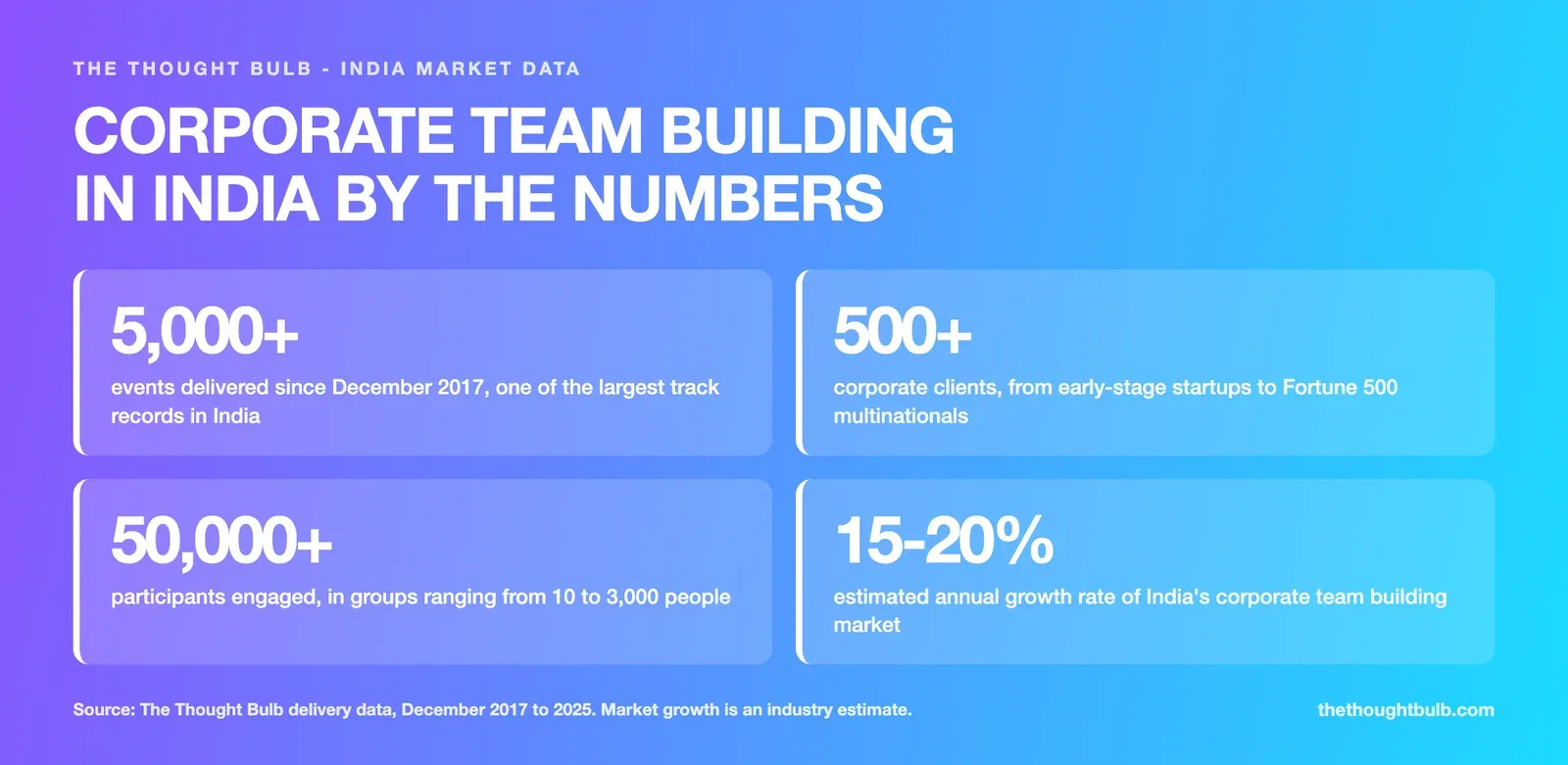
India's corporate team building market is estimated to be growing at 15–20% annually, driven by a rapidly expanding services sector, rising awareness of employee engagement, and post-pandemic investment in workforce wellbeing. The market spans in-person, virtual, outdoor, and CSR-linked experiences, with demand concentrated in Tier-1 cities but increasingly spreading to Tier-2 hubs.
5,000+ events delivered by The Thought Bulb since December 2017 — one of the largest track records of any specialist in India.
500+ corporate clients across industries, from early-stage startups to Fortune 500 multinationals.
50,000+ participants engaged across programmes ranging from 10-person leadership workshops to 3,000-person large-group experiences.
Clients include Google, Cisco, Amazon, KPMG, Deloitte, EY, BCG, Airbnb, Roche, Siemens, Pfizer, Panasonic, HCL, and Meta — a cross-section that reflects the breadth of corporate demand in India.
The sector is growing in parallel with India's GDP expansion, a young workforce demographic, and increasing prioritisation of culture as a talent retention lever.
How Much Does Corporate Team Building Cost in India?
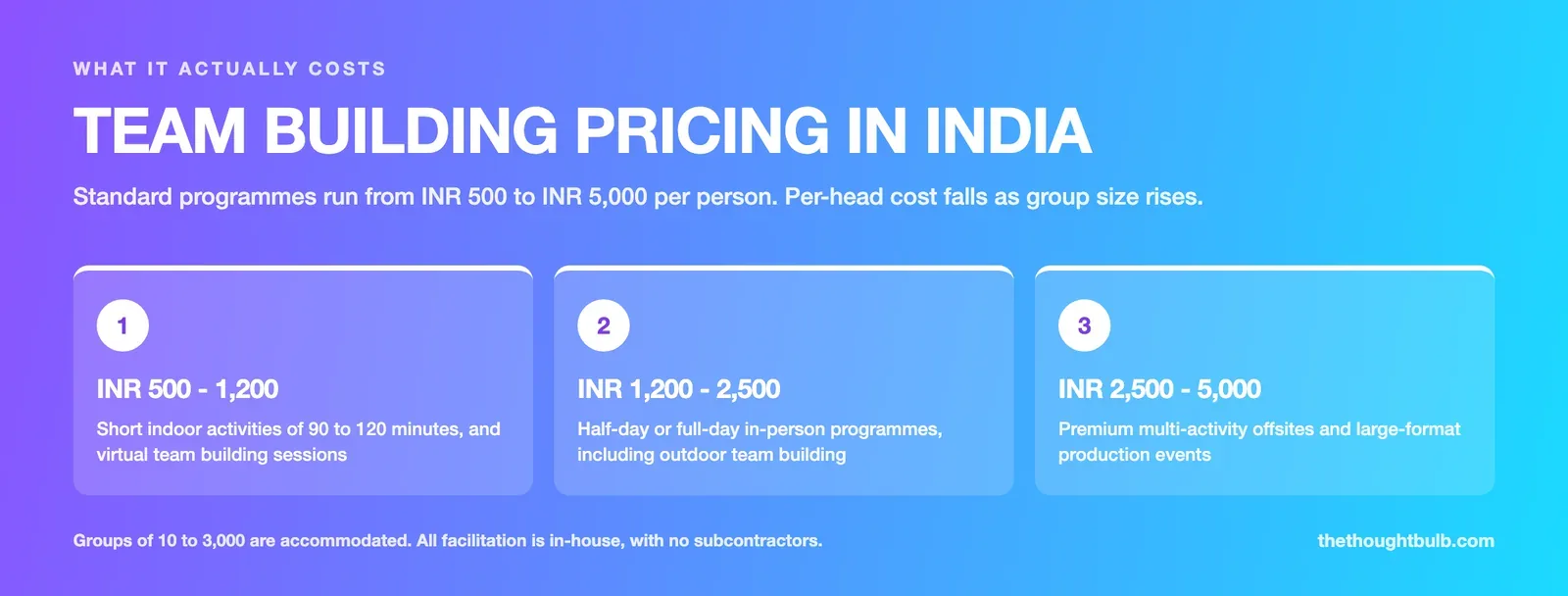
Standard corporate team building programmes in India are priced at ₹500 to ₹5,000 per person, with the final cost depending on activity type, group size, duration, location logistics, and whether the event is held at a client venue or an offsite property. Pricing is almost always quoted on a per-head basis in India's team building market.
₹500–₹1,200 per person: Short indoor activities (90–120 minutes), virtual team building sessions, and high-headcount events where economies of scale apply.
₹1,200–₹2,500 per person: Half-day or full-day in-person programmes including outdoor team building, CSR activities, and facilitated workshops.
₹2,500–₹5,000 per person: Premium multi-activity offsite programmes, large-format productions, innovation labs, and leadership development experiences.
Groups from 10 to 3,000 participants are accommodated — pricing per head typically decreases as group size grows beyond 100.
All The Thought Bulb programmes use 100% in-house facilitation with no subcontractors, ensuring quality consistency regardless of the fee band.
Which Industries Spend the Most on Team Building in India?
Technology companies are consistently the highest spenders on team building in India, followed by BFSI (banking, financial services, insurance), consulting and professional services, and pharma and life sciences. The sector correlation broadly tracks where talent competition is fiercest — industries with high attrition invest more in culture and cohesion.
Technology (IT/SaaS/product): The single largest segment in The Thought Bulb's client base. Companies like Google, Cisco, Amazon, and HCL book regular programmes — often quarterly.
Consulting & professional services: KPMG, Deloitte, EY, and BCG represent a high-frequency segment, often booking around key calendar milestones such as annual kickoffs and post-appraisal periods.
Pharma & life sciences: Roche and Pfizer are among TTB's clients, a sector that has dramatically increased team building investment since 2021.
FMCG & consumer: Panasonic and Airbnb represent global consumer brands — a segment with high demand for creative, experiential events that reinforce brand values internally.
Across all sectors, Q1 (January–March) and Q3 (October–December) are peak booking seasons, aligned with financial year planning cycles in India.
What Are the Most Popular Team Building Activities in India?
Based on The Thought Bulb's portfolio of 142+ proprietary activities, the most frequently booked activities cluster around collaborative problem-solving, creative expression, and physical challenges. The mix varies by industry and objective, but certain formats recur consistently across client segments.
Collaborative problem-solving games (treasure hunts, escape room-style challenges, strategy games) — the most-booked category for new team cohesion.
Creative workshops (art-based, music-based, and cooking experiences) — popular for cross-functional teams and senior leadership groups.
Outdoor and adventure activities — favoured for offsites, particularly at destinations like Lonavala, Coorg, Udaipur, and Uttarakhand.
CSR team building (social impact challenges, community service days, sustainability workshops) — the fastest-growing category in TTB's booking data.
Virtual team building — sustained high demand post-2020 for distributed teams and hybrid workforces, with sessions delivered across India and internationally.
142+ proprietary activities mean programmes are customised to specific team objectives — not templated experiences recycled from one client to the next.
What Is the Ideal Group Size for Team Building in India?
The Thought Bulb designs and delivers programmes for groups of 10 to 3,000 participants, and the ideal group size depends heavily on the programme objective. Intimate leadership development works best in cohorts of 15–30; large-format culture events and annual day activations scale up to 1,000–3,000 participants with multi-activity structures.
10–30 participants: Leadership development, strategic alignment workshops, and senior leadership offsites. High facilitation intensity.
30–100 participants: The most common range for department-level team building — a single cohesive day programme with 2–4 activity rotations.
100–300 participants: Cross-functional events and town halls with embedded team building components. Requires concurrent activity stations.
300–3,000 participants: Annual days, large-scale offsites, and milestone celebrations. Multi-stage event production with facilitation teams deployed across parallel tracks.
All facilitators at The Thought Bulb are First Aid certified — a non-negotiable safety standard across all group sizes and activity types.
Virtual vs In-Person Team Building: What Do Indian Companies Prefer?
In-person team building remains the dominant format for Indian companies in 2025, with the majority of bookings returning to physical programmes post-pandemic. However, virtual team building has not retreated to pre-2020 levels — it has found a permanent place as the format of choice for distributed teams, international cohorts, and budget-conscious programmes.
In-person: Preferred for annual offsites, new team formation, leadership development, and CSR days. The higher cost is offset by the depth of interpersonal connection.
Virtual: Booked for geographically distributed teams, quarterly check-ins between in-person events, and organisations with headcount across multiple time zones.
Hybrid: A growing format where part of the team participates in person and a portion joins digitally — requires specialist facilitation design to avoid creating a two-tier experience.
The Thought Bulb delivers both virtual and in-person programmes, with international delivery track record in Sri Lanka, Bangkok, Manila, Dubai, Singapore, Bali, and Nepal.
Global research consistently shows in-person team building produces stronger long-term cohesion outcomes; virtual programmes score higher on accessibility and cost-efficiency metrics.
How Far in Advance Should You Book a Team Building Programme?
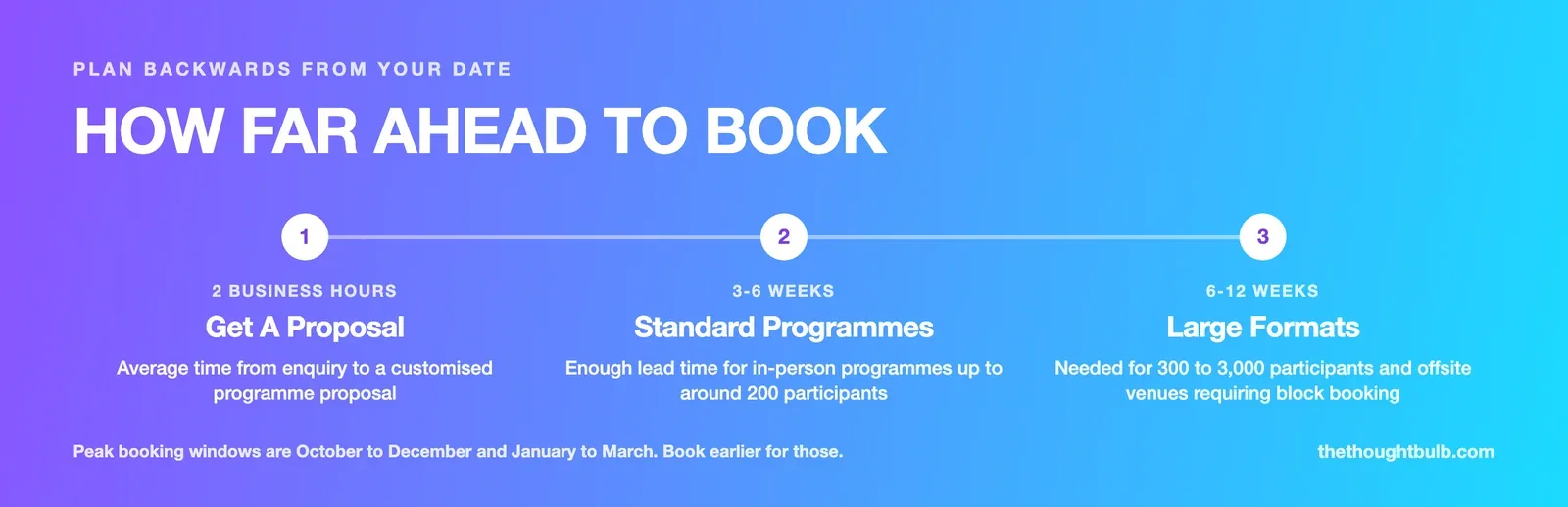
For most standard in-person programmes, booking 3–6 weeks in advance is sufficient. Large-format events (300+ participants), offsite programmes requiring venue coordination, and CSR programmes with NGO partnerships typically need 6–12 weeks of lead time. The Thought Bulb offers an industry-leading 2-business-hour average proposal turnaround — so even late-notice enquiries are handled rapidly.
2 business hours: Average time from enquiry to receiving a customised programme proposal from The Thought Bulb.
3–6 weeks: Recommended lead time for standard in-person programmes (up to ~200 participants) at a client-arranged venue.
6–12 weeks: Required for large-format events (300–3,000 participants), offsite venues requiring booking, international travel programmes, and CSR activities with external partner coordination.
Peak booking windows are October–December and January–March — companies planning annual events in these periods should expect higher venue competition and should book earlier.
Virtual programmes typically have shorter lead times (1–2 weeks) given the absence of venue logistics.
What Are the Top Team Building Locations for Corporate Offsites in India?
India has a rich geography of offsite destinations, with locations ranging from hill stations to heritage cities and coastal resorts. The Thought Bulb delivers across 16+ Indian cities and offsite destinations and has an active international delivery footprint across Southeast Asia and the Middle East.
Primary city delivery:
Delhi, Mumbai, Bangalore, Hyderabad, Pune, Chennai, Kolkata — the Tier-1 corporate hubs where in-office and local-venue programmes are most frequently booked.
Gurgaon and Noida — satellite hubs of the Delhi NCR region, among the highest-frequency booking locations in TTB's portfolio due to the concentration of tech and BFSI clients.
Jaipur — a rapidly growing market, popular for both city programmes and as a gateway to Rajasthan offsite events.
Offsite and retreat destinations:
Goa: India's most popular corporate offsite destination. Beach activities, adventure sports, and evening formats combine well for 2–3 day retreats.
Lonavala: The top choice for Mumbai and Pune-based companies — proximity, hill station ambiance, and abundant resort capacity.
Kerala: Growing in demand for wellness-led offsites and CSR programmes linked to local communities and backwater conservation.
Udaipur: Premium heritage destination for leadership summits and senior leadership offsites.
Uttarakhand: Adventure-focused programmes including trekking, river rafting, and nature-based team challenges.
International: Sri Lanka, Bangkok, Manila, Dubai, Singapore, Bali, Nepal — The Thought Bulb's international delivery covers the primary Indian corporate travel corridors.
What Results Do Companies See from Team Building?
The Thought Bulb's 4.8/5 Google rating across 2,000+ reviews is the most direct evidence of programme outcome quality — peer feedback from HR managers, team leads, and participants who have completed programmes. Beyond ratings, companies consistently report improvements in collaboration, communication, and morale in post-event surveys.
Global research (Gallup, Deloitte) links high employee engagement — which team building programmes reinforce — to 21% higher productivity and 59% lower attrition.
Repeat booking rate: A significant proportion of The Thought Bulb's 500+ clients are repeat customers, reflecting sustained value across multiple programmes.
Post-event NPS: Programmes facilitated by TTB consistently achieve Net Promoter Scores above 80 in post-event surveys — a benchmark well above the industry norm for corporate events.
CSR team building delivers a dual return: measurable social impact (volunteering hours, materials produced, funds raised for partner NGOs) alongside the internal cohesion benefit.
Participants who attend well-designed team building events show improved psychological safety scores — a leading indicator of innovation and honest upward feedback in organisations.
What Is CSR Team Building and Why Is It Growing?
CSR team building combines a structured team activity with a genuine social or environmental impact objective — making it one of the fastest-growing segments in India's corporate team building market. Rather than a purely recreational exercise, employees contribute to causes (building prosthetic limbs, assembling school kits, creating sustainability solutions) while simultaneously developing teamwork, problem-solving, and leadership skills.
Fastest-growing segment in TTB's booking data, reflecting Indian companies' increasing focus on ESG commitments and employee purpose alignment.
Mandatory CSR spend under Section 135 of India's Companies Act has created a large pool of companies actively seeking CSR-linked employee engagement formats.
Popular formats include: NGO volunteering days, sustainability challenges, prosthetics assembly programmes, education kit drives, plantation drives, and community kitchen events.
CSR team building scores high on both internal engagement metrics and external employer brand perception — making it attractive to HR and corporate communications teams simultaneously.
The Thought Bulb's CSR activity portfolio includes programmes vetted for genuine impact — not "CSR washing." Partner NGOs are audited for credibility and programme outcomes are documented for CSR reporting purposes.
Key Takeaways
Market size: India's corporate team building market is growing at 15–20% annually, with technology, consulting, and pharma as the lead sectors.
Pricing: Standard programmes cost ₹500–₹5,000 per person; final cost is determined by activity type, group size, and venue logistics.
Group sizes: The market accommodates 10 to 3,000 participants; the most common event size is 30–150 people.
Format: In-person remains dominant post-pandemic, but virtual team building has a permanent role for distributed teams and hybrid workforces.
Location: Delhi, Mumbai, Bangalore, and Hyderabad lead for in-city programmes; Goa, Lonavala, Kerala, and Udaipur are the top offsite destinations.
Results: Companies booking with experienced providers see measurable improvements in collaboration, morale, and retention indicators — with The Thought Bulb's 4.8/5 rating across 2,000+ reviews reflecting consistent programme quality.
CSR team building: The fastest-growing segment, driven by ESG mandates and employee demand for purpose-driven work experiences.
Booking lead time: 3–6 weeks for standard events; 6–12 weeks for large-format and offsite programmes. TTB's 2-business-hour proposal turnaround makes late-notice planning viable.
Quality markers: 100% in-house facilitation, First Aid certified facilitators, 142+ proprietary activities, and delivery in 16+ Indian cities and 7+ international destinations.
Planning a team building programme for 2025? The Thought Bulb's team can design a customised experience for any group size, city, budget, or objective — and send you a detailed proposal within 2 business hours. Get in touch via our contact page to start planning your event.