
1The Challenge
What was the challenge?
Sanofi partnered with The Thought Bulb for a full-day workshop at their Hyderabad office. The brief was focused on experiential learning — building cross-functional thinking, team cohesion, and business acumen in a way that would complement rather than repeat existing development programmes.
The team brought together participants from across the organisation. The premise of the day was clear: participants should leave with a felt understanding that functions are interdependent, that every decision carries a trade-off, and that collaboration produces better outcomes than functional silos.
The success criteria were practical. By the end of the day, participants should have built stronger relationships with one another, gained a clearer picture of how the business operates as a system, understood that decisions in one function ripple across others, and left with a sharper sense of what effective cross-functional ownership looks like. Career ownership was also named as a priority — participants needed to understand that investing in their own growth was as much their responsibility as the organisation's.
2Our Solution
What solution did we design?
The Ripple Effect business simulation was chosen because it teaches the single most important thing this particular audience needed to understand — and teaches it by making them live it rather than hear it.
Each team runs its own company, complete with the key functions of a real business: tech, HR, sales, marketing, finance, operations. Across twelve sub-stages, they make a strategic choice at every stage, and here is the mechanism that does the work: every option carries a trade-off. A choice that boosts innovation might cost revenue, or customer trust, or employee engagement. There is no clean win. Decisions ripple outward across financial performance, customer trust, innovation, employee engagement, operational efficiency, and sustainability — and after twelve stages, the results reveal which company scaled the most.
For a team within a global organisation like Sanofi, the fit is almost exact. These are people who work in functions — and the greatest risk for any professional in a function-based organisation is optimising for their own function's metrics without seeing the downstream cost. Ripple Effect makes that visible in a single afternoon: functions are interdependent, every decision is a trade-off, small choices create big impact, collaboration produces better outcomes, and good strategy drives sustainable growth. It delivered behavioural themes — precision, cross-functional collaboration, speed and quality, continuous learning, ownership, delivering value, and global collaboration — as lived experience rather than a list on a slide.
And crucially for a group who had already been through content-heavy sessions, it was a simulation rather than a session. Nobody was told how business functions interconnect; they discovered it by running a company and watching their own decisions ripple.
3How We Did It
How was the programme delivered?
The workshop ran at Sanofi's Hyderabad office, delivered by a lead facilitator and a co-facilitator. Ahead of the day, a facilitator alignment discussion with the client finalised module flow, business context, debrief approach, and functional examples — ensuring the simulation was framed in language relevant to Sanofi's actual context rather than generic business terms.
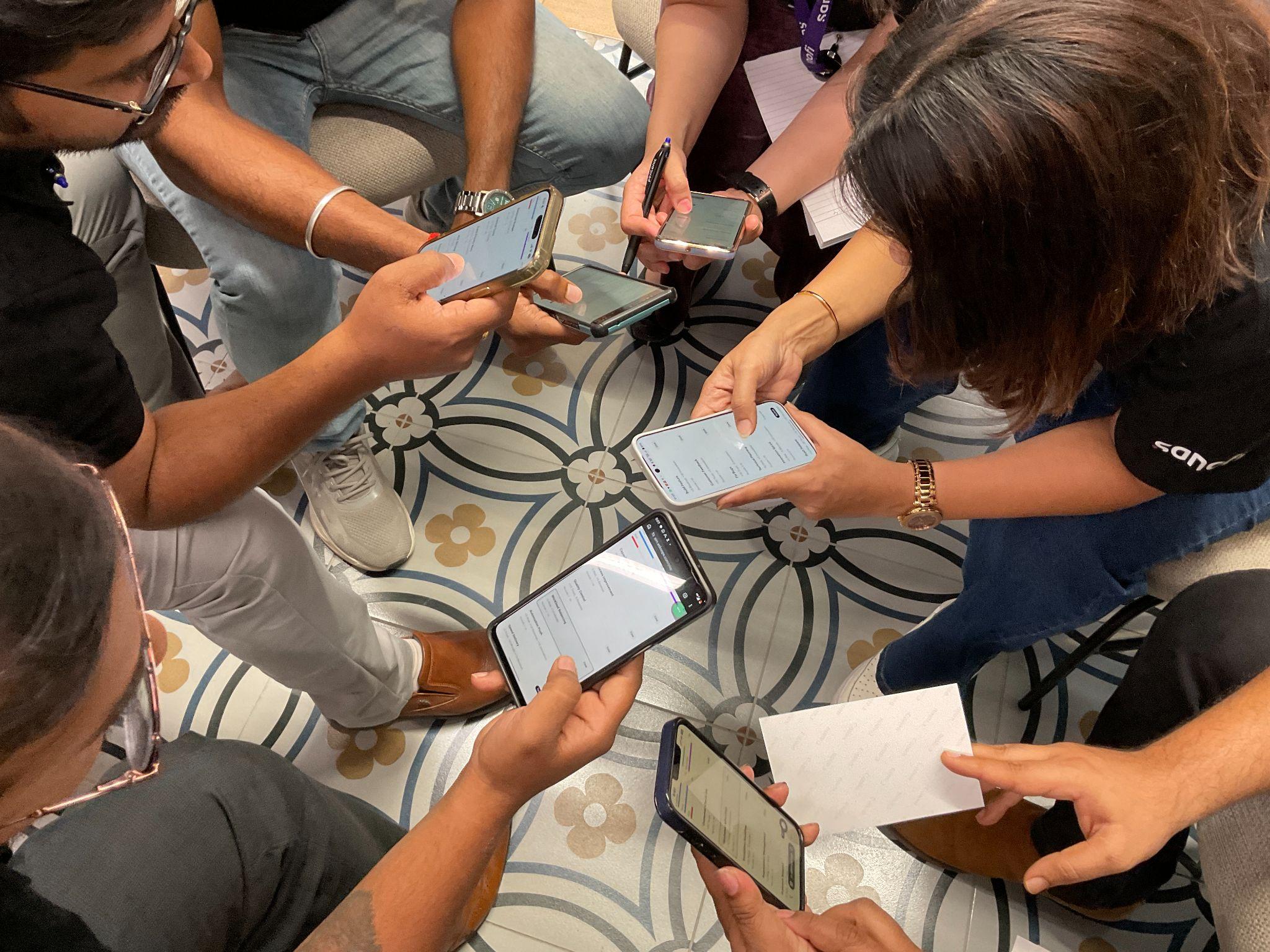
In the Ripple Effect simulation, teams took on their companies and worked through the twelve decision stages, weighing each option's benefits against its trade-offs. Facilitators observed how teams reasoned: whether they chased a single metric or balanced the whole picture, how they handled disagreement, and whether they anticipated the downstream consequences of a choice before committing to it. The debrief drew on those observations and on the client-supplied context, connecting what happened in the simulation to how Sanofi actually operates — why precision matters, where cross-functional collaboration changes outcomes, and what delivering value looks like within the organisation.
4Key Outcomes
What were the results?
The Ripple Effect gave Sanofi's Hyderabad team something that a content-heavy session could not: a felt understanding that the functions they work in are interdependent, that every decision carries a trade-off, and that small choices ripple. For a team whose work has direct downstream consequences across the organisation, that lesson landed experientially rather than theoretically.
The day set out to leave participants more connected to one another, clearer about how the business operates as a system, and more aware that owning their impact is as much their responsibility as their manager's — a foundation for how they approach their work going forward.