Restructuring rarely ends on the day the announcement goes out. The org chart changes in an afternoon, but the people who stay carry the questions for months: Am I next? Who do I report to now? Can I trust what leadership tells me? In 2026, many Indian companies are living through exactly this. Tech and GCC teams are being reshaped around AI, cost targets are tighter, and managers are being asked to hold together teams that are smaller, more stretched and quietly anxious. If you lead HR or a business unit, rebuilding trust after restructuring is not a soft extra. It is the difference between a team that recovers and a team that slowly walks out the door.
This guide explains why trust breaks during reorganisations, what the latest data says about Indian teams, and a practical 90-day plan to rebuild it, including the team experiences that work best when people have to learn to rely on each other again.
Why Trust Breaks During Restructuring
Most restructuring is handled as a legal and financial exercise. The people side is often reduced to a town hall and an FAQ document. That gap is where trust leaks out.
Survivors feel the loss too
The employees who keep their jobs often experience what researchers call survivor syndrome: guilt about colleagues who left, fear about their own position, and extra workload they did not ask for. They rarely say this out loud, especially in hierarchical Indian workplaces where questioning leadership can feel risky.
Silence fills up with rumours
When leaders go quiet after an announcement, WhatsApp groups and corridor conversations fill the vacuum. Every delayed answer is read as a sign that more cuts are coming.
Old working relationships disappear
Restructuring removes the informal glue of a team: the colleague who knew how a process worked, the manager who shielded people from noise, the peer you could ask anything. New reporting lines exist on paper long before they exist in practice.
What the Data Says About Trust After Layoffs
The numbers make it clear that the people who stay are the real risk after a restructuring:
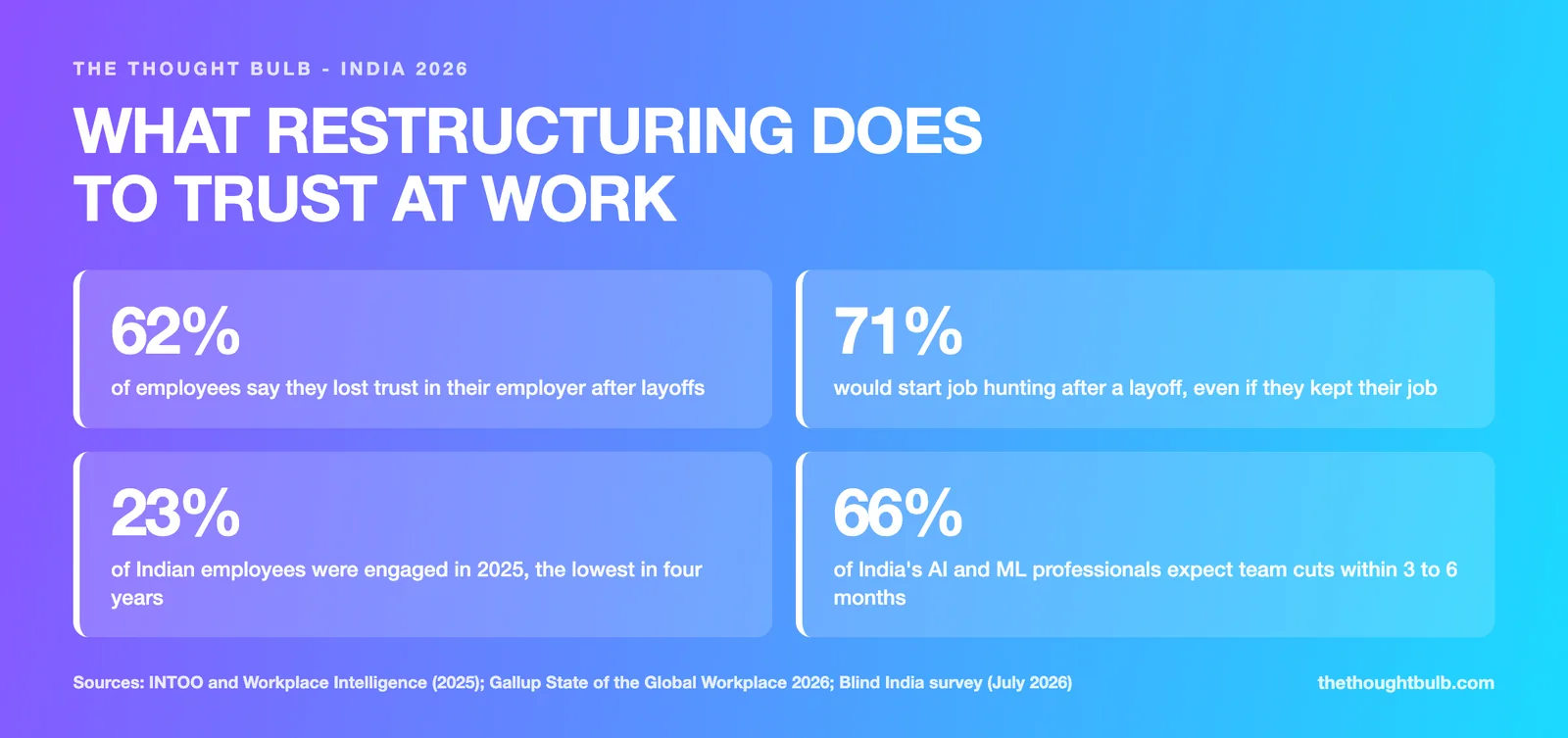
62% of employees say they lost trust in their employer following layoffs, according to the INTOO and Workplace Intelligence Culture in the Balance study (2025, 2,200 employees and HR leaders across five countries).
71% of employees in the same study said they would begin job hunting immediately after a layoff, even if they were spared.
Only 23% of Indian employees were engaged at work in 2025, the lowest figure in four years and down from 30% in 2024, according to Gallup's State of the Global Workplace 2026 report.
66% of India-based AI and ML professionals expect a layoff or significant headcount reduction in their team within three to six months, according to a Blind survey of 1,552 Indian professionals in July 2026.
Read together, these figures describe a workforce that is already disengaged, increasingly expects further cuts, and treats a badly handled restructuring as a signal to leave. Gallup also found that manager engagement in India has fallen sharply since 2024, which matters because managers are the people expected to rebuild trust on the ground. If they are running on empty, the recovery stalls.
Five Principles for Rebuilding Trust
Before jumping into activities, get the fundamentals right. Team experiences amplify whatever culture already exists, so they work best on top of these principles.
1. Say more than feels comfortable
Explain what changed, why it changed, and, just as important, what will not change. Share what you know, admit what you do not, and give a date for the next update. Predictability rebuilds confidence faster than reassurance.
2. Make the new structure real
People cannot trust a team they cannot see. Redraw roles, decision rights and handoffs, and walk every person through where they fit and who they now depend on.
3. Give managers support before you give them targets
Managers absorb the emotional load of a reorganisation. Brief them first, give them talking points and room to ask hard questions, and invest in their own resilience before asking them to lift team morale.
4. Create shared wins quickly
Trust is rebuilt through experience, not slides. Teams need early moments where they succeed together under the new structure, ideally in a low-stakes setting where mistakes are safe.
5. Measure trust, then act visibly
Run short pulse surveys on trust and intent to stay, and close the loop by telling people what you changed because of their answers. Asking without acting does more harm than not asking.
Team Experiences That Rebuild Trust
The right experience puts newly formed teams in situations where they have to communicate clearly, share information and depend on each other, which is exactly what restructuring disrupts. Here are two that work particularly well for reorganised teams, one in person and one virtual.
Lost Dutchman Goldmine (in person)
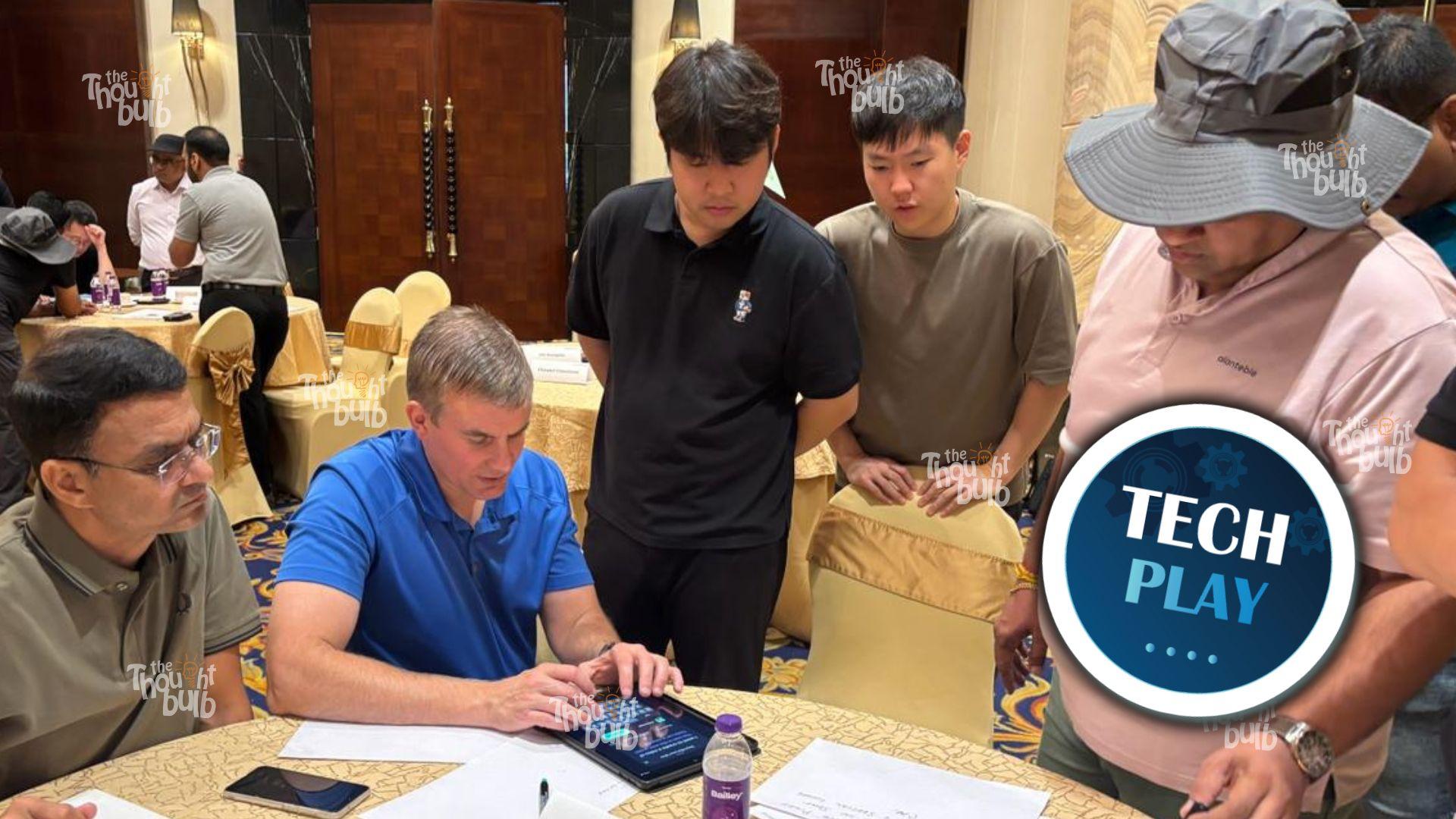
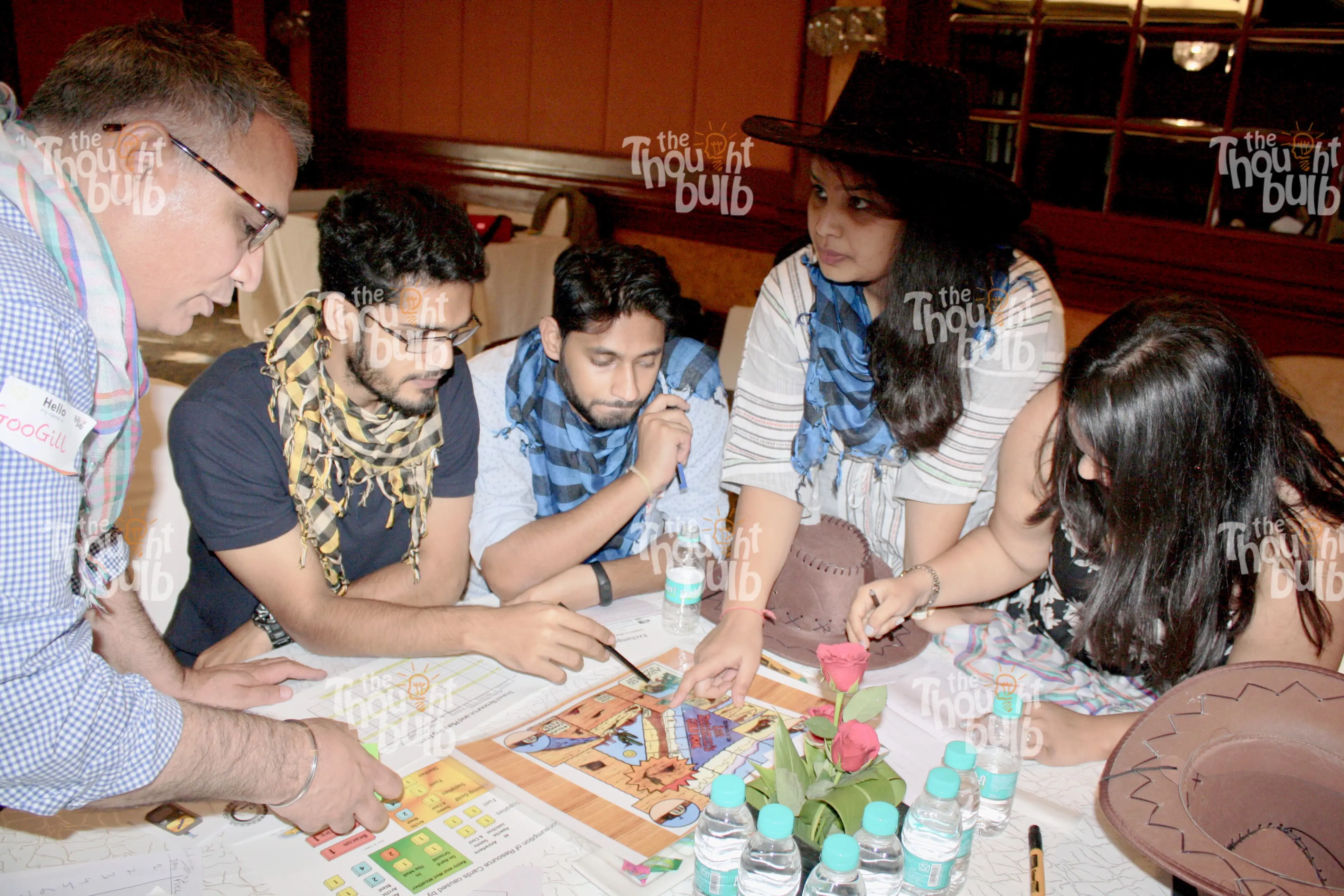
Lost Dutchman Goldmine is a business simulation where teams plan an expedition, manage scarce resources and make decisions under pressure. The twist is that the highest collective score only comes when teams stop treating each other as rivals and start sharing information. For a reorganised business where departments are suddenly competing for the same reduced budget, that lesson lands hard. The debrief connects directly to cross-team trust, accountability and how leaders frame competition.
Mission Moon Lander (virtual)
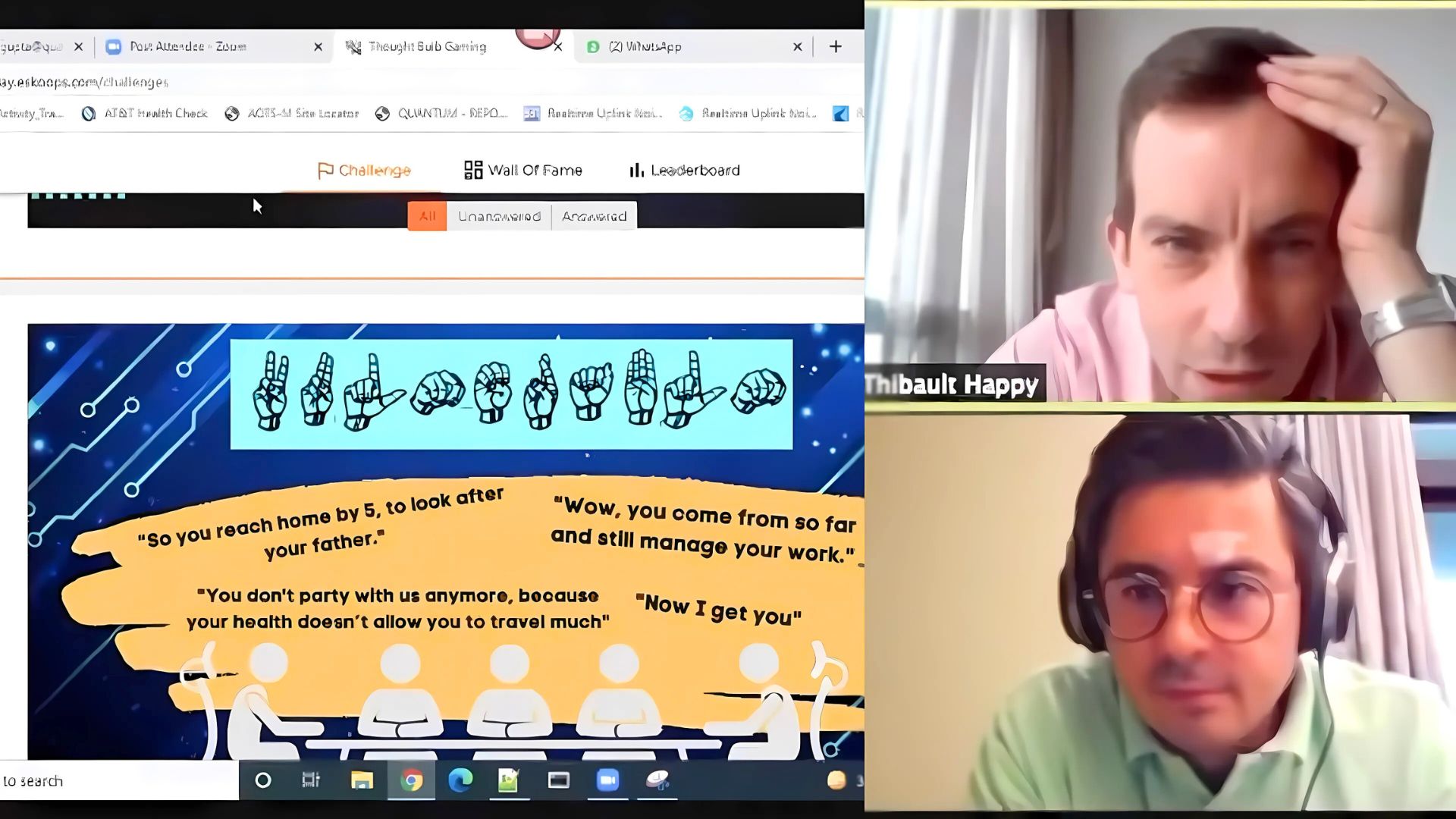
Many restructured teams are now spread across cities or working hybrid. Mission Moon Lander is a virtual challenge in which teams work together to land a craft safely, relying on clear communication and shared decision-making under time pressure. It is ideal for new reporting lines that have not yet met in person, and the facilitated debrief surfaces how the team handles trust, open conflict and accountability.
You can explore more formats for distributed teams on our virtual team building page, or browse every in-person and online option in our full list of activities.
If the restructuring has created a new leadership layer, pair these experiences with a leadership offsite so that new managers build trust with each other before they are expected to build it with their teams.
Case Study: Getting 20 Teams to Think Collectively
Schaeffler, the global automotive and industrial supplier, brought around 200 people together in Mahabalipuram, split across 20 teams. The brief focused on energy, problem solving, innovation and creativity, and the real challenge was scale: twenty teams in one room can easily turn into twenty separate agendas.
The Thought Bulb ran The Lost Dutchman with a team of three facilitators to keep every team briefed, paced and in sync through the planning and decision rounds. Facilitators observed which teams treated others purely as rivals and which spotted the cooperative opportunity. The debrief then tied those behaviours back to Schaeffler's themes: questioning the frame you have been handed, and seeing past the instinct to win your own round so the whole room gets the best result. For any organisation rebuilding trust between functions after a reorganisation, that is the core shift.

You can read this and other client stories on our case studies page.
A 90-Day Plan to Rebuild Team Trust
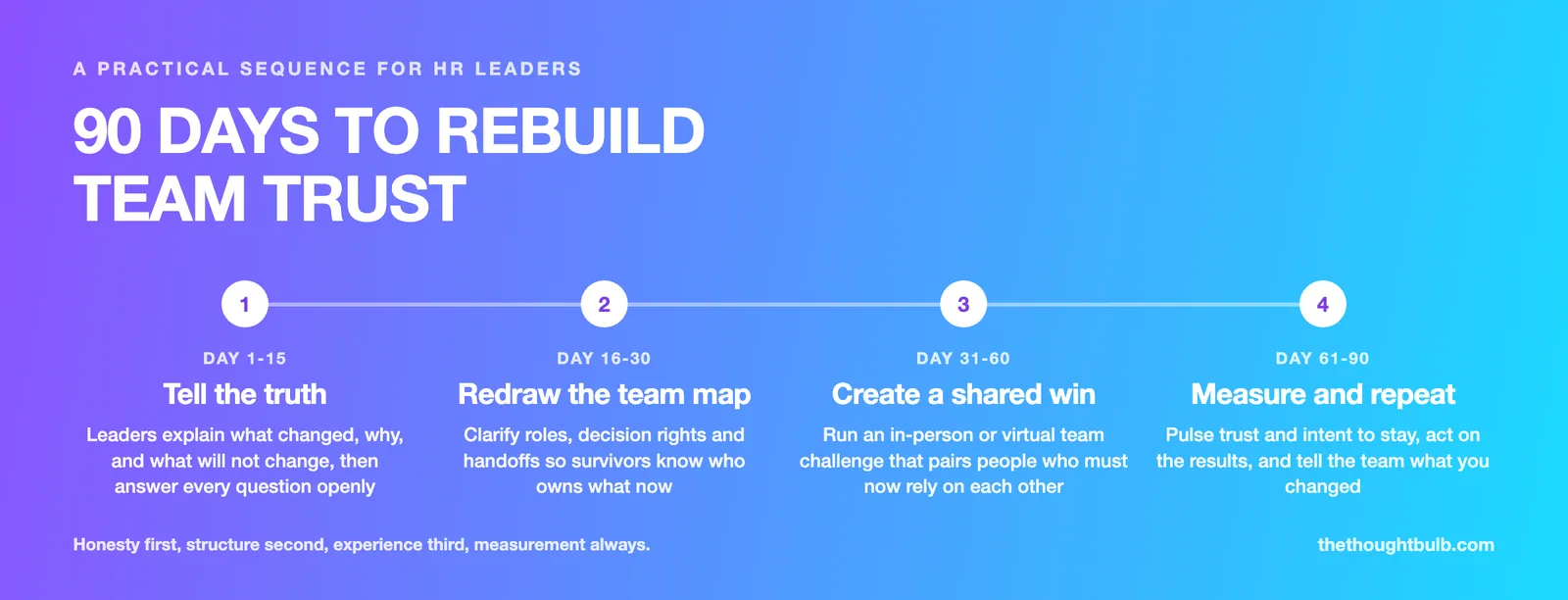
Trust does not come back in a single offsite. Use this sequence as a starting point and adapt it to the size and mood of your organisation:
Day 1 to 15, tell the truth: leaders explain what changed, why, and what will not change, then hold open question sessions and answer every question, including the uncomfortable ones.
Day 16 to 30, redraw the team map: clarify roles, decision rights and handoffs so that everyone who stayed knows who owns what in the new structure.
Day 31 to 60, create a shared win: run an in-person or virtual team challenge that deliberately pairs people who now need to rely on each other, followed by a facilitated debrief.
Day 61 to 90, measure and repeat: pulse trust and intent to stay, act on the results, and tell the team exactly what you changed because of their feedback.
Common Mistakes to Avoid
Celebrating too soon: a lavish party the week after layoffs feels tone-deaf. Choose purposeful, collaborative formats over pure entertainment.
Forcing positivity: do not ask people to perform enthusiasm. Acknowledge the loss first and make space for honest conversation in the debrief.
Treating it as a one-off: a single event without follow-up looks like a box being ticked. Link the experience to the 90-day plan.
Ignoring managers: if managers are exhausted or confused, nothing else sticks. Support them first.
Conclusion
Restructuring tests whether employees believe what their organisation says. The data shows that most people lose some trust after layoffs and many start looking elsewhere, even when they keep their jobs. The organisations that recover fastest are honest early, make the new structure tangible, support their managers, and give teams real experiences of succeeding together again.
If your team is rebuilding after a reorganisation, The Thought Bulb can help you design a trust-focused experience, in person or virtual, with a facilitated debrief that turns the day into lasting change. Explore our team building activities or get in touch to plan your next step.