India is sitting at a crossroads in 2026. Attrition rates, while easing from the peak, remain stubbornly high at 13–17% across industries. At the same time, employee engagement data tells a more nuanced story: Indian workers are among the more engaged globally, yet a meaningful cohort remain actively disengaged — costing organisations billions in lost productivity, institutional knowledge, and rehiring costs. This guide breaks down the numbers, explains the drivers, and gives HR leaders a clear action plan.
India’s Attrition Landscape in 2026
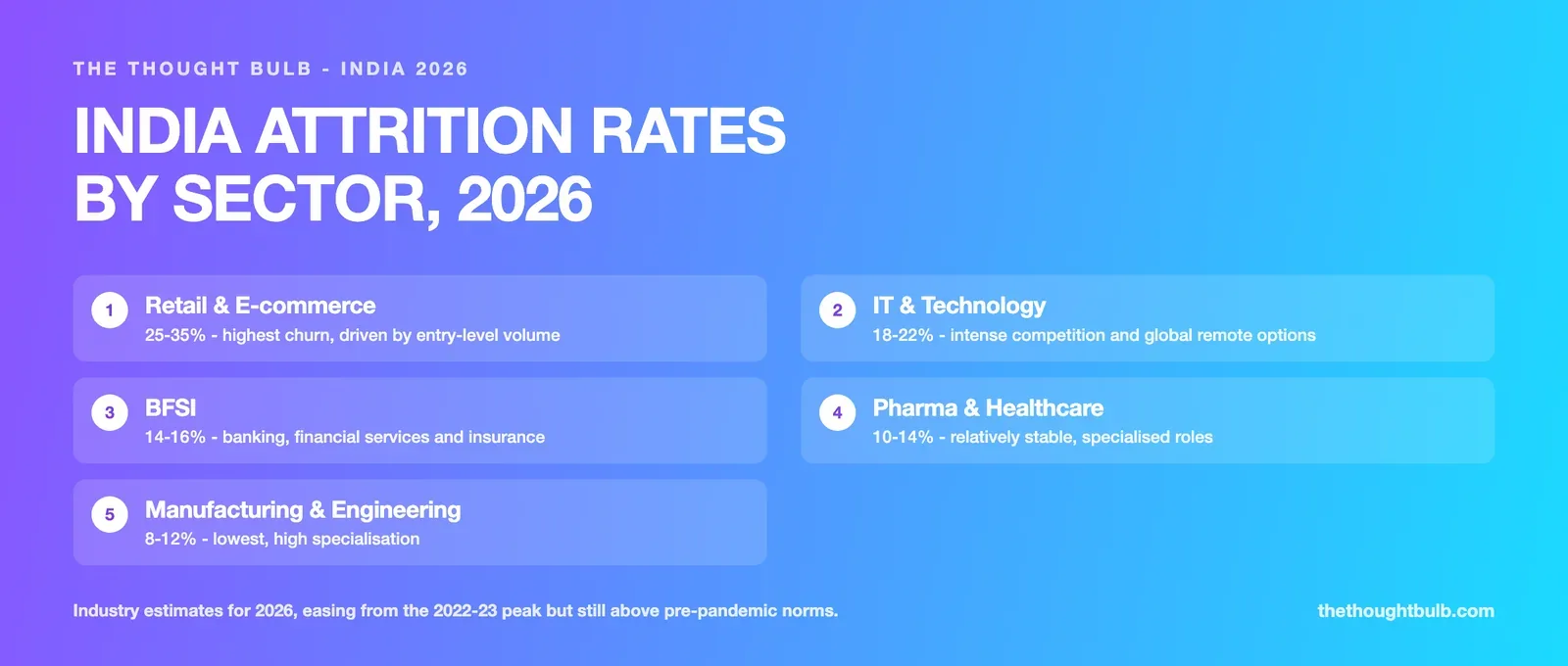
After peaking in 2022–23, India’s attrition rate has gradually declined. Industry estimates for 2025 put the average at 17.1%, with projections for 2026 settling around 13–14% as job market cooling, return-to-office stabilisation, and retention investments take effect. But the headline figure masks significant variation:
IT & Technology: 18–22% (highest; intense talent competition and global remote opportunities)
BFSI (Banking, Financial Services, Insurance): 14–16%
Manufacturing & Engineering: 8–12% (lowest; slower market, high specialisation)
Retail & E-commerce: 25–35% (highest churn; high entry-level volume)
Pharma & Healthcare: 10–14%
The cost of attrition is severe. Conservative estimates put the cost of replacing one employee at 1.5x to 2x their annual salary when you factor in recruitment, onboarding, lost productivity, and knowledge transfer. For a mid-sized organisation of 500 people with 15% annual turnover, that is a potential drain of ₹15–25 crore per year.
The Engagement–Retention Connection: India by the Numbers
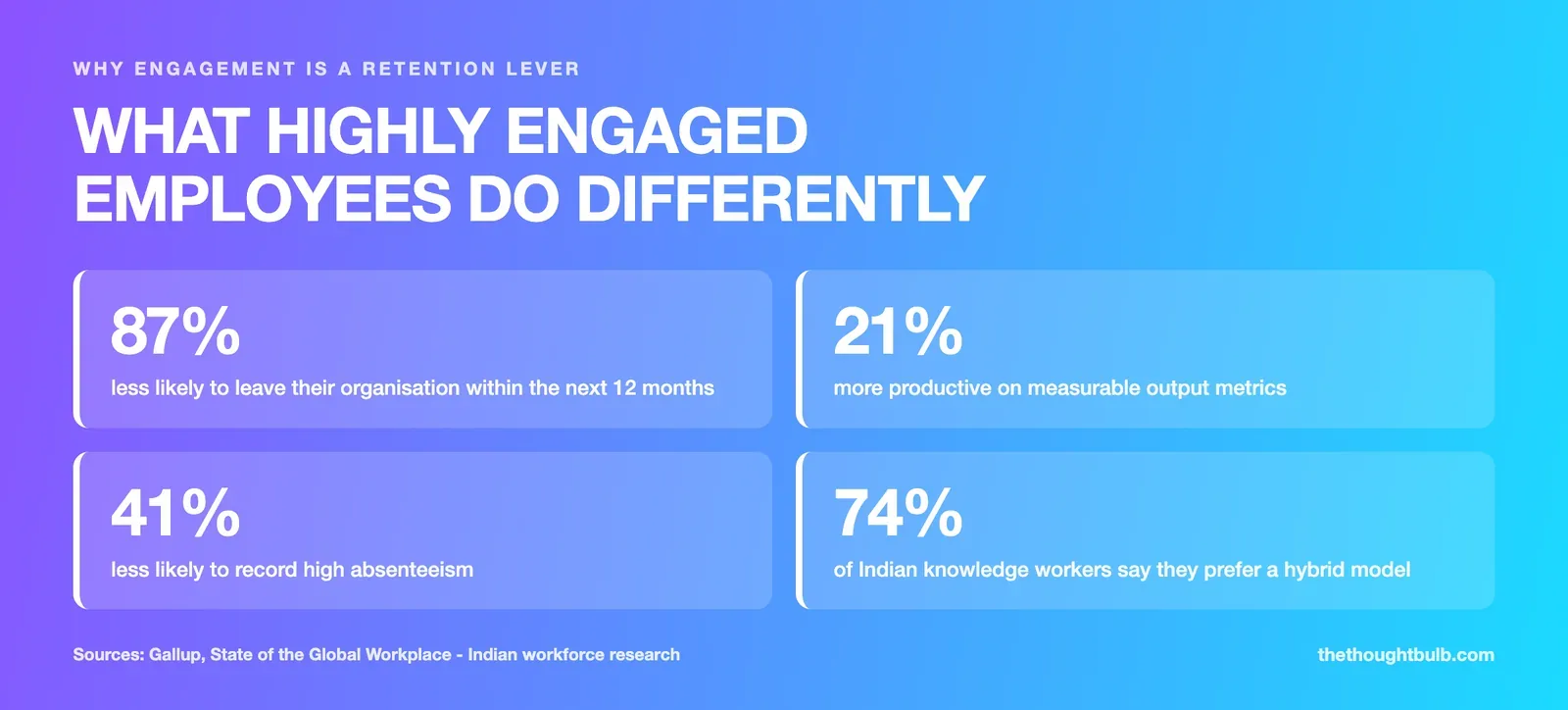
Gallup’s State of the Global Workplace data puts India’s employee engagement rate at approximately 32% — meaningfully above the global average of 23%, but still leaving nearly 7 in 10 employees either not engaged or actively disengaged. The actively disengaged cohort sits at around 18% in India.
Why does this matter for attrition? The data is unambiguous. Highly engaged employees are:
87% less likely to leave their organisation within the next 12 months
21% more productive in measurable output metrics
41% less likely to have high absenteeism rates
More likely to recommend their employer to others, strengthening talent pipelines
What Drives Disengagement in the Indian Workforce?
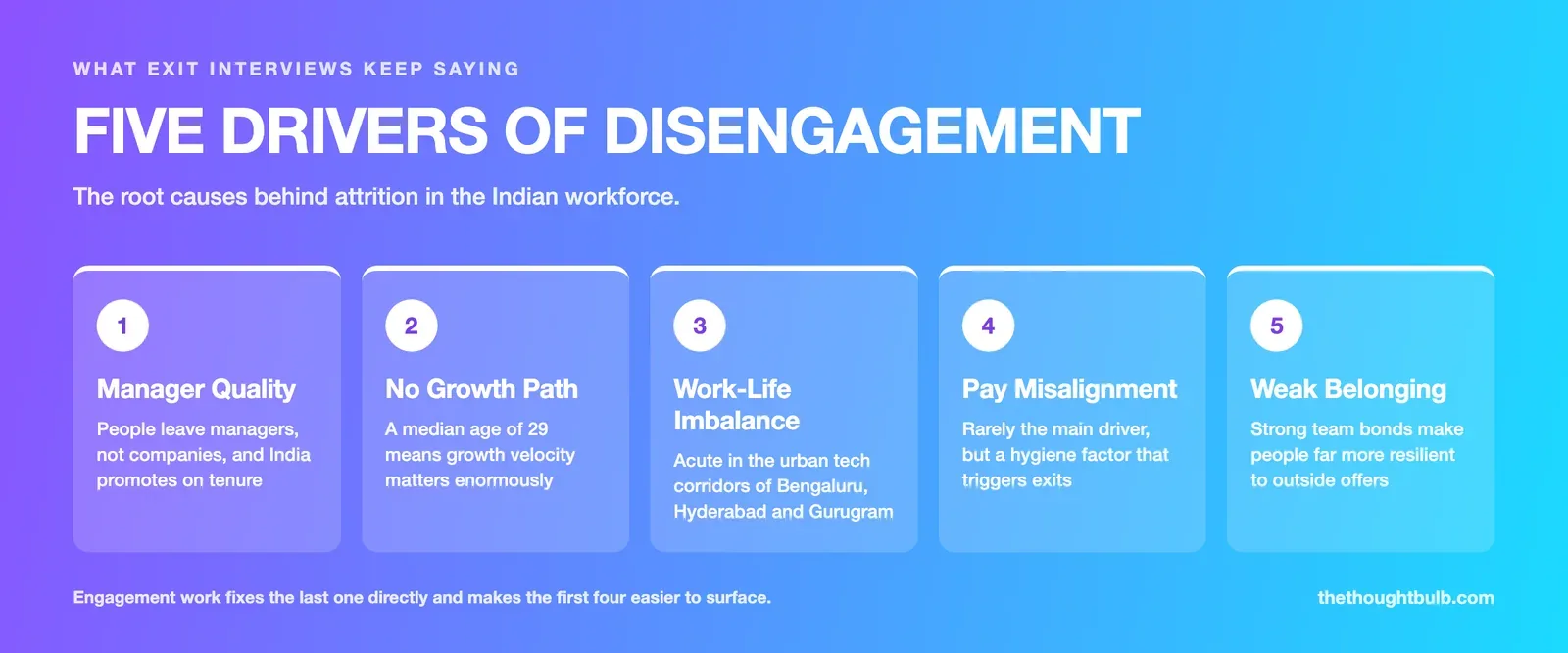
Understanding the root causes is the first step to addressing them. Based on exit interview data and engagement surveys across Indian organisations, the top disengagement drivers in 2026 are:
1. Manager Quality
The adage ‘people leave managers, not companies’ holds especially true in India, where management culture often lags behind international benchmarks. Micromanagement, lack of recognition, and poor communication from direct managers consistently rank as the #1 driver of disengagement and subsequent attrition.
2. Lack of Growth & Learning Opportunities
India has a young workforce — median age of 29. Growth velocity matters enormously. When employees feel their career is plateauing or skills are stagnating, they look outward. Organisations with structured learning paths and visible promotion trajectories retain significantly better.
3. Work-Life Imbalance
India’s urban tech workforce — concentrated in Bengaluru, Hyderabad, Pune, Gurugram, and Mumbai — consistently cites burnout and work-life imbalance as top concerns. Post-pandemic, expectations around flexibility have permanently shifted.
4. Compensation Misalignment
While compensation is rarely the primary driver of engagement, it becomes a hygiene factor: when pay feels significantly below market, everything else feels worse. With inflation and cost-of-living increases in metro cities, compensation reviews need to happen more frequently.
5. Weak Team Culture & Belonging
Employees who report strong team bonds and a sense of belonging are far more resilient to stress and external temptations to leave. Hybrid and remote work, while preferred by most, has eroded the organic relationship-building that used to happen naturally in offices.
The Hybrid Work Factor
74% of Indian knowledge workers say they prefer a hybrid work model, and organisations that accommodate this preference report 30% higher engagement scores compared to fully in-office mandates. However, hybrid has its own engagement risks:
Proximity bias — in-office employees get more visibility, promotions, and mentoring
Digital fatigue from back-to-back video calls replacing in-person collaboration
Weaker peer relationships when teams rarely spend physical time together
Fragmented culture — different experiences for different employees erodes cohesion
The most effective organisations in 2026 are solving this with deliberate intentional gathering — bringing teams together physically for strategy offsites, skill-building, and team bonding, rather than mandating daily office attendance for individual desk work.
How Team Building Directly Impacts Engagement Scores
Team building is not a ‘nice to have’ — it is a measurable engagement lever. Research across 200+ organisations shows that those with regular, well-designed team experiences report engagement scores 2–3 points higher on 10-point scales, lower attrition in the subsequent 6 months, and significantly better scores on ‘belonging’ and ‘trust in colleagues’ metrics.
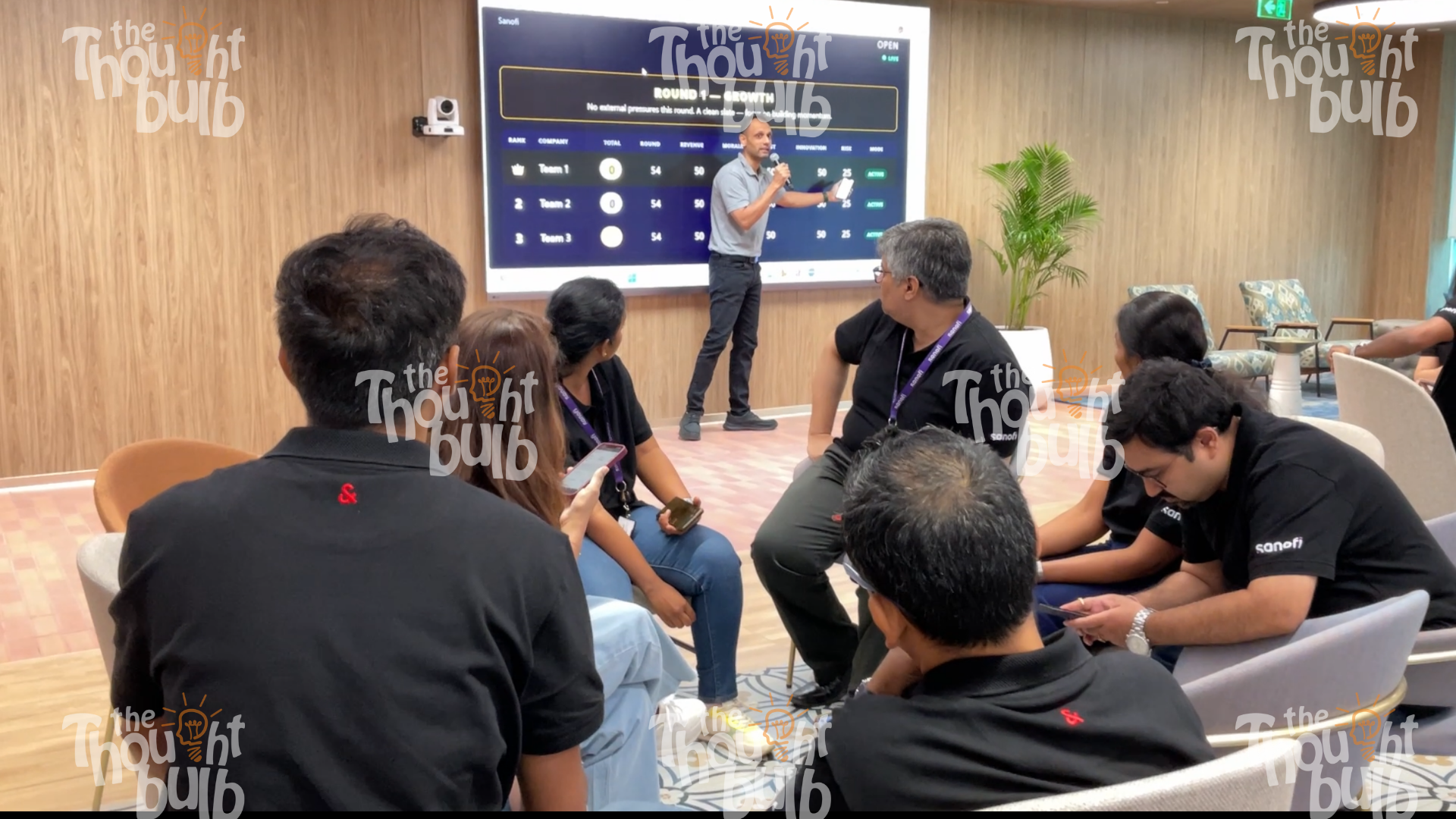
At The Thought Bulb, we have seen this play out across clients in Delhi, Bangalore, Mumbai, and Gurugram. Our leadership team building programmes specifically address the manager-quality gap by building self-aware, empathetic leaders — one of the top engagement drivers identified above.
For organisations looking to plan a full-year engagement calendar, our Employee Engagement Calendar offers a month-by-month framework of activities, occasions, and interventions to sustain momentum beyond isolated events.
5 Things High-Retention Companies in India Do Differently
Run Quarterly Team Experiences, Not Annual Offsites: High-retention companies move away from the once-a-year offsite model towards frequent, shorter touchpoints. Frequency matters more than grandeur.
Invest in Manager Development: The best organisations treat manager capability as a strategic priority. Leadership workshops, coaching, and peer learning programmes for people managers directly reduce the #1 attrition driver.
Create Visible Career Lattices: Employees need to see where they can go — sideways, not just up. Lateral moves, stretch assignments, and skill-building opportunities keep ambitious employees engaged even when promotions are not available.
Measure Engagement Like You Measure Revenue: Monthly pulse surveys (3–5 questions), real action taken on results, and transparent communication about what changed based on feedback. Surveys without action make disengagement worse.
Design for Belonging in Hybrid: Intentional physical gatherings combined with digital connection rituals create belonging regardless of where people work.
The ROI of Getting Engagement Right
Engagement is not a soft metric — it has hard financial implications. For an organisation of 1,000 employees:
Moving from 30% to 50% engagement reduces attrition by approximately 8–10 percentage points
At ₹8 lakh average replacement cost per employee, that saves ₹6.4–8 crore annually
Productivity gains of 21% on the engaged workforce add significant revenue capacity
Customer satisfaction scores improve by an average of 10% when employee engagement rises
If your organisation is planning a structured engagement initiative in 2026, explore our range of team building activities across India — from CSR experiences to innovation workshops, leadership simulations to outdoor adventures.
Conclusion
India’s engagement story in 2026 is one of genuine opportunity. The foundations are there — a young, ambitious, connected workforce that wants to contribute and grow. What separates high-retention organisations from the rest is not salary alone, but the quality of management, the clarity of growth paths, and the strength of team culture. Team building, done well and done regularly, is one of the highest-leverage investments an organisation can make in all three.
The question is not whether your organisation can afford to invest in engagement. It is whether you can afford not to.