India did not just win the back office. It won the brain. More than 2,100 Global Capability Centres now operate out of Bengaluru, Hyderabad, Pune, Gurugram, Chennai and a growing list of tier-two cities, employing roughly 2.4 million professionals. The mandate has shifted too: these are no longer cost centres running someone else's process, they are product, data and AI hubs that own outcomes end to end. But there is a quiet problem underneath the growth story. The average GCC employee in 2026 works on a global product, reports into a manager eight time zones away, sits next to colleagues from three other business units, and often does not know a single person in the building outside their own pod. That is a structural belonging problem, and it shows up in exactly the metric GCC leaders care about most: whether the best people stay.
Why GCC engagement is a different problem from ordinary engagement
Most employee engagement advice assumes a single organisation with one culture, one calendar and one set of leaders. A GCC has none of those cleanly. It carries the parent company's brand and values, the Indian labour market's expectations, and a local leadership team that usually has influence but not final authority. That combination creates three failure modes we see repeatedly.
1. Proximity without connection
A 4,000-person centre feels crowded and lonely at the same time. People come to the office, sit with their scrum team, and leave. The floor is full but the network is thin, and thin networks are fragile when a recruiter calls.
2. Distance from the decision
When the roadmap is set at headquarters and communicated at 9 PM IST, Indian teams experience work as execution rather than ownership. Engagement surveys pick this up as low scores on 'my opinion counts', which HR then tries to fix with communication campaigns instead of genuine shared work.
3. A talent market that never sleeps
A senior engineer in Bengaluru can change employers without changing her commute, her school run or her friend circle. In that market, the cost of leaving is almost zero, so the reason to stay has to be something other than convenience.
What the 2026 data actually says
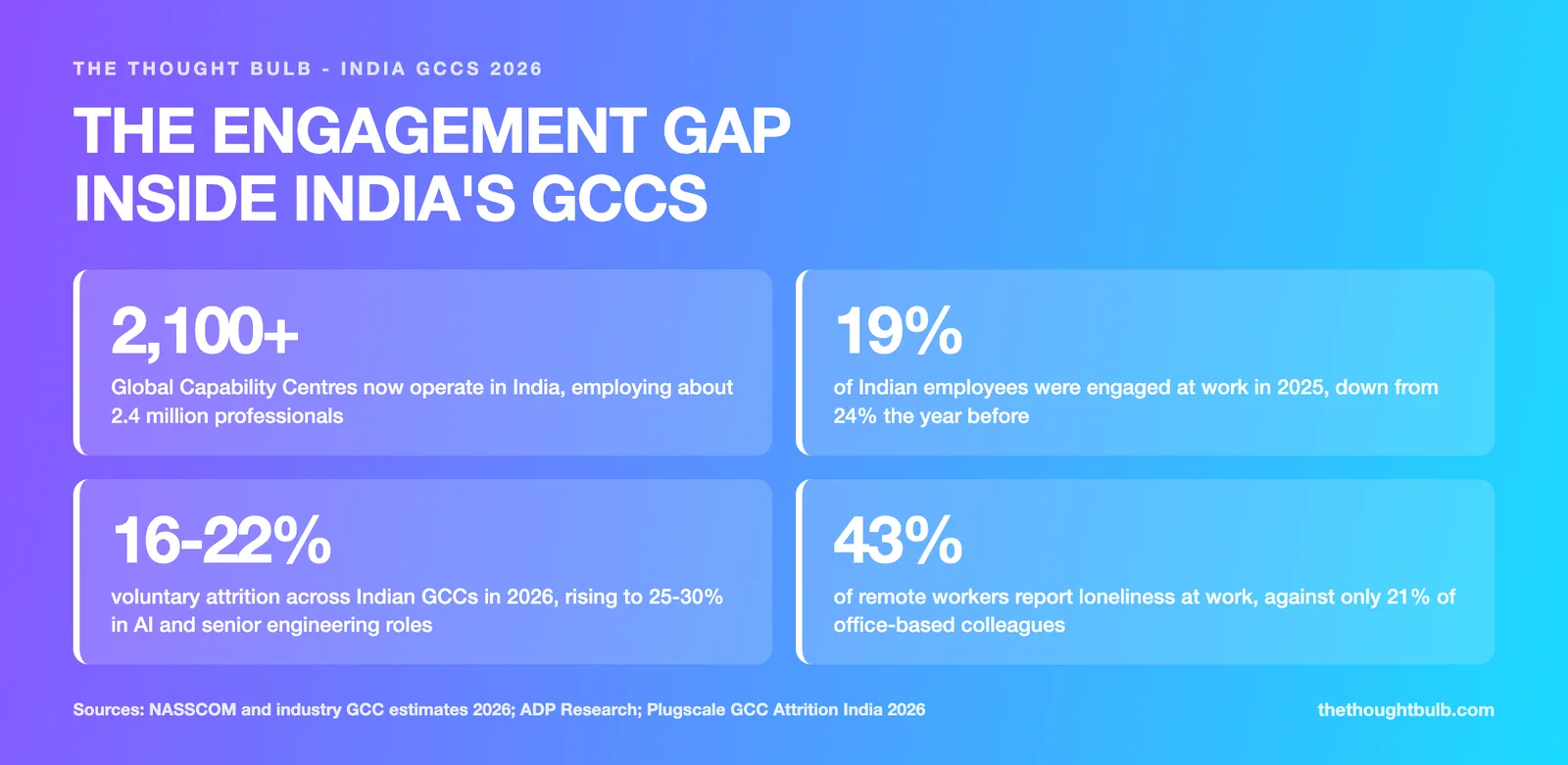
Three numbers frame the challenge. First, scale: India now hosts over 2,100 GCCs employing about 2.4 million professionals, and NASSCOM projects that workforce reaching 2.8 million by 2030. Second, engagement: ADP Research found Indian workforce engagement fell to 19 percent in 2025, down from 24 percent the year before, the steepest single-year decline recorded globally. Third, churn: voluntary attrition across Indian GCCs sits between 16 and 22 percent in 2026, and rises to 25 to 30 percent in AI, machine learning and senior engineering roles.
A fourth number explains the mechanism. Research on distributed work finds that 43 percent of remote workers report feeling lonely at work, against 21 percent of office-based colleagues, and a 2026 study on the 'loneliness paradox' shows that constant digital connectivity does not by itself produce belonging. GCC teams live in precisely this condition: permanently online with headquarters, structurally under-connected with the people beside them. Belonging and strong team relationships are among the strongest predictors of intent to stay, which means the attrition number and the loneliness number are the same story told twice.
Stop measuring satisfaction. Start measuring connection.
The single most useful change a GCC HR team can make is to their diagnostic. Satisfaction scores tell you how people feel about the company. Connection data tells you whether the organisation actually holds together. Before you book anything, ask four questions in your next pulse survey.
Name three colleagues outside your immediate team you would call for help. Count how many people cannot.
How many people in this centre have you worked with on something outside your own project in the last six months?
Do you know what the team on the next floor is building, and why it matters to the customer?
When was the last time you spoke to someone from the global HQ team about anything other than a status update?
Plot the answers by tenure band and by function. In almost every GCC we work with, the weakest scores sit in the 6-to-18-month tenure band, and in functions that joined during a rapid ramp-up. Those are the people who leave first, and they are the people an experience can genuinely reach.
The two kinds of experience a GCC actually needs
GCC engagement calendars tend to be busy and shallow: a festival celebration, a wellness week, a townhall, a sports day. None of it is wrong, but none of it deliberately builds the missing links. What works is a deliberate pairing of one high-density in-person format that mixes people across pods, and one virtual format that bridges India and headquarters.
In-person: engineer the collisions
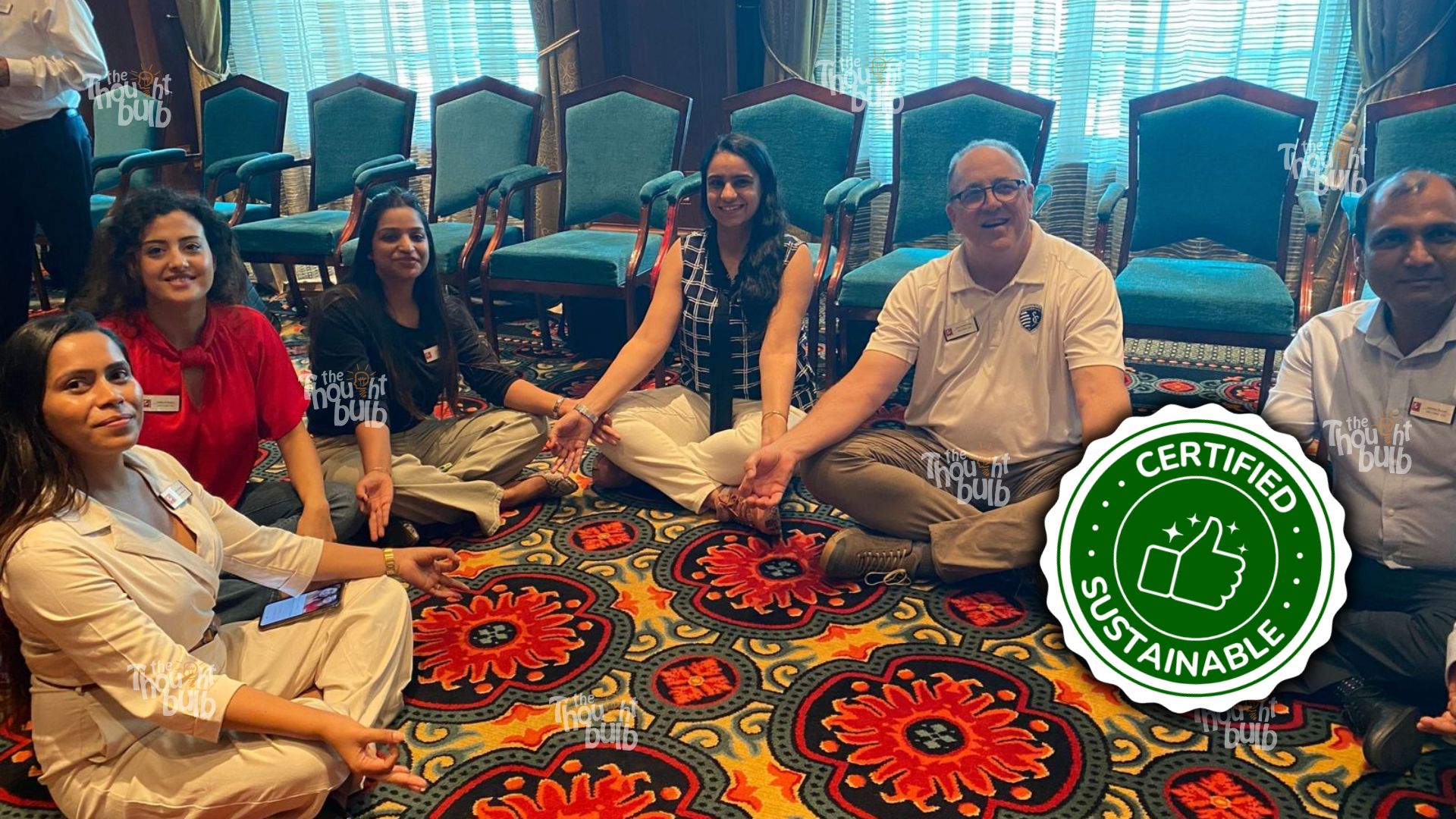
Speed Networking is the format we recommend most often for large capability centres, because it is built for exactly this problem. Structured, timed rounds put every participant face to face with people they would never otherwise meet, and the debrief converts those introductions into working relationships rather than polite small talk. For a 300-person floor it does in ninety minutes what an organic office culture takes two years to do, and it scales cleanly across multiple sites.
Virtual: bridge India and headquarters
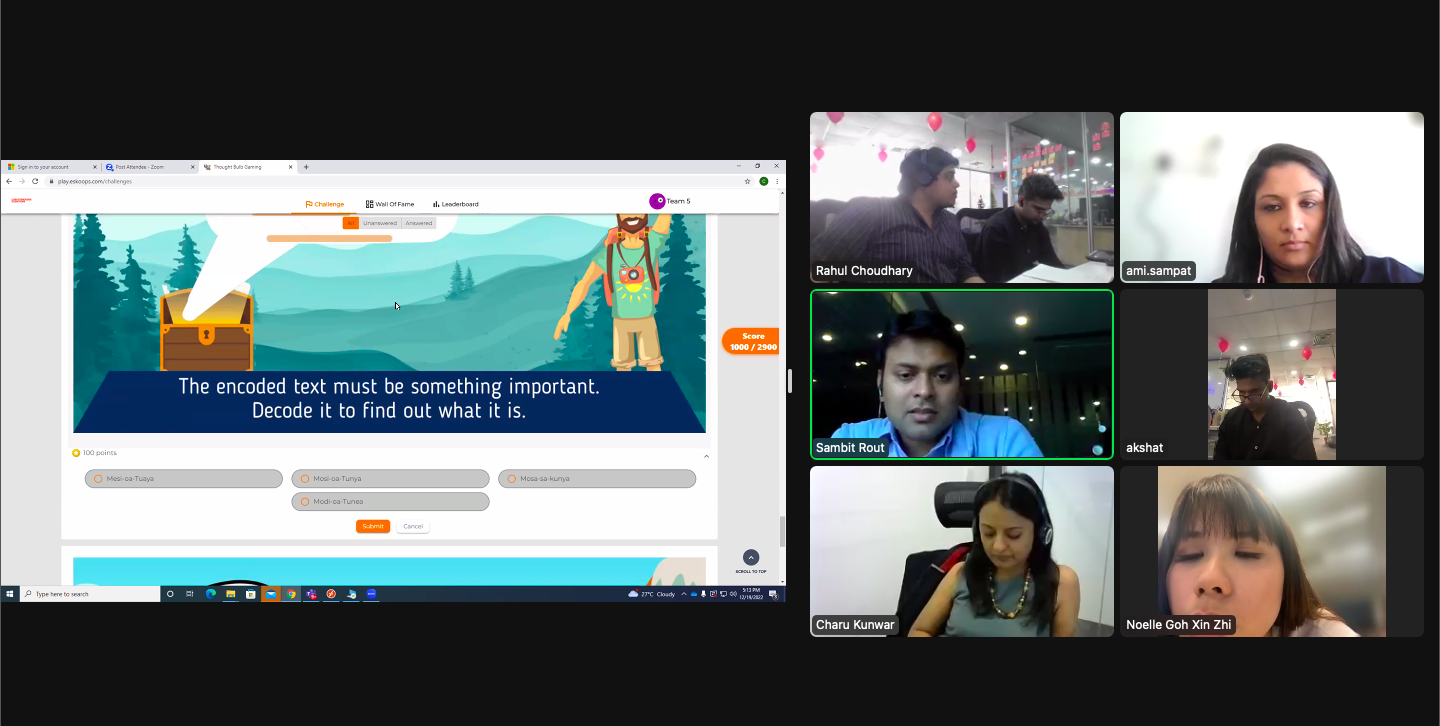
The second gap is harder and more valuable. Go Global Treasure Hunt places India-based teams and global counterparts on the same mixed squads and gives them a shared problem to solve, which is the only reliable way we have found to turn a name on a call invite into a colleague. Mixed squads matter more than the game itself: if you run it with India in one room and HQ in another, you have simply re-created the divide with better lighting.
If you are building a full-year plan rather than a one-off event, our employee engagement calendar is a useful starting frame, and you can browse formats by group size and city on the activities catalogue.
What this looks like in practice: EY in Pune
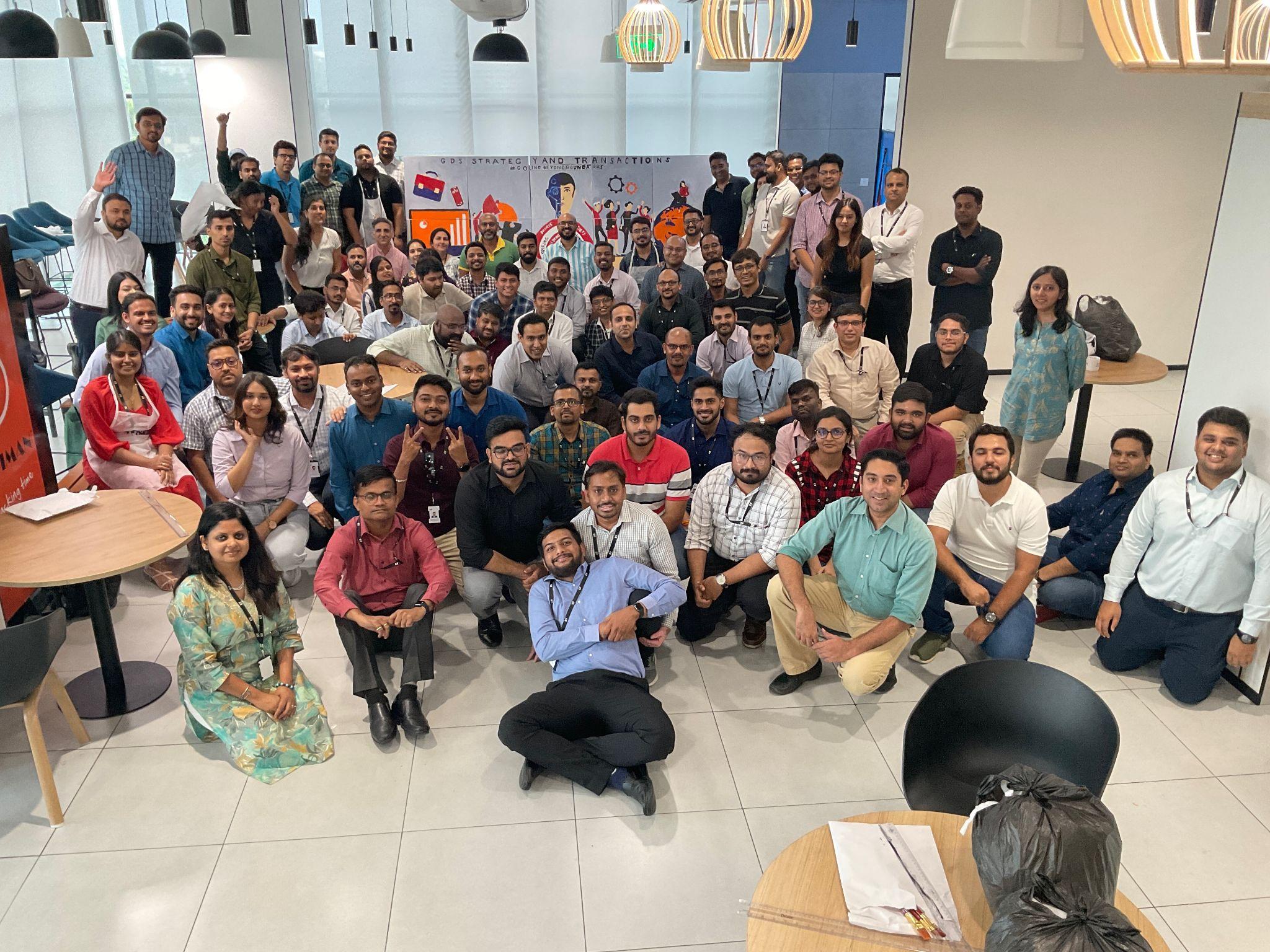
EY ran a combined Speed Networking and Million Pixels Challenge for their Pune team, a group with the classic capability centre profile: large, fast-growing, and organised into project pods that rarely intersected. The session opened with structured networking rounds to break the pod boundaries, then moved into Million Pixels, where separate teams each build a fragment of a picture that only resolves into a single image when every fragment is brought together. The design is deliberate. The networking creates the relationships; the challenge then forces those new relationships to produce something none of the sub-teams could see on their own. Participants left with named contacts across functions rather than a pleasant afternoon, which is the difference between an event and an intervention.
You can read the full write-up and other capability-centre engagements in our case studies.
A 90-day plan for GCC HR leaders
Most engagement programmes fail because they start with a booking rather than a baseline. This sequence puts diagnosis first and measurement last, so you can show your global HR partner what changed.
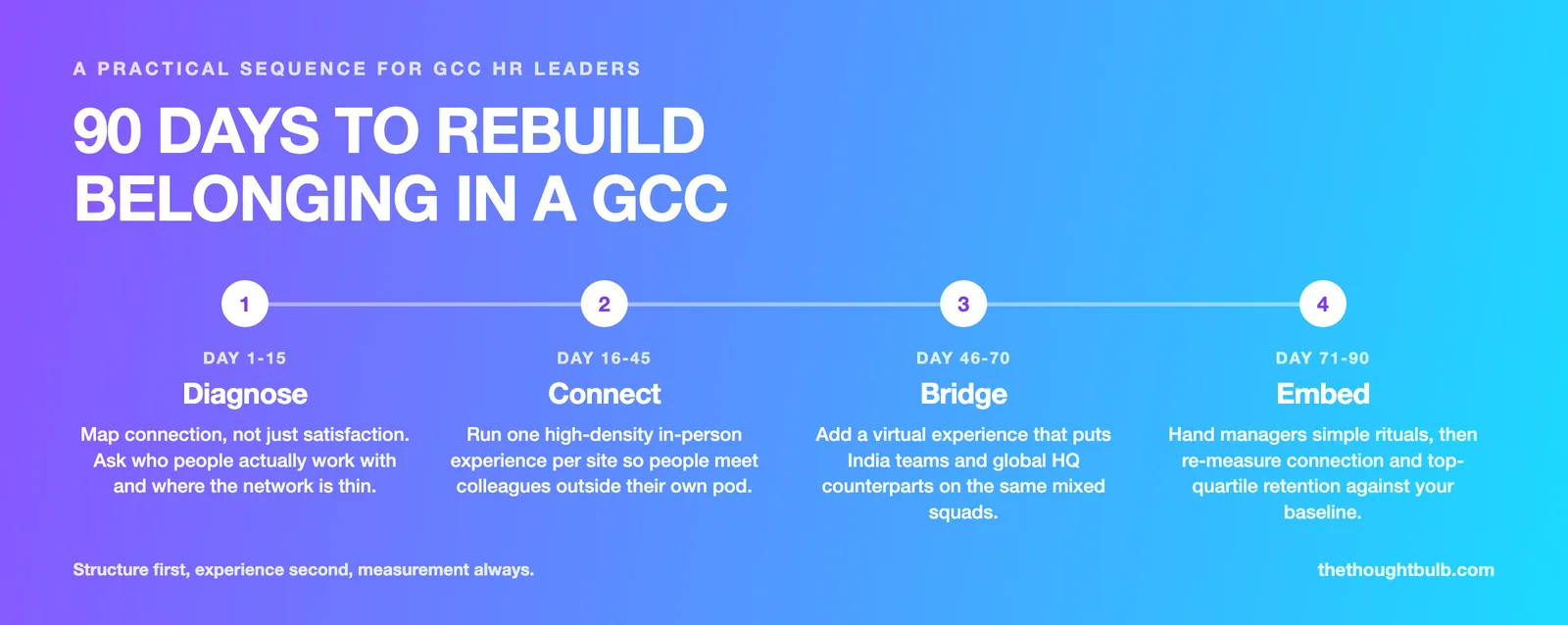
Day 1 to 15, Diagnose: run the four connection questions above. Segment by tenure and function. Record your baseline for cross-team connection and for retention in your top performance quartile.
Day 16 to 45, Connect: run one high-density in-person experience per site, designed to mix pods rather than reward existing teams. Speed Networking or a similar structured format works best at scale.
Day 46 to 70, Bridge: run one virtual experience with genuinely mixed India and headquarters squads. Schedule it in an overlap window that is reasonable for both sides, not just for HQ.
Day 71 to 90, Embed: hand managers three simple rituals, a rotating project demo, a monthly cross-pod coffee pairing, and a five-minute credit round in team meetings. Then re-run the diagnostic and compare.
Three mistakes that waste the budget
Running the experience only for the teams that are already close. Intact-team activities strengthen bonds that are already strong and do nothing for the network gaps that drive attrition.
Treating the leadership layer as spectators. GCC leaders who host rather than participate signal that connection is a junior concern. Mixed-level squads are worth the discomfort.
Skipping the debrief. Without a structured reflection that names what the group learned about how it works together, an activity is entertainment and will be remembered as such by the finance team reviewing spend.
For centres where the immediate gap is at the manager and senior-leader level rather than across the floor, our leadership team building formats are usually the better first move.
The retention argument, in your CFO's language
Attrition in a GCC is not evenly costly. Losing a first-year analyst is an inconvenience; losing a senior engineer who holds three years of undocumented product context can delay a roadmap by a quarter. With AI and senior engineering attrition running at 25 to 30 percent, the relevant metric is not headline attrition but departure rate within your top quartile. Frame your engagement spend against that number. A structured connection programme across four sites typically costs a fraction of replacing a handful of senior engineers, and it is one of the few levers that acts on the reason people actually leave, which is rarely compensation alone and very often the absence of anything holding them in place.
Where to start this quarter
You do not need a new strategy. You need a baseline, one in-person experience that mixes people who do not normally meet, one virtual experience that makes headquarters feel like colleagues, and a manager layer that keeps the new connections warm. Run that sequence once, measure it honestly, and you will have something far more useful than an engagement score: evidence about what your centre is actually made of. If you would like help designing that ninety days for your sites, our team has run these programmes for capability centres across Bengaluru, Hyderabad, Pune, Gurugram and Chennai, and we are happy to think it through with you.