
1The Challenge
What was the challenge?
Airbnb's team was coming together after a long stretch apart — around 70% based in India, 30% in Europe — and the two days needed to rebuild connection across a group that had been operating largely at a distance from one another.
The specific constraint came from history. Airbnb had run a programme with us the previous year built around Team Olympics, and they were explicit: they'd aligned on Squid Games as a format, but wanted continued discussion to enhance its creativity and novelty, and to avoid any sense of repetition from last year. That's a demanding ask. Repeat clients are the best kind to have and the hardest to design for — the format has to feel genuinely new to people who remember the last one clearly, without abandoning what worked.
There was a structural request too: having spent all of Day One indoors, the client wanted Day Two to move outside.
2Our Solution
What solution did we design?
Squid Games was built for Day Two as an outdoor, high-energy close — and, critically, designed from the ground up to avoid overlap with the previous year's Indoor Olympics.
Rather than presenting a single fixed format, two distinct variations were developed so Airbnb could choose based on preference and budget. The standard experience comprised five new challenges with no crossover from the earlier programme: Red Light, Green Light; Alpha Link; Marbles of Negotiation; Mercy Go Around; and a further challenge from the wider set. The premium experience built on Red Light, Green Light and two further selections with two distinctive additions — a Board Creation Challenge, in which every participant receives their own board (63 in total) to design collaboratively into a single collective piece, and a Human Ladder Challenge. Uniforms were provided in both versions to carry the spirit and theatre of the format.
The design logic is straightforward: the outdoor setting, the costuming, and the elimination-driven format deliver energy and spectacle, while the specific challenge selection was curated explicitly against what this group had already done. For a reunited team, the format also does something useful — it's physical, loud, and low on hierarchy, which cuts through the awkwardness of colleagues who haven't shared a room in a long time far faster than a structured session would.
Squid Games closed a deliberately sequenced two days. Day One opened with an hour of Speed Networking, chosen because the group genuinely needed reintroducing to one another, then moved post-lunch into Radio Relay, delivered with a bespoke twist: the structure teams had to replicate was designed as a Smart City — creating a true cross-team collaboration experience, with sub-tasks nested within each team and a level of challenge calibrated to bring out the group's best.
3How We Did It
How was the programme delivered?
Day One ran indoors. The morning was given to Speed Networking — a full hour, deliberately generous, because with 63 people meeting again after a long gap, reconnection was the prerequisite for everything else. Post-lunch, Radio Relay ran with its Smart City structure, teams passing a vision through communication layers and discovering how much survived the journey. The debrief drew out the three qualities the design was built around: genuine cross-team collaboration, meaningful sub-tasks within each team, and a challenge level that pushed the group.
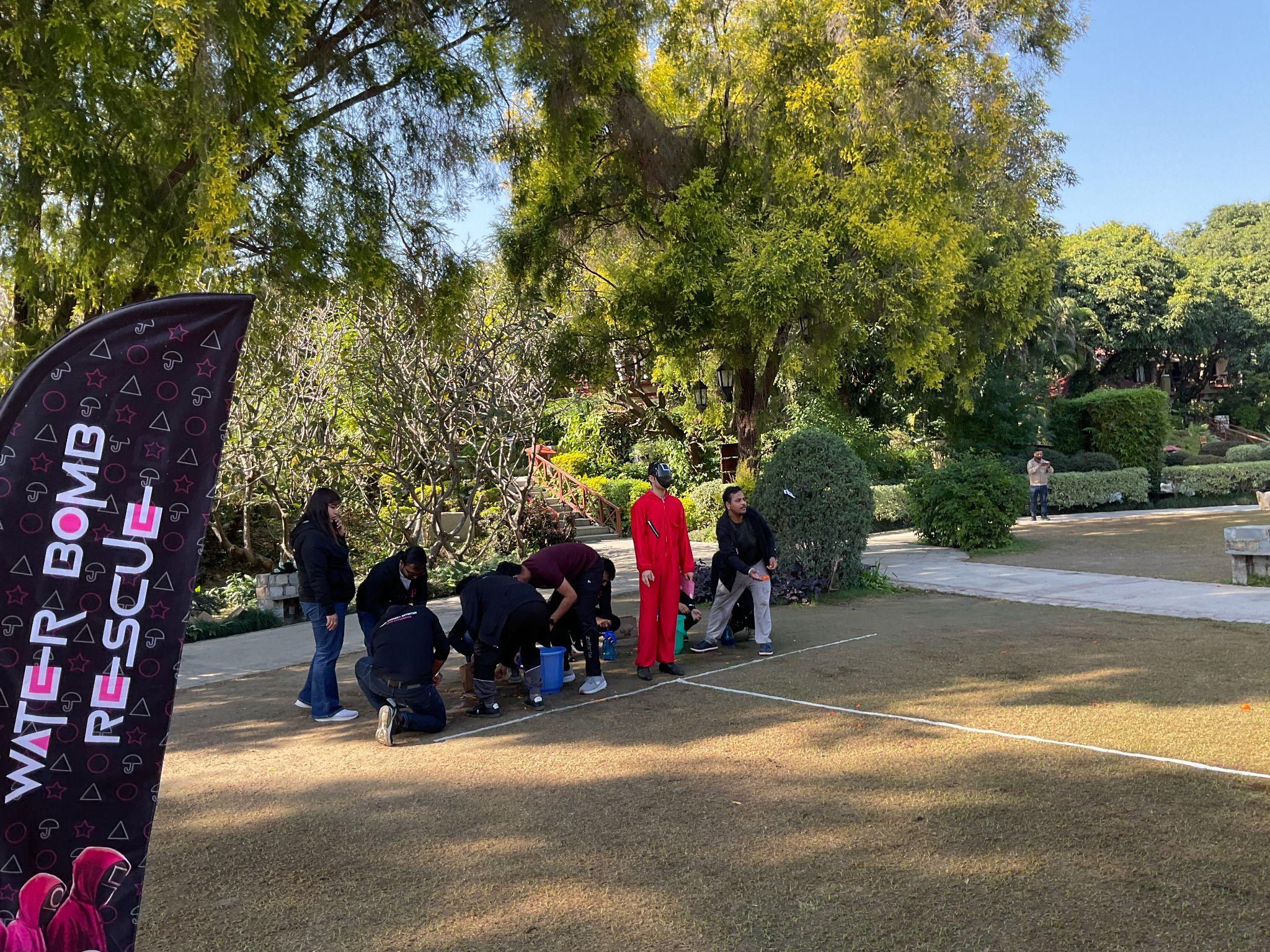
Day Two moved outdoors for Squid Games. Teams competed through the curated challenge sequence in uniform, with elimination pressure driving the pace — the physical, high-spectacle counterpoint to Day One's indoor work.
Throughout, the facilitation team worked closely with Airbnb ahead of delivery, with the client asking to connect directly with the facilitator during design — a collaborative process that shaped the final challenge selection and ensured the day landed as something new rather than a reprise.
4Key Outcomes
What were the results?
Squid Games gave Airbnb's reunited India–Europe team an outdoor, high-energy close to two days built around reconnection — and, for a returning client who explicitly asked not to repeat the previous year, a format curated challenge-by-challenge to feel genuinely new.
Across two days in Bangalore, the programme moved a distributed group from reintroduction to collaboration to shared competition — and gave 63 people who had been apart for a long time a reason to feel like one team again.