Have you ever encountered a jaw-dropping situation when you found yourself vulnerably trying to lead a team with a low level of commitment and competence? How was your experience? Did you emerge as a triumph or ended being a silent victim of the awful situation? Did you make an account of things that worked for you and things that did not fall in your favour? Which team-leading strategies gave you the utmost benefit, and which ones laboriously backfired? Whatever may be the observations, next time you can incorporate Situational Leadership when leading a team that may be going through various stages of external and internal situations.
Firstly, let’s try and understand Situational Leadership. A prominent leader is aware of the various variables when closely working with a team. Each member has their personality, learning style, experience, expectations, and needs. The way a leader adjusts his working style in the coherence of these variables defines situational leadership.
Situational leadership means adapting your leadership style to each specific situation, keeping in mind the individual needs of the team members. The Situational Leadership Theory was developed by Paul Hersey and Ken Blanchard in the year 1969. According to them, there is no single unique type of leadership. Effective leadership is task-specific, and the most successful leaders are the ones who adapt their leadership style as per the capability and readiness of the group of people they are leading. Situational leadership is not just specific to the group of people led by their leader. But also to the goal that the team wishes to achieve.
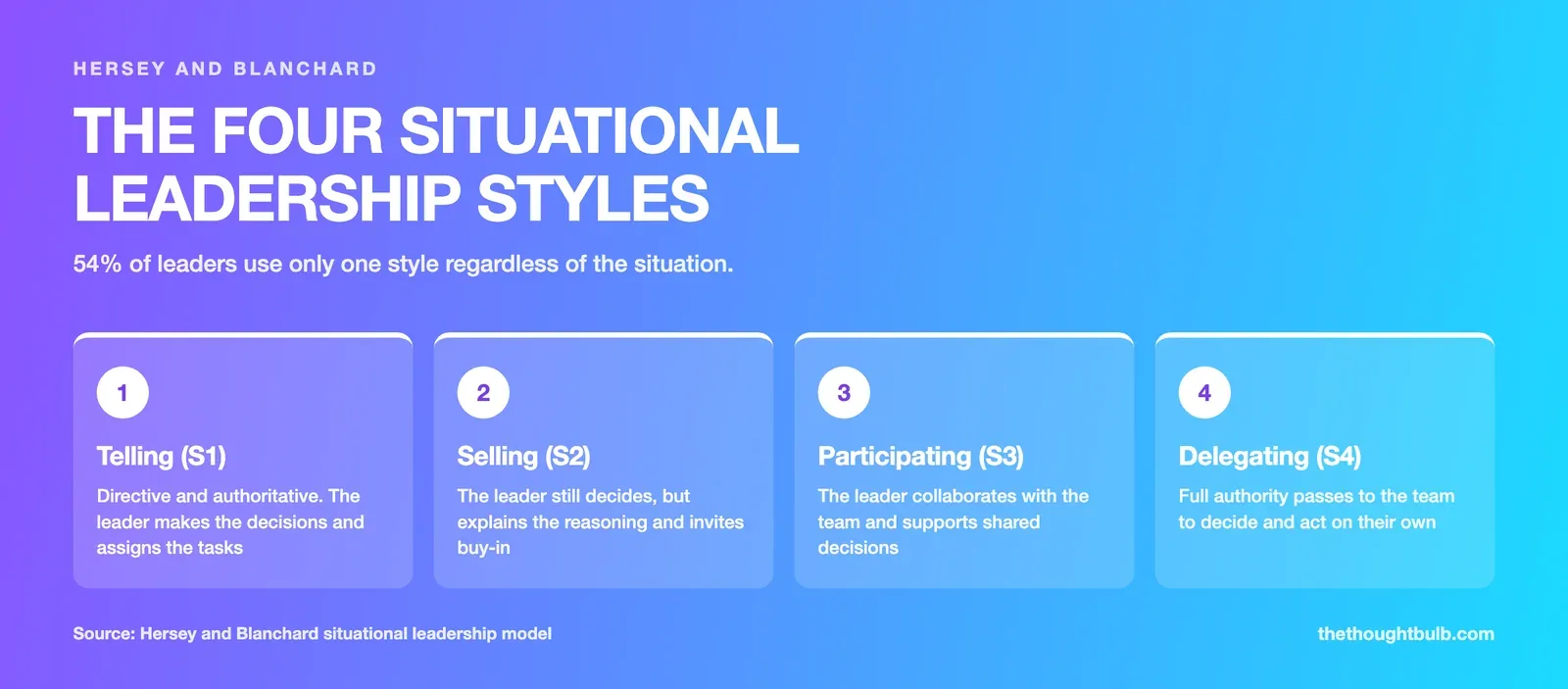
54 percent of leaders use only one leadership style, regardless of the situation, which means that 50 percent of the time, leaders are using the wrong leadership style to meet the needs of their people.
Ken Blanchard, author of The One-Minute Manager
This theory recognizes four main leadership styles
Telling (S1): It is a more directive and authoritative approach. Here leader makes all the decisions and tells employees what to do and what not to do.
Selling (S2): All the major decisions are made by the leader however there is clear communication within the team and, also he persuades the employees to abide by the decision rather than simply directing them.
Participating (S3): The leader collaborates with the team to come up with decisions. He supports each team member and promotes creativity and talent.
Delegating (S4): The leader gives full authority to the team to make decisions as per their choice but oversees each step and progress made by the team.
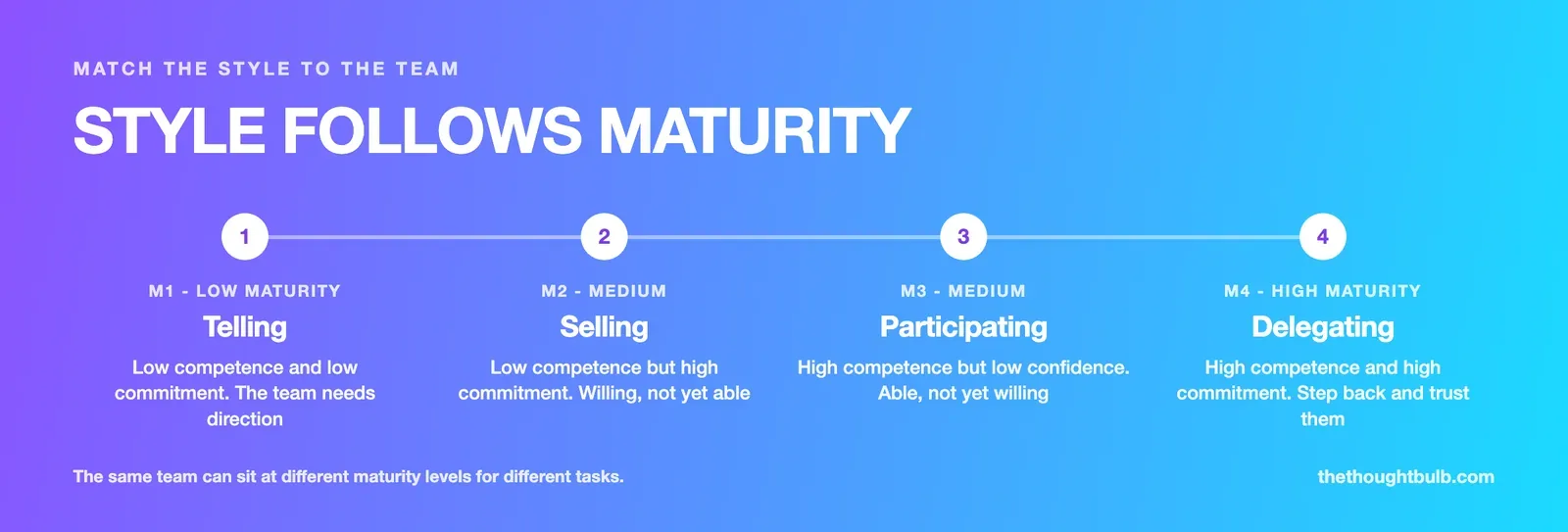
In addition to these four approaches of leadership, there are also four levels of follower maturity:
M1: Team has low competence and a low level of commitment.
M2: Team has low competence, but a high level of commitment.
M3: Team has a high competence, but a low-level commitment and confidence.
M4: Team has a high level of competence, also a high level of commitment, and confidence.
Matching Styles and Levels
The Situational Leadership styles can be matched with various levels of maturity. The Hersey-Blanchard model proposes that the following leadership styles are the most suitable for these maturity levels:
Low Maturity (M1)—Telling (S1)
Medium Maturity (M2)—Selling (S2)
Medium Maturity (M3)—Participating (S3)
High Maturity (M4)—Delegating (S4)
Chak de India, a Bollywood movie released in the year, 2007 is a brilliant example of this style of leadership. It highlights the core challenges that a leader comes across when striving to get along with an ineffective team, which is far from being motivated to achieve the goal. Each team member had their own experiences, expectations, ambitions, skills, and apprehensions surrounded by the bubble of self-preservation and ego. Coach Kabir Khan very mindfully matches his leadership style with the team’s maturity level. Initially, he started with the telling approach as the team performance was low, with minimum clarity and commitment. On the other hand, some seasoned players with an evolved skill set did not believe in performing along with the team and were not comfortable taking orders from the coach. In this scenario, Kabir Khan would not force his decisions but involve them by giving his complete support and listening to their pains and ideas. As a result, the team developed a strong sense of purpose. That paved the way for a higher sense of commitment and an enriched level of competence within the entire team. When on the field, he would delegate complete authority to the players to make decisions as per the need of the hour. Adopting this approach, made all the players give their best and take complete responsibility for their actions. This movie establishes the principle that when the correct approach is applied at the right time, it can always give the desired results.
Situational Leadership II
The Situational Leadership II ] was developed by Kenneth Blanchard and builds on Blanchard and Hersey’s original theory. As per the new version of the theory, effective leaders must establish their behaviour on the developmental level of team members for precise tasks.
Level of individual’s competence and commitment
Enthusiastic beginner (D1): Has high commitment, low competence.
Disillusioned Learner(D2): Some level of competence, but setbacks has led to a low level of commitment.
Capable but cautious performer (D3): Competence is growing, but the level of commitment varies different depending on the external situation.
Self-reliant achiever(D4): Has high competence and a high level of commitment.
Situational Leadership II, Leadership Styles
Situational Leadership II holds that impactful leadership depends on two core behaviors: supporting and directing. Directing behaviors involve, giving direct instructions to the team members and being in complete control of the situation. Whereas the supporting behavior includes, encouraging the team in the form of listening, recognition, and timely feedback.
This theory recognizes four basic leadership styles that include:
Directing (S1): High on directing but low on supporting.
Coaching (S2): High on both directing and supporting.
Supporting (S3): Low on directing and high on supporting.
Delegating (S4): Low on both directing and supporting.
Key Advantages of Situational Leadership
It recognizes diversity
We may come across a lot of similarities in others however, every human being is unique. Our experiences and perception create diversity. Instead of treating everyone similarly, the situational leader recognizes the needs of each individual. Rather than creating a specific set of guidelines to be followed by everyone, they create a working environment where people feel comfortable and confident to share and add value.
It forms a comfortable working environment
Situational leaders create a way based on the willingness level of their team. That, in turn, makes the team members more comfortable. With this, the leader can focus on individual needs and development. That helps to get the maximum productivity and efficiency.
The increased cognitive ability of the leader
A situational leader uses each situation to help him evolve and get better. They adapt to change and use specific approaches to help their team stay positive. It enables the leader to develop a heightened sense of emotional intelligence to approach each employee in the best way. Situational leader steps into the shoes of others while making decisions that will impact them.
Brings team together to achieve bigger goals
A situational leader approaches every situation with intuitiveness while being flexible. Each team member has access to them. Also, the leader can reach out to his members directly for any support or counsel needed. It leads to less conflict in the team, and issues disperse before it could become a big nuisance.
Boosts training and development
A situational leader evaluates the competence of each team member, which allows customer training as per the specific needs. Training needs as per the current job role and future industry needs. The goal is to empower employees to handle diverse situations in life. However, to achieve this, a leader does not use force but through clear communication with the team.
Major Disadvantages of Situational Leadership.
It can create chaos. Employees may not always perceive the same what the leader would communicate. Depending upon the leader’s communication style, there could be confusion in the team, which could lead to a lack of trust amongst the team members.
It focuses on short-term goals. Situational leaders attend to the immediate needs, which may ignore the long-term goals and the higher vision. Visionary leaders always keep in mind the situations that may arise in the future.
It places too much responsibility on the leader. Situational leadership requires the leader to access the situation most reasonably. However, a leader may not have the appropriate knowledge to make an accurate decision. That may lead to the failure of the entire team.
Finally, to conclude, every leader is different and has specific strengths and areas of opportunity. However, the quality to adapt to different people as per the present situation is what makes a Situational Leader.
Bibliography
Blanchard, Ken and Spencer Johnson. “
The One Minute Manager.” William Morrow & Co: Publisher, 1982.