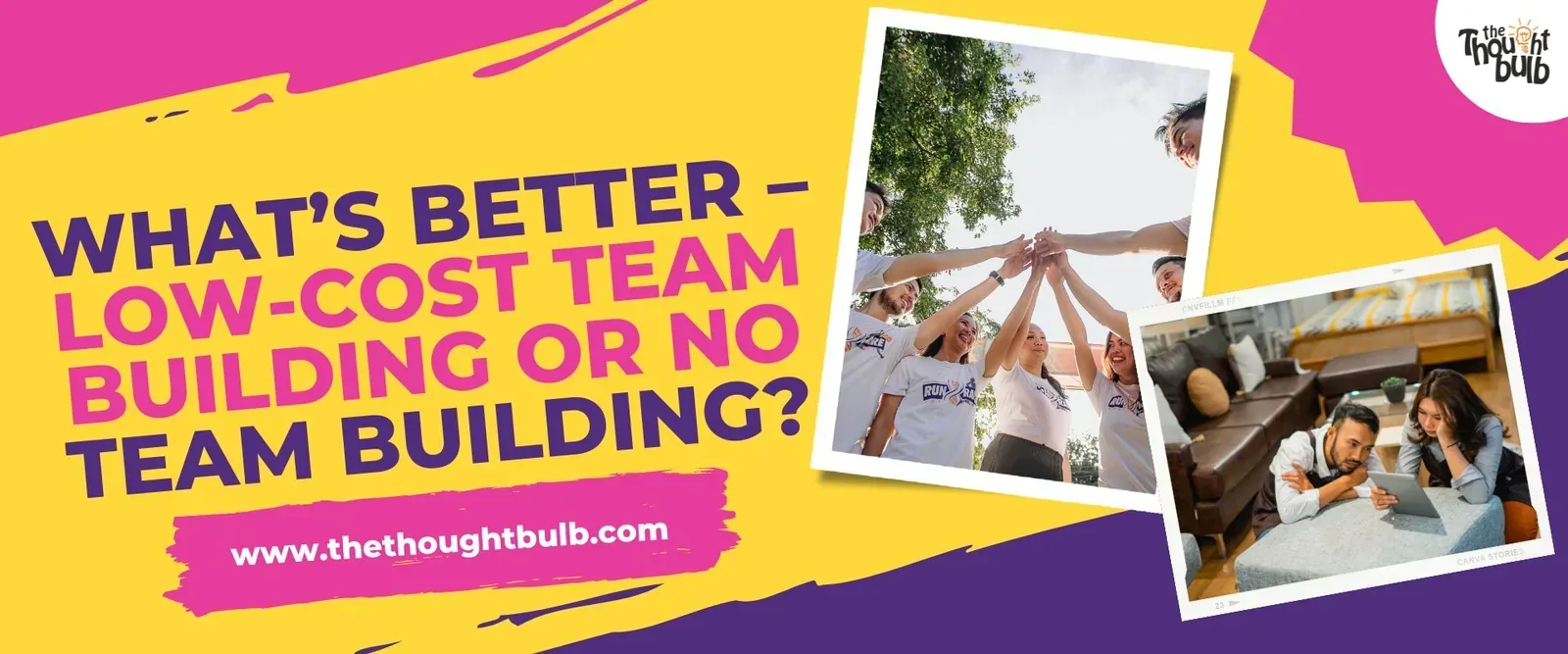
Spoiler: “No team building” isn’t saving you anything—it's costing you more than you think.
Every organization wants productive teams. We invest in tools, talent, and training. But when budgets get tight, the first thing often slashed is… you guessed it: team building.
Why? Because it’s perceived as “fluffy,” “non-essential,” or “a nice-to-have.” And when money is tight, many leaders ask:
“Isn’t it better to do nothing than to do something small and cheap?”
The short answer? No. The longer answer? Read on.
The Cost of No Team Building
Let’s imagine a team with no structured bonding, no planned interactions beyond work, and no space for shared experience.
Here’s what typically starts happening:
Silos develop. People stick to their own groups. Collaboration drops. Innovation suffers.
Conflicts simmer. Misunderstandings increase. Little frictions escalate due to lack of rapport.
Morale dips. Without connection, work feels transactional. Employees disengage.
Attrition rises. Especially among newer or younger employees who seek culture, not just compensation.
Leaders struggle. Managing disconnected or mistrusting teams becomes exhausting and reactive.
All of this leads to one outcome: low performance over time. And guess what? That’s a much bigger cost than spending ₹500 per employee on a meaningful team activity.
What About Low-Cost Team Building?
Contrary to popular belief, impactful team building doesn’t need a fancy resort or a five-star buffet. It needs intention, creativity, and consistency. You can build connection, trust, and collaboration with small budgets—if you do it right.
Here are some high-impact, low-budget formats:
1. Desk Olympics or Indoor Sports Day

Turn a regular afternoon into a series of quirky games—pen cap tossing, paper javelin, or chair relays. Bonus: teams bond through laughter.
2. Vision Board

Give teams chart papers, markers, and magazine cut-outs. Let them reflect on shared values, goals, or future projects. It sparks conversation and purpose.
3. Speed Networking

Rotate employees across timed stations with conversation prompts. It’s like team speed-dating, minus the awkwardness.
4. CSR Build-a-Thon

Give teams recyclable materials and challenge them to build something useful—like a model water filter, shelter, or toy—for a social cause.
5. City Race Challenge

Create location-based riddles and tasks inside your office or building. Teams race to solve challenges and win points. It’s low cost, high adrenaline.
So, Why Do People Avoid It?
There are three main reasons:
1. Fear of Being Lame
Some managers think low-cost = low-quality. But done well, even a post-it-note challenge can leave a strong impression.
2. Time Crunch
It’s seen as time away from "real work." In truth, team building boosts communication and collaboration, which saves time in the long run.
3. Lack of Ownership
No one “owns” team culture. Without dedicated effort, it slips through the cracks.
But here’s the thing: doing something—no matter how small—sends a message that people and relationships matter. And that alone makes a big difference.
The ROI of Low-Cost Activities
Still not convinced? Here’s what well-designed, budget-friendly team-building can bring:
Higher collaboration
Improved employee morale
Better communication
Greater psychological safety
Lower attrition and burnout
Even if you spend just a few hundred rupees per person, the return in engagement and performance far outweighs the cost.
5 Tips for Doing Team-Building on a Budget
Think Small, Consistent, and Creative It’s better to do a 30-minute energizer every month than a one-time grand offsite.
Use What You Have Office space, leftover materials, in-house talent—there’s more at your disposal than you think.
Mix Work With Fun Make brainstorming sessions interactive. Turn townhalls into quiz shows. Add challenges to product launches.
Celebrate Micro-Moments Use work anniversaries, milestones, or project completions as reasons to bond.
Ask for Feedback Let the team suggest or vote on activities. Involvement = better engagement.
Final Thought: Doing Nothing Is Not Neutral
Many leaders think skipping team-building has no effect. But doing nothing is doing something—it’s sending a message:
“Connection doesn’t matter here.” “You’re hired for tasks, not for who you are.” “Culture is an afterthought.”
That message—whether intended or not—breeds disconnection, resentment, and high turnover. Low-cost team building, on the other hand, says:
“We value people.” “We want teams to work together, not just side-by-side.” “We care about how you feel, not just what you produce.”
So the next time you’re choosing between a small activity or none at all—go for it. Even if it’s simple. Even if it’s scrappy. Because connection builds culture—and culture builds companies.